


Where do gnats come from?
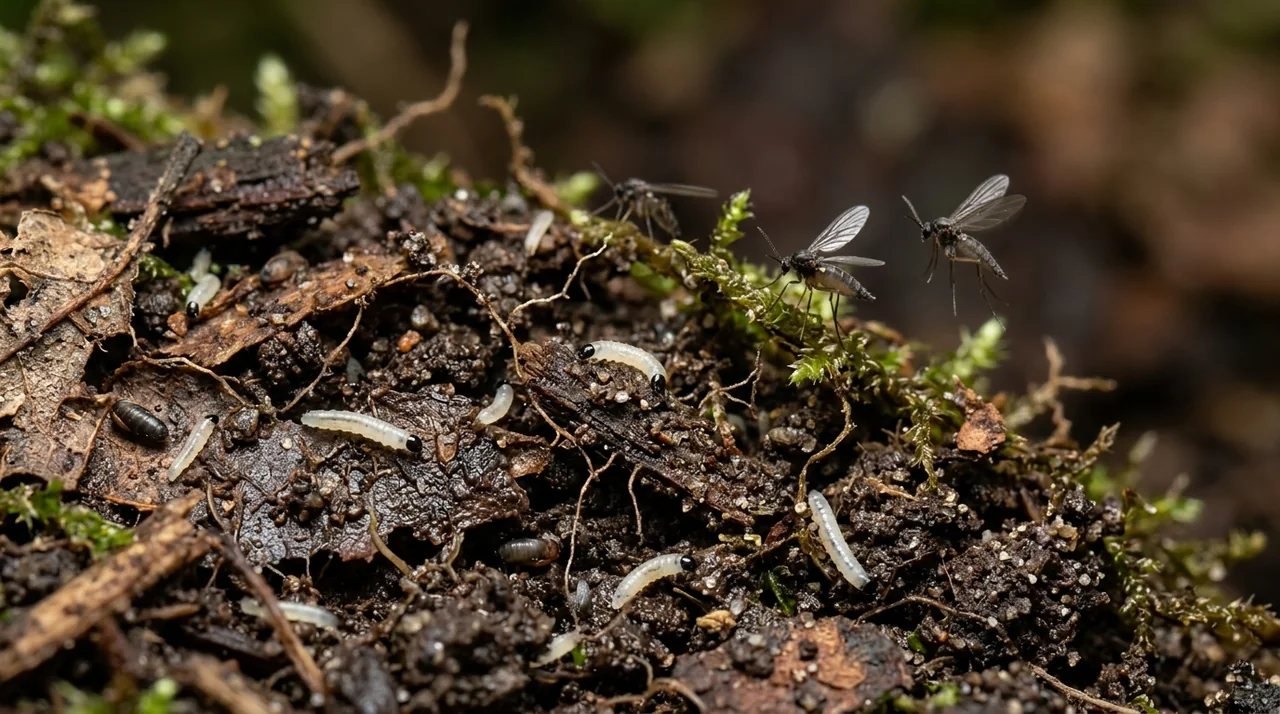
"Gnat" is a catch-all term for several kinds of tiny flies. Each has its own moist breeding ground, which is exactly why identifying the culprit matters. Indoors, the two most common are fungus gnats and drain flies. Fungus gnats develop in the damp soil of overwatered houseplants. There, their larvae feed on fungus, algae, and decaying roots. Drain flies breed in the organic slime that coats the inside of sink, tub, and floor drains. Other gnats simply drift in from outdoors through gaps and torn screens.
Typical indoor gnat sources include:
- Overwatered or poorly draining potting soil
- Drains, garbage disposals, and seldom-used sink or floor traps
- Trash, compost buckets, and overripe produce
- Standing water in plant saucers, buckets, or clogged gutters
How do I tell which gnat I have?
Location is the biggest clue. Small flies weaving around your houseplants, especially when you water them, are almost certainly fungus gnats. Fuzzy, moth-like flies resting on bathroom or kitchen walls near a drain are drain flies. Flies swarming a fruit bowl instead are fruit flies, and ones near garbage or drains can be phorid flies. Matching the insect to where it gathers points you straight at the breeding site.
Why do fungus gnats keep coming back?
Because the problem is in the soil, not the air. As long as the top layer of potting mix stays wet, it is a perfect nursery for eggs and larvae. Killing the adults you see does nothing about the next generation developing underground. Overwatering is the single biggest driver of a persistent fungus gnat problem.
How do I get rid of gnats?
The reliable fix is to find the breeding site and dry it out or clean it, rather than chase the adults.
- For fungus gnats: let the top inch or two of houseplant soil dry completely between waterings, and empty standing water from saucers. Consider a layer of coarse sand or grit on top to discourage egg-laying. Yellow sticky traps catch flying adults while the soil dries.
- For drain flies: physically clean the drain to scrub away the film the larvae feed on. Pouring boiling water alone often is not enough. The greasy biofilm needs to be broken up.
- General steps: take out the trash regularly, cover compost, and fix any standing water or slow leaks.
When should I be concerned?
Gnats are mostly a nuisance rather than a health hazard. A small outbreak usually clears within a couple of weeks once the moisture source is gone. Sometimes gnats persist despite drying the soil and cleaning drains. Then there may be a hidden water source, such as a leaking pipe, a chronically damp subfloor, or an overwatered plant you have overlooked. Large or repeated infestations, or ones you cannot trace, are worth a professional inspection to locate the moisture problem feeding them.
Do gnats bite?
It depends entirely on which "gnat" you mean. The common indoor culprits, fungus gnats and drain flies, do not bite. They simply annoy you by hovering and landing. The biting kinds are outdoor insects that are also loosely called gnats. Biting midges, often nicknamed no-see-ums, and black flies can deliver itchy bites, usually near water and around dawn and dusk. So if something is biting you outdoors, it is likely one of those. The tiny flies circling your houseplants or drains indoors are harmless nuisances that only need their breeding site cleaned up.