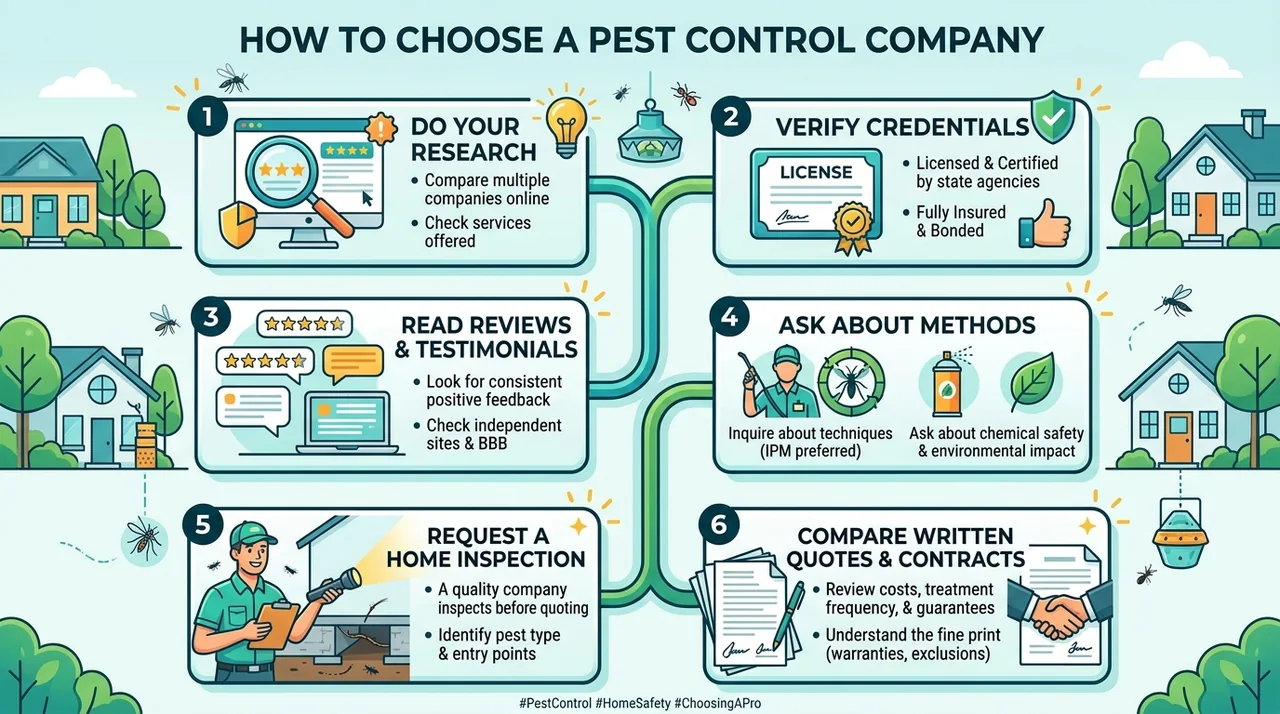
To choose a pest control company, confirm three things before you sign: a current state license (verify it with your state's pest-control authority, not just the company's word), liability insurance, and a clear written, itemized quote that states exactly what's treated and what's guaranteed. Then compare two or three companies on those terms — not on price alone. Walk away from anyone who pressures you, quotes a firm price sight-unseen, or won't put the treatment plan in writing.
Questions to Ask a Pest Control Company Before You Hire
A few pointed questions to ask sort a real professional from a fly-by-night crew. Ask them before you hire anyone. Write down each answer so you can compare firms later.
- Are you licensed in this state? What is your license number?
- Do you carry liability insurance? Can I see proof?
- Which pest are you treating? With what product and method?
- How many visits does this include? What is the re-service policy?
- Is there a written warranty or guarantee?
- Will you give an itemized quote after an inspection?
How to Verify a Pest Control License
Every U.S. state licenses pest-control operators. The license comes from a state authority. That is often the Department of Agriculture or a pest-control board. The products are a second layer. Pesticides are registered by the EPA. But the person who sprays them must hold a state license.
Confirm the Company Is Licensed
Do not trust a logo on a truck. Ask for the license number. Then look it up on the state authority's official site. Our exterminator directory links to each state's license-verification page. You can confirm a company's standing in a couple of minutes.
Check Reviews and Complaints
Read recent reviews on more than one site. Look for a pattern, not one angry post. Many state boards also list formal complaints. A clean record and steady reviews point to a reputable firm.
Why Insurance Matters
Spraying pesticide carries real risk. It can affect your home, your pets, and the worker. A properly insured company protects you if something goes wrong. An uninsured one leaves you on the hook. Ask for proof of general liability insurance. For roof or tree work, ask for workers' comp too. Reputable companies show proof without a fuss.
Insist on an Inspection First
A fair price follows an inspection of your home. The pro should look for the pest, the entry points, and the size of the problem. A firm price with no inspection is just a guess. It often hides extra charges later.
What a Written Quote and Estimate Should Include
Get the plan in writing before work starts. A clear quote lists the pest, the method, the visit count, and the price. A rough phone estimate is fine to start. But the final quote should be itemized and signed. That written estimate is your proof of the deal.
Ask for References
Ask for references from recent local customers. A settled, honest company will share a few. Call one or two. Ask if the work fixed the problem for good. Skip any firm that dodges this simple request.
Red Flags to Avoid
Watch for these warning signs.
| Red flag | Why it matters |
|---|---|
| Door-to-door high pressure | Legitimate firms don't need to rush you into a same-day signature |
| A firm price with no inspection | Honest quotes follow an inspection of your actual home and pest |
| No license number offered | Unlicensed application is illegal in every state |
| Cash-only, no written contract | You have no recourse and no warranty |
| Vague "we treat everything" claims | Different pests need different, targeted treatments |
How Many Quotes Should You Get?
Get two or three written quotes for anything beyond a routine plan. Comparing quotes shows whether a price is fair. It also exposes a scope that is too thin or padded. Weigh what is included — pest, method, visits, warranty — not just the bottom line.
Warranty and Guarantee: Get It in Writing
A warranty or guarantee is only as good as its paper trail. Ask what it covers and for how long. Ask what earns you a free re-treatment. Then get those terms in the signed quote. A spoken promise means little once the bugs come back.
Signs of a Reputable, Professional Company
A reputable firm makes the whole process easy. It shows its license and insurance up front. It inspects first, then quotes in writing. A true professional explains the plan in plain words. You should never feel rushed or confused.
One-Time Treatment or an Ongoing Plan?
Decide which service you actually need. A one-time visit can clear a single, minor problem. An ongoing plan makes more sense for pests that keep coming back. Ask the company to explain both options for your pest. A good quote spells out the price of each. Do not let anyone push a long plan you do not need.
Read the Contract Before You Sign
Slow down at the contract stage. Read every line before you sign. Check that the pest, the price, and the visit schedule match your quote. Look for auto-renewal terms and any cancellation fee. Make sure the written warranty is stapled to the deal. Ask the company to fix any blank or vague spot in writing. A reputable firm will wait while you read. If someone rushes this step, treat it as a red flag.
National Chain vs. Local Exterminator
A national chain offers set pricing, online booking, and warranties that can move with the home. A local exterminator often knows regional pests better. They can also bend more on price and timing. Either one can be a great pick. What matters is the license, the insurance, the reviews, and the written plan — not the size of the company.