

Type "bug spray best" into any search box and you get thousands of products. The phrase means very different things depending on the job. Buying the wrong category is the most common reason a spray disappoints. A smart bug treatment starts by naming the pest, then choosing the right insecticides for it.
Matching the Bug Treatment to the Job
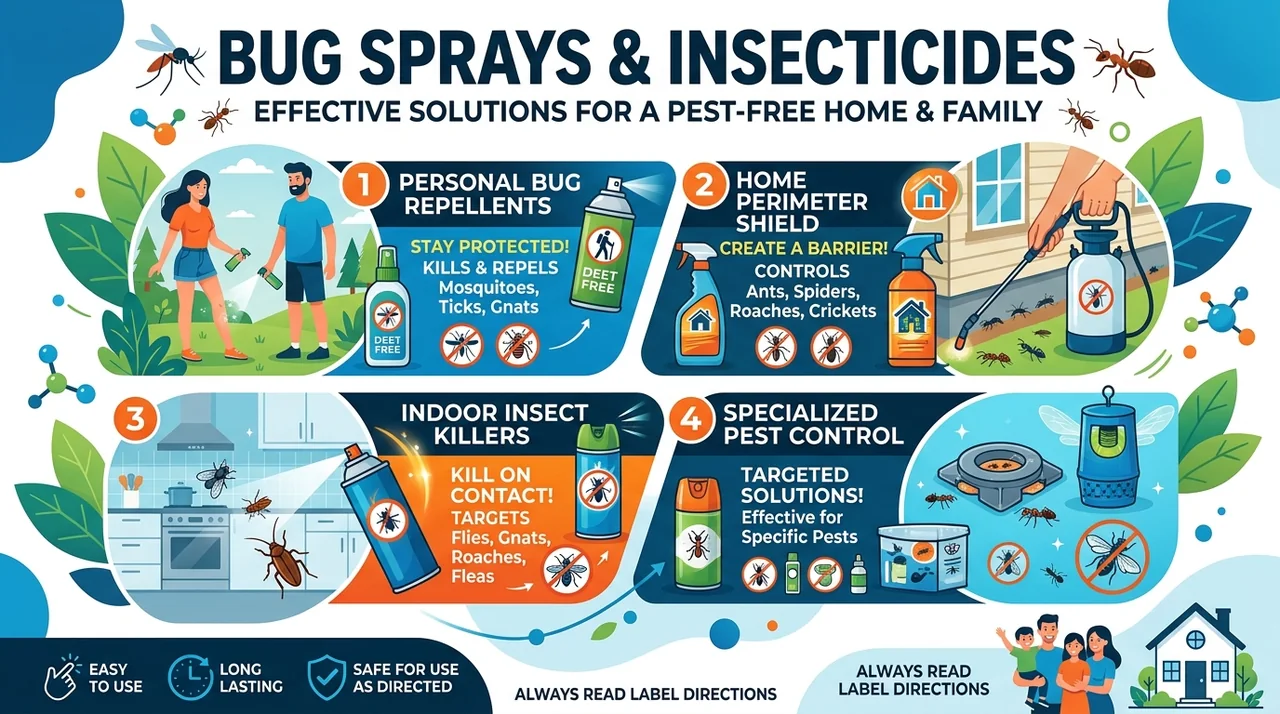
Before comparing brands, decide what you actually need. A personal repellent for skin? A contact killer for insects you can see? A residual insecticide that keeps working on surfaces? Or a bait that insects carry back to a colony? A single product rarely does more than one of these well. Getting the category right matters more than any label boast. This is the core of Integrated Pest Management: pick the least-toxic tool that fits the job.
Skin Repellents: DEET, Picaridin, and Oil of Lemon Eucalyptus
Skin repellents do not kill. They keep biting insects off you. Look for EPA-registered actives: DEET, picaridin, oil of lemon eucalyptus or PMD, and IR3535. Choose a concentration suited to how long you need protection, and follow the age guidance. OLE and PMD are not recommended for children under three.
Contact Insecticides, Sprays, and Aerosols
Contact insecticides kill insects they directly hit, with little lasting effect once dry. An aerosol can suits wasps, a visible roach, or the occasional invader. The insecticides sprays and dusts you see on the shelf do nothing for the nest you cannot see, and they can scatter social insects like roaches and ants. Reach for an aerosol only when you need a quick knockdown you can aim.
Residual Pyrethroid Sprays and Concentrates
Residual sprays leave an active deposit that keeps affecting insects for days or weeks. Most use a pyrethroid active ingredient, such as bifenthrin, permethrin, cypermethrin, or deltamethrin. You buy many as a concentrate you dilute yourself, which stretches the cost. A pyrethroid is broad-spectrum, so it affects beneficial insects too. Use it for perimeter and crack-and-crevice work, not as an all-purpose room spray.
Bed Bug Treatment and Spot Treatment Insecticides
Bed bugs deserve their own warning. Store bug sprays labeled for bed bugs rarely solve a real infestation, because bed bugs hide deep and many have resistance. A store bed bug treatment can knock down a few you see, but it will not clear the harborage. Spot treatment insecticides help around a defined problem, yet a true bed bug case usually needs a professional with heat or a full treatment plan. Do not soak a mattress with a bed spray hoping to end it.
Baits Versus Botanical Sprays
Baits are not sprays, but they are often the most effective option for ants and roaches, because they reach the colony. For those pests, a bait usually beats a spray. Botanical sprays based on cedar or peppermint oil offer short-lived, spot control and break down quickly.
Reading the EPA Label and Registration Number
With insecticides, the EPA label is the instruction manual and the law. Read and follow it before you buy and before you spray.
- Check the target pests and sites. The product must be labeled for the pest and the place, indoor or outdoor.
- Note the active ingredient and concentration, so you do not double up.
- Follow the application rate exactly. More is not better.
Protecting People, Pets, and Pollinators
Even everyday insecticides carry real precautions. Store products in original containers, out of reach of children and pets. Avoid spraying near food, dishes, and pet bowls, and ventilate indoor areas. Be careful around aquariums, since many insecticides are toxic to fish. Do not spray broad-spectrum insecticides on blooming plants where pollinators forage. If a person swallows or overexposes to an insecticide, call Poison Control at 1-800-222-1222, or 911 for an emergency, with the label ready.
Prevention First With Integrated Pest Management
The best outcomes rarely come from the strongest spray. Integrated Pest Management puts prevention first. Seal entry points, remove food and water, and clean up, so you need far less product. When you do spray, target the specific pest and location for indoor or outdoor use. Choose baits over broadcast sprays for ants and roaches, and reserve residual insecticides for defined problem areas.
When to Call a Professional
Reach out to a licensed pro when an infestation persists despite proper product use, when the pest is structural like termites or carpenter ants, when the problem is bed bugs, or when household members have health sensitivities. Professionals select and apply the right materials safely, and often solve the problem with less product than repeated DIY spraying.