
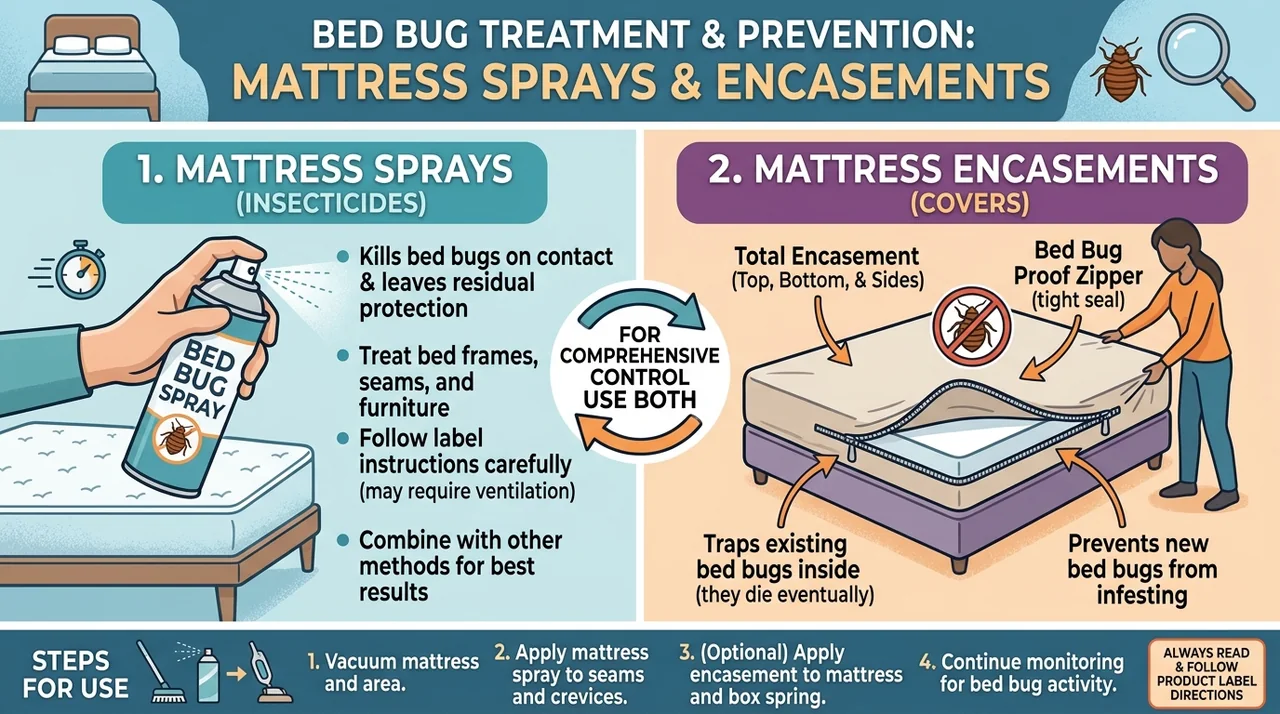


Bed bugs are one of the hardest household pests to treat, and mattress products are only part of the answer. Sprays and encasements each play a specific role — and knowing what each can and can't do keeps you from wasting money or, worse, putting the wrong chemical on the surface you sleep on.
Encasements Are the Foundation
A quality, bed-bug-rated zippered encasement for the mattress and box spring is the single best mattress product you can buy — and it's chemical-free. It doesn't kill on contact, but it works two ways: any bugs and eggs already inside are trapped and eventually starve, and new bugs are denied the seams and folds they love to hide in. Choose encasements that are specifically lab-tested and labeled bite-proof and escape-proof (not just a generic waterproof cover), check that the zipper seals completely, and leave them zipped on for at least a year, since bed bugs can survive many months without feeding. A bonus: with the mattress sealed smooth, inspecting and treating the bed frame becomes far easier, because there are fewer hiding spots to check.
Mattress-Safe Sprays
Here's the critical rule: only use a spray whose label specifically lists mattress use for bed bugs. Many insecticides are not intended for sleeping surfaces, and outdoor or garden products must never go on a bed. Labeled products are typically applied lightly to seams and tufts, then allowed to dry fully before the mattress is re-covered.
Even the right spray has limits. Bed bugs have widespread resistance to pyrethroids, so single-active sprays often underperform; products combining multiple modes of action tend to do better. Residual sprays are generally for cracks and the bed frame, while contact sprays target visible bugs — but no spray reaches every hidden egg, and eggs are tough to kill.
What Sprays Can't Do Alone
Bed bug control is a system, not a bottle. Alongside encasements and labeled sprays, you'll need to launder and hot-dry bedding and clothing, vacuum thoroughly (including the frame, headboard, and nearby cracks), and place interception traps under the bed legs to catch travelers and monitor progress. Reducing clutter around the bed removes hiding spots and makes every other step work better. For a true infestation, professional heat treatment or a licensed exterminator is often what finally succeeds, because DIY commonly falls short with this pest.
When Mattress Products Aren't Enough
Mattress sprays and encasements manage the bed, but bed bugs hide throughout a room — behind headboards, in baseboards and outlet plates, along the seams of nearby furniture, and in cracks several feet from where you sleep. A widespread infestation rarely responds to bed-focused products alone. Signs you've reached that point include bites continuing after weeks of careful DIY, live bugs found well away from the bed, or a growing number of shed skins and dark fecal spots. At that stage a professional using heat or a structured chemical program is usually the fastest and most reliable route, because heat treats an entire room at once and reaches harborage no consumer spray can.
Never use foggers for bed bugs — they scatter the population and don't reach harborage. Follow every EPA-registered label exactly, never spray your body, and call Poison Control at 1-800-222-1222 for any exposure or ingestion.


