

Two insecticides can list the same target pests yet behave completely differently once applied. The dividing line is whether a product is a contact or a residual killer — and matching that property to your goal is what separates a quick fix from lasting protection.
Contact Insecticides
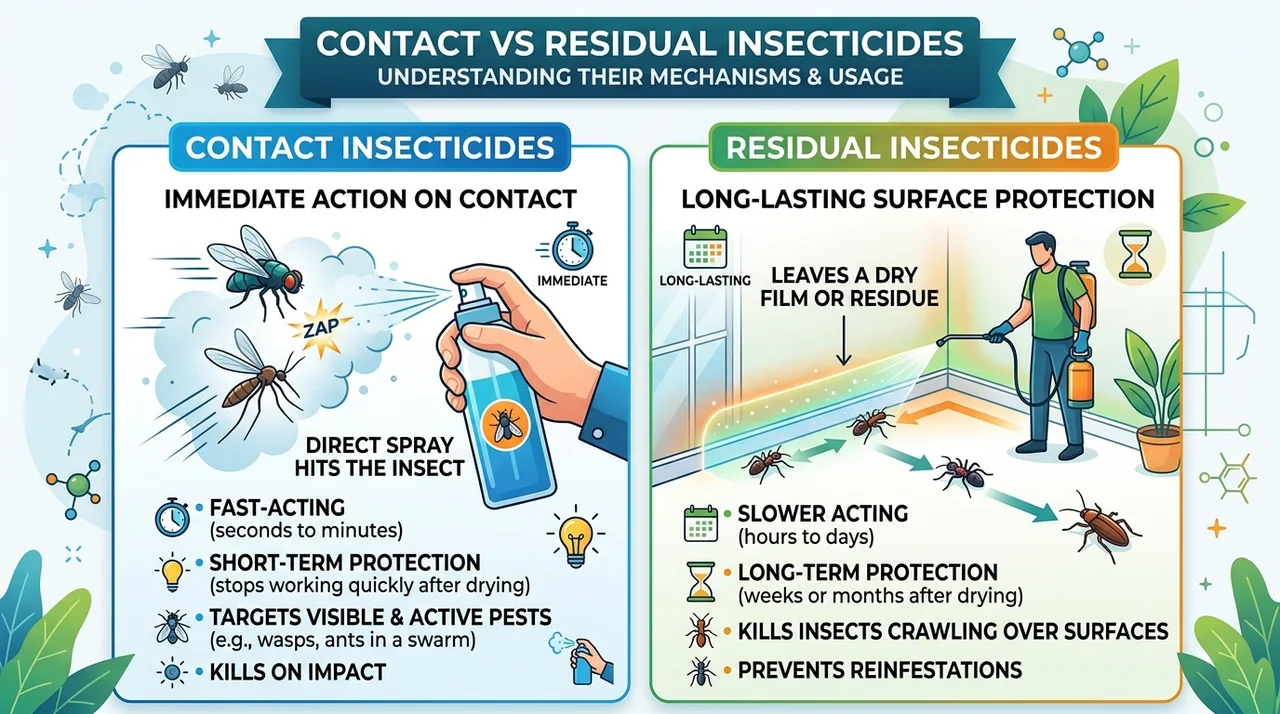
A contact insecticide kills the pests it directly hits, or those present at the moment you spray, then breaks down quickly and leaves little lasting deposit. Pyrethrins, insecticidal soaps, and horticultural oils are classic examples, as are many aerosol "knockdown" sprays. Their strengths are speed and low residue — great for a wasp you can see, a cluster of visible insects, or a sensitive area where you don't want lingering chemical, such as around a kitchen. Their weakness is equally simple: once the spray dries, it offers no protection against pests that arrive later, so a contact spray alone won't stop reinfestation.
Residual Insecticides
A residual insecticide leaves a deposit that keeps killing pests that cross the treated surface for weeks to months. Many pyrethroids (bifenthrin, permethrin, deltamethrin) are residual, as are non-repellent actives like fipronil. These are the workhorses of perimeter barriers, crack-and-crevice treatments, and ongoing prevention. How long the residual lasts depends on the surface (porous materials absorb the active and shorten it), sun exposure, rainfall, and foot traffic — which is why an outdoor barrier needs reapplication on a schedule rather than lasting indefinitely.
Repellent vs. Non-Repellent Residuals
Among residuals, there's a second important split. Repellent residuals (most pyrethroids) drive pests away from the treated zone — useful for a barrier, but counterproductive if it makes ants "bud" and scatter, or keeps roaches away from bait. Non-repellent residuals (like fipronil) can't be detected by the pest, so insects walk through, pick up a dose, and carry it back to share — ideal for colony pests. Choosing the right one depends on whether you want to exclude pests or eliminate a colony, so it's worth checking which category a product falls into before you buy.
Choosing and Combining
Reach for a contact product when you need an immediate result on a visible problem, and a residual product when you want to prevent pests or hold a barrier over time. Many labeled products actually do both — a fast knockdown plus a lasting deposit — which is why reading the label matters more than the marketing name on the front.
A practical example makes the split clear. For a home invaded by occasional ants in summer, you might use a fast contact aerosol on the trail you can see for instant relief, while a residual barrier around the foundation stops new foragers over the following weeks. For a wasp nest you can safely reach, a contact knockdown is usually all you need. For ongoing prevention against spiders and occasional invaders, a residual perimeter treatment carries the load between seasons. Reading the active ingredient and the label language — "kills on contact," "controls for up to X weeks," "non-repellent" — tells you far more about how a product will actually behave than any bold name on the front of the bottle.
Because residuals persist, keep them off food-prep surfaces, respect the label's re-entry and drying times (especially around children and pets), and never exceed the labeled rate. Follow the EPA-registered label on any product, and call Poison Control at 1-800-222-1222 for any accidental exposure.


