
House Mouse
Mus musculus · also called house mouse, common mouse
Quick answer
The house mouse (Mus musculus) is a small gray-brown rodent with large ears, a pointed snout, and a long tail. It squeezes through dime-sized gaps, nests in walls and attics, and breeds year-round. Mice contaminate food, gnaw wiring, and can spread Salmonella and other diseases through their droppings.
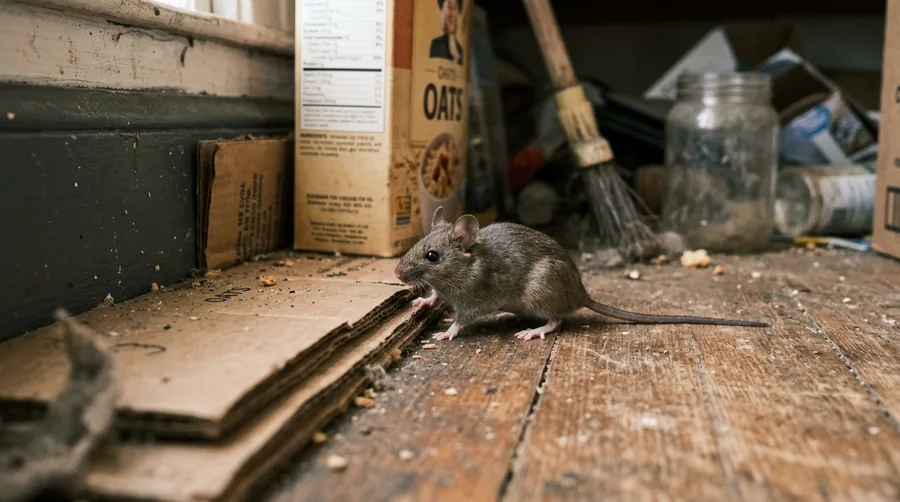
Small gray-brown house mouse with large ears and a long thin tail on a wooden floor
Recommended Products


What it does
House mice are curious, nocturnal, and constantly nibble as they explore. They are strong climbers and jumpers, follow the same runways along walls, and can squeeze through a gap the size of a dime (about 1/4 inch). They stay close to their nest and food.
Where it lives
Mice nest in hidden, sheltered spots: inside wall voids, attics, basements, cabinets, and behind or under appliances, building nests from shredded paper, insulation, and fabric. They live in homes, barns, and commercial buildings nationwide, moving indoors especially as weather cools.
How it breeds
Mice breed prolifically year-round indoors. Females mature at about six weeks, gestation lasts around three weeks, and a litter averages five to six pups. One female can produce five to ten litters a year, so a few mice become an infestation quickly.
What it eats
House mice prefer seeds and grains but are opportunistic and will nibble many foods. They eat little at a time from many spots and need very little water, getting much of their moisture from food.
Identification
A house mouse has a rounded body 2.5-4 inches long, gray to light brown fur, a pale belly, large ears, a pointed snout, and a thin, nearly hairless tail about as long as its body. Droppings are rod-shaped and pointed, about 1/4 inch.
Signs of an infestation
- Small, dark, rod-shaped droppings with pointed ends
- Gnaw marks on food packaging, wood, and wiring
- Greasy rub marks along walls and baseboards
- Scratching or scurrying sounds in walls and ceilings at night
- Shredded nesting material and a musky, ammonia-like odor
Prevention tips
- Seal exterior gaps 1/4 inch or larger with steel wool and caulk
- Store food and pet food in sealed metal or glass containers
- Keep kitchens clean and take out trash promptly
- Declutter storage areas that offer nesting sites
- Trim vegetation and move woodpiles away from the foundation
Professional solutions
Snap traps and tamper-resistant bait stations handle many small infestations, paired with sealing entry points. Recurring activity, large numbers, or mice inside walls and hard-to-reach voids are best handled by a professional who can locate entry points and manage baiting safely.
Health & safety
Mice can contaminate food and surfaces with droppings and urine, spreading Salmonella, leptospirosis, and (mainly via wild deer mice) hantavirus. Their constant gnawing on electrical wiring is a fire hazard. Overall risk is moderate to high given contamination and property damage.
Relevant Products






Frequently asked questions
How can I tell if I have mice?
Common signs are small rod-shaped droppings with pointed ends, gnaw marks on packaging and wiring, greasy rub marks along walls, scratching sounds at night, shredded nesting material, and a musky ammonia-like smell.
How small a gap can a mouse fit through?
A house mouse can squeeze through a gap about the size of a dime, roughly 1/4 inch. That is why sealing even small cracks and holes with steel wool and caulk is a key part of keeping mice out.
Are house mice dangerous?
Mice can contaminate food and surfaces and spread illnesses such as Salmonella and leptospirosis, and their gnawing on wiring is a fire risk. They rarely bite. Overall the health and property risks make prompt control worthwhile.
Fact-checked by Morgan Vance, Editorial Director (editorial review, not a professional pest-control or medical sign-off). Last reviewed June 22, 2026. We correct anything a reader shows us is wrong — see our corrections policy.