
Roof Rat
Rattus rattus · also called black rat, ship rat, house rat
Quick answer
The roof rat (Rattus rattus) is a sleek, agile climbing rat with a pointed nose, large ears, and a tail longer than its body. It nests high in attics, trees, and rafters, favoring coastal and southern states. Roof rats contaminate food, gnaw wiring, and can spread disease, making them a serious household pest.
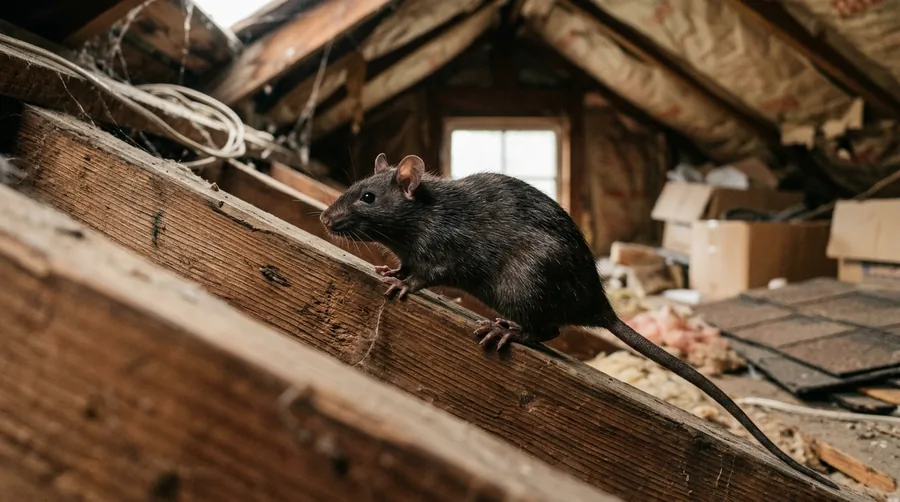
Sleek brown roof rat with large ears and a long tail on an attic beam
Recommended Products
See the full ranking →


What it does
Roof rats are agile, cautious climbers that travel overhead along wires, fences, tree limbs, and rooflines, nesting high in attics, rafters, and dense vegetation. They are nocturnal, wary of new objects, and rarely burrow like Norway rats. They gnaw constantly to keep their teeth worn, damaging wiring, pipes, and structures.
Where it lives
They prefer upper areas: attics, ceiling voids, upper cabinets, palm trees, ivy, and citrus and fruit trees. Roof rats dominate in warmer coastal and southern regions, including California, the Gulf Coast, Florida, and the Pacific coast, and are strongly tied to landscaping, fruit, and dense ground cover near buildings.
How it breeds
Roof rats breed year-round in mild climates, producing several litters a year of about five to eight young each. Females mature in a few months, so numbers climb quickly. A pair and their offspring can build a sizable colony within a year where food, water, and harborage are plentiful.
What it eats
Roof rats favor fruits, nuts, berries, seeds, and plant material, earning the nickname fruit rat, but they are opportunistic and also eat pet food, garbage, grains, and insects. They need a regular water source and often follow fruit trees, bird feeders, and gardens to a food supply.
Identification
Roof rats are 6-8 inches in the body with a scaly tail longer than the body, plus large ears, a pointed muzzle, and sleek brown-to-black fur with a paler belly. The long tail, big ears, and slender build distinguish them from the heavier, blunt-nosed Norway rat.
Signs of an infestation
- Droppings about 1/2 inch with pointed ends in attics and along beams
- Gnaw marks on wires, wood, and fruit, and greasy rub marks on rafters
- Scratching and scurrying sounds in ceilings and walls at night
- Nests of shredded material in attics, and gnawed fruit in trees
- Grease-darkened runways along overhead wires and fence tops
Prevention tips
- Trim tree limbs and shrubs back several feet from the roof
- Seal gaps 1/2 inch or larger at the roofline, vents, and utility lines
- Pick up fallen fruit and secure garbage and pet food
- Store food in sealed containers and remove clutter in attics
- Screen vents and cap chimneys to block overhead entry
Professional solutions
Roof rats are challenging because they nest high and travel overhead. Small problems may respond to snap traps and sealing, but established colonies, attic nesting, or repeated activity call for a professional who can find entry points, set traps safely, and manage any EPA-registered rodenticide in tamper-resistant stations. Pros also handle exclusion at the roofline.
Health & safety
Roof rats can spread disease through droppings, urine, and contaminated food, and historically carried plague via their fleas; they can also transmit rat-bite fever and cause food poisoning. They rarely bite unless cornered. Their gnawing on wiring is a fire hazard. Keep any rodenticide away from children and pets, and call Poison Control at 1-800-222-1222 if exposure occurs.
Relevant Products



Frequently asked questions
How do I know if I have roof rats or Norway rats?
Roof rats are sleeker with large ears and a tail longer than the body, and they nest high in attics, trees, and rafters. Norway rats are heavier and blunt-nosed with a shorter tail and burrow low, in basements and along foundations.
Are roof rats dangerous to my health?
They can be. Roof rats contaminate food and surfaces with droppings and urine, can spread diseases such as rat-bite fever and food poisoning, and historically carried plague fleas. Their gnawing on wiring is also a fire risk, so prompt control matters.
How do roof rats get into the attic?
Roof rats travel overhead along wires, fences, and tree branches and enter through gaps at the roofline, vents, and utility penetrations as small as a half inch. Trimming branches away from the roof and sealing those openings is key to keeping them out.
Fact-checked by Morgan Vance, Editorial Director (editorial review, not a professional pest-control or medical sign-off). Last reviewed August 1, 2026. We correct anything a reader shows us is wrong — see our corrections policy.