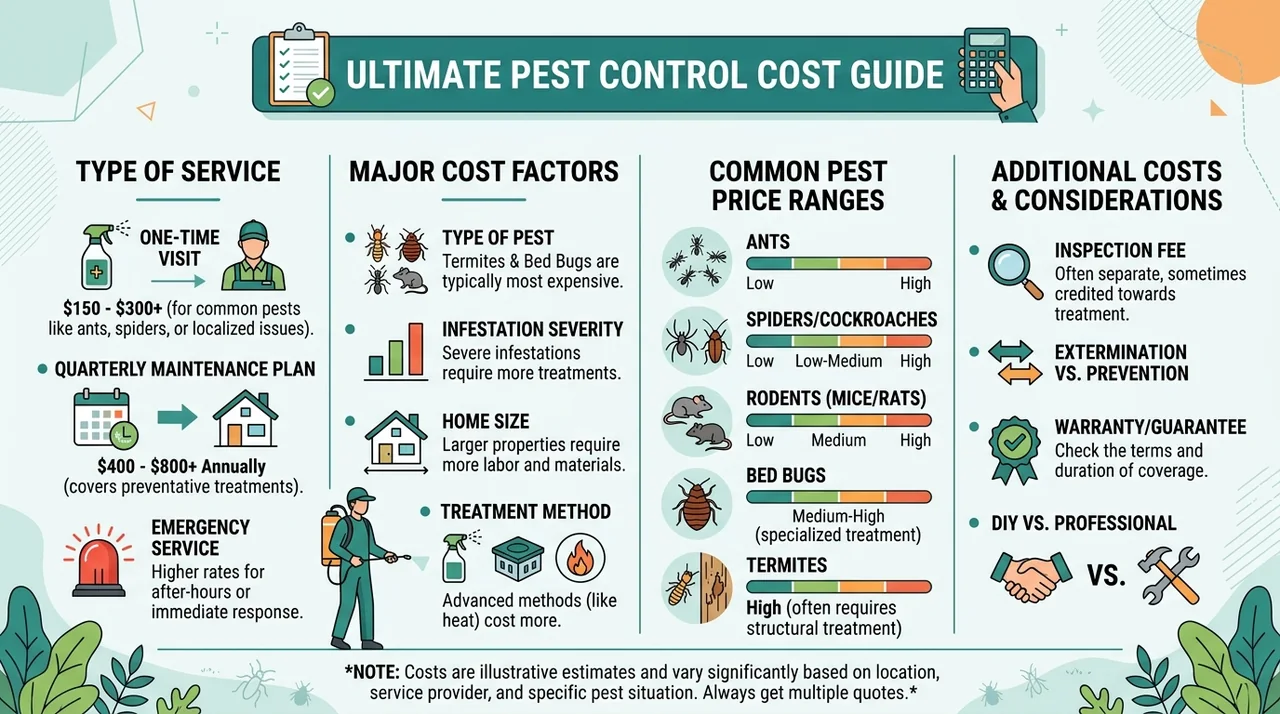
Most U.S. homeowners pay about $40–$70 per visit for recurring general pest control on a quarterly plan. That works out to roughly $400–$950 a year. A single one-time treatment usually costs $150–$300. The first visit costs more, because it adds a full inspection and a heavier knock-down treatment. Specialty jobs are quoted on their own and cost far more. Termite treatment commonly runs $300–$2,500+. Bed bug treatment runs $300–$5,000. Your real price depends on the pest, your home's size, the severity, and where you live. So always get a written, itemized quote before you agree to anything.
How Much Does Pest Control Cost Per Visit?
Per-visit pricing is the clearest way to compare quotes. General pest control covers ants, cockroaches, spiders, and wasps. It is sold two ways. You can book a one-time visit. Or you can pay per visit on an ongoing plan. The table below shows the typical U.S. ranges by service type.
What the Average Cost Per Visit Covers
The average cost per visit depends on what the visit includes. A basic recurring visit is the cheapest option. An initial visit costs more, because it adds a full inspection. The numbers below are typical U.S. price ranges. They are not fixed rates.
| Service type | Typical cost | What it covers |
|---|---|---|
| One-time treatment | $150–$300 | A single visit targeting one pest |
| Initial / first visit | $150–$350 | Inspection plus a heavier first treatment |
| Monthly plan | $40–$70 per visit | High-pressure areas; frequent re-service |
| Quarterly plan | $100–$300 per visit ($400–$950/yr) | The most common general-pest plan |
| Annual maintenance | $300–$550 | One inspection and treatment a year |
How Much Is Monthly or Quarterly Pest Control?
Recurring plans are how most households buy pest control. One treatment rarely keeps pests out for good. So most homes pay on a set schedule.
Monthly Pest Control Costs
Monthly pest control runs $40–$70 per visit. It is usually reserved for warm, high-pressure regions. It also suits an active problem that needs frequent re-service.
Quarterly Pest Control Pricing
Quarterly service is the default for general pests. It averages $100–$300 per visit. That is about $400–$950 a year. The initial visit is higher. The quarterly rate refers to the lighter follow-up visits.
How Much Does Pest Control Cost by Pest or Job?
Price varies enormously by pest. The treatment, equipment, and time all differ. General-pest plans are cheap. Structural and specialty jobs are not.
| Pest or job | Typical price range | How it's priced |
|---|---|---|
| General pests (ants, roaches, spiders) | $40–$70/visit or $400–$950/yr | Recurring plan |
| Termites — spot / localized | $250–$900 | Per treated area |
| Termites — whole-structure / fumigation | $1,200–$2,500+ | By linear or square foot |
| Bed bugs | $300–$5,000 | Heat vs. chemical, per room or whole home |
| Rodents (exclusion + removal) | $200–$600 | Sealing entry points plus trapping |
| Mosquitoes | $75–$150 per treatment | Seasonal yard service |
| Wildlife removal | $200–$600+ | By animal plus entry repair |
Termite Treatment Cost
Termite treatment is priced by the area treated. A spot treatment runs $250–$900. Whole-structure work or fumigation runs $1,200–$2,500+. Bigger homes cost more, because pricing follows linear or square footage.
Bed Bug Treatment Cost
Bed bug treatment runs $300–$5,000. The method drives the price. Heat treatment costs more than chemical rounds. Treating one room is cheaper than treating a whole home.
Rodent Control Cost
A rodent job runs $200–$600. It usually pairs trapping with exclusion. Exclusion means sealing the entry points that let a rodent in. Sealing the gaps is what stops the problem coming back.
Mosquito Treatment Cost
Mosquito treatment is a seasonal yard service. It runs $75–$150 per treatment. Most homes book it across the warm months. It knocks down adults and treats breeding spots.
One-Time Treatment vs. a Recurring Plan — Which Is Cheaper?
A one-time treatment costs $150–$300. It is cheaper up front. It makes sense for a single, contained problem. A wasp nest or an early ant trail are good examples. A recurring plan costs more over a year. But it prevents re-infestation. It also usually includes free re-service if pests return. For chronic pressure, the plan is almost always the better value. Roaches, seasonal ants, and warm climates all count as chronic pressure. Repeated one-time visits add up fast. For a rare, isolated pest, one-time is fine.
What Affects the Price of Pest Control?
Six factors drive most of the variation in a quote:
- Pest type — termites, bed bugs, and wildlife cost far more than general pests.
- Severity — an established infestation needs more visits and more product.
- Home size — pricing often scales with square footage or linear feet of foundation.
- Construction and access — crawlspaces, slabs, and hard-to-reach voids raise labor.
- Location — regional cost of living and local pest pressure both move the price.
- Frequency and guarantee — recurring plans and warranties change the total.
How an Infestation Changes the Price
Severity is the factor people underestimate. A light, early problem is cheap to treat. An established infestation is not. It needs more visits and more product. That is why the same pest can cost very different amounts at two homes.
Is Professional Pest Control Worth the Cost?
For general nuisance pests, you can often do it yourself. Bait and good sanitation go a long way. Professional pest control earns its cost when the stakes are high. Termites and rodents cause structural and health damage. That damage dwarfs the treatment price. Bed bugs are notoriously hard to clear without professional heat or repeated chemical rounds. A pro also brings a warranty. A pro can use products you cannot buy retail.
When the Exterminator Cost Is Worth Paying
Here is the honest rule of thumb. Pay the exterminator cost when the problem threatens your home or your health. Also pay it when DIY has already failed twice. For a one-off nuisance, save your money.
How to Get an Accurate Pest Control Quote
Never accept a price over the phone, sight unseen. That rule holds for anything beyond a basic general-pest plan. Insist on an inspection first. Then get a written, itemized quote.
Why the Inspection Comes First
The inspection is what makes a quote accurate. It confirms the pest, the severity, and the access. A good quote states the pest, the treatment method, and the number of visits. It also states what is guaranteed and the total. Get two or three quotes so you can compare on scope, not just price.
Check the Warranty and License Before You Sign
Confirm the company is licensed by your state's pest-control authority. Check that it carries insurance. Read the warranty, so you know what a callback costs. Our exterminator directory links to each state's official license lookup. Use it to verify a company before you hire.
Figures above are typical U.S. price ranges compiled from published industry pricing and company rate cards; actual costs vary by region, home size, and severity. Get a local quote for your situation.