
Pest Control for Home: Identify, prevent & control any home pest — honestly.
In-Depth Guide Researched & Fact-Checked

Questions to Ask a Pest Control Company

A detailed companion guide: questions to ask a pest control company.

Questions to Ask a Pest Control Company

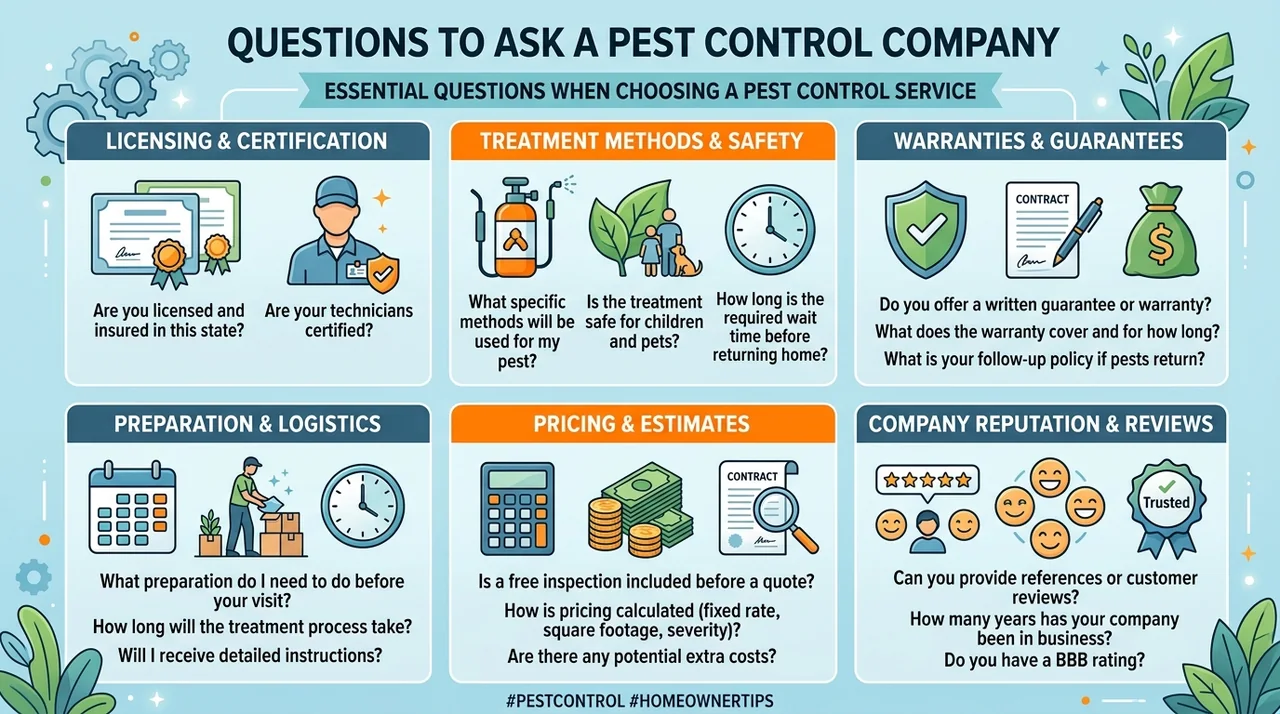
The questions you ask before hiring tell you more than any advertisement. A good pest control company will answer them openly; one that dodges them is telling you something too. Here are the questions that actually protect you — grouped so you can work through them on a call or during an estimate visit.

Licensing, Insurance, and Credentials

Start here, because these protect you if something goes wrong:

  • Are you licensed by the state, and can I see the license?
  • Are your applicators certified and trained?
  • Do you carry liability insurance — and, for damage-prone work like termite treatment, are you bonded?
  • Are you a member of a professional pest management association?
Licensing and insurance are non-negotiable; skip a company that won't show them.

Treatment, Products, and Safety

Next, understand what they'll actually do to your home:

  • What pest have you identified, and what's your treatment plan?
  • What products will you use, and can I see the labels or safety data sheets (SDS)?
  • What safety precautions apply for my children, pets, and family?
  • Do you offer pet-safe or reduced-risk options?
  • Do you practice integrated pest management — inspection, exclusion, and targeted treatment — rather than just spraying everything?
A quality company inspects first and explains the why behind its plan; it doesn't just show up with a sprayer and blanket the house.

Guarantees, Pricing, and References

Finally, pin down the business terms:

  • What does the price include, and is it itemized?
  • Is there a guarantee or warranty, and what triggers a free re-service?
  • Is this one-time or a contract, and what are the cancellation terms?
  • Can you provide references or verifiable reviews?
  • Will I get a written inspection report and service record?
Take notes as you ask these, because comparing two or three companies side by side is where the answers become useful. One company might quote a lower price but offer no guarantee; another might cost a little more yet include free re-service and a detailed written report. The questions above turn a vague "which is cheaper" decision into a clear comparison of value — what's actually covered, how the company works, and whether it stands behind the result. It's also fair to ask how the company communicates during a job: whether you'll get the same technician, how to reach them between visits, and how they handle a callback if pests return. Those practical details often separate a company you'll be glad you hired from one that's hard to reach once the contract is signed.

Red Flags to Watch For

Certain behaviors should give you pause: high-pressure sales, no written quote, refusal to show a license or proof of insurance, vague talk of "secret" or proprietary chemicals, door-to-door scare tactics, and a price far below every other bid. Any of these is a reason to keep looking. Get at least a couple of quotes and compare the approach, not just the number — the goal is a company that identifies the pest, explains its plan, and puts everything in writing. Any product a company uses should be EPA-registered and applied strictly to its label, and you can keep Poison Control (1-800-222-1222) on hand for peace of mind.

Frequently Asked Questions

At minimum, a current state license you can view, certified and trained applicators, and liability insurance — plus bonding for damage-prone work like termite treatment. Membership in a professional pest management association is a good sign. If a company won't show its license or proof of insurance, treat that as a reason to look elsewhere.

Absolutely. Ask what products they'll apply and request to see the labels or safety data sheets, along with the precautions for children and pets and any reduced-risk options. A reputable company answers openly, because everything it uses should be EPA-registered and applied to the label. Vague talk of a proprietary or secret chemical is a red flag.

Watch for high-pressure sales tactics, no written quote, refusal to show a license or insurance, vague 'secret' chemicals, door-to-door scare pitches, and prices far below every other bid. A trustworthy company inspects first, identifies the pest, explains its plan, and puts pricing and guarantees in writing. Get a couple of quotes and compare the approach, not just the price.

Continue Reading