
Drain Fly
Clogmia and Psychoda spp. · also called drain flies, moth fly, sewer fly
Quick answer
The drain fly (family Psychodidae) is a tiny, fuzzy, moth-like fly, also called a moth fly or sewer fly, that breeds in the gelatinous gunk inside drains. Weak fliers, they hop around sinks, tubs, and floor drains. They do not bite, and the fix is cleaning out the organic film they breed in, not just killing adults.
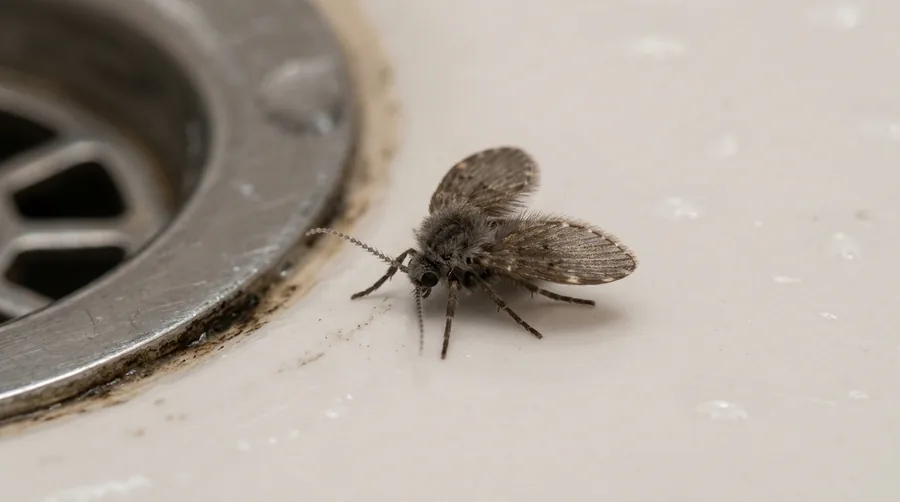
Tiny fuzzy moth-like drain fly with heart-shaped wings resting on a bathroom sink
Recommended Products


What it does
Drain flies are weak fliers that rest on walls near their breeding sites and move in short, hopping flights rather than sustained flight. Adults are harmless nuisances; the action happens in the drains, where larvae live in the moist, gelatinous organic film. Because they breed in that hidden film, killing visible adults alone never solves the problem.
Where it lives
Larvae develop in the slimy organic buildup inside drains, overflow pipes, garbage disposals, sewage, septic systems, and other consistently wet, organically rich spots. Adults gather near sinks, tubs, floor drains, and basement or utility areas. They occur nationwide in homes and commercial buildings wherever such moist films persist.
How it breeds
Females lay eggs in the moist film lining drains and pipes. Larvae feed on the organic gunk and microorganisms there, then pupate, with the whole cycle often completing in one to three weeks. Continuous breeding in an undisturbed drain can sustain a steady supply of adults until the film is removed.
What it eats
Larvae feed on the organic matter, bacteria, algae, and sludge in the moist film inside drains and similar wet habitats. Adults feed little, sipping liquids or nectar, and are chiefly a nuisance rather than a feeder on human food.
Identification
Adults are tiny, about 1/8 inch, gray to tan, and densely fuzzy, giving them a moth-like look, with rounded, heart-shaped wings held roof-like over the body at rest. Their small size, hairy appearance, and habit of resting near drains and hopping when disturbed distinguish them from fruit flies and other small flies.
Signs of an infestation
- Small fuzzy moth-like flies resting near drains and sinks
- Flies most numerous in bathrooms, basements, or utility rooms
- A gelatinous film inside slow or seldom-used drains
- Flies reappearing despite killing the adults
- Larvae in the sludge when a drain is cleaned
Prevention tips
- Physically scrub drain walls to remove the organic film
- Use a drain brush and hot water to clear buildup
- Run water in seldom-used drains to keep traps from drying
- Fix leaks and eliminate standing water and moist debris
- Clean garbage disposals and overflow openings regularly
Professional solutions
Most drain fly problems are solved by locating and cleaning the breeding drain, since the fix is mechanical removal of the film, not spraying adults. A professional or plumber helps when the source is hidden, tied to a broken pipe or sewage leak, or persists after cleaning accessible drains, and can locate the true breeding site.
Health & safety
Drain flies do not bite or sting and are not considered significant disease vectors, though because they develop in drains and sewage they can mechanically carry bacteria, so basic hygiene is sensible. They are primarily a nuisance, and in rare cases their debris may contribute to allergies or asthma in very heavy indoor infestations.
Relevant Products


Frequently asked questions
How do I get rid of drain flies for good?
Find the drain they are breeding in and physically scrub its walls to remove the gelatinous film where larvae live, using a drain brush and hot water. Killing the adults alone will not work, because new ones keep emerging from the film until that organic buildup is removed.
Are drain flies harmful?
They do not bite or sting and are not considered major disease carriers, but since they breed in drains and sewage they can mechanically pick up bacteria, so cleaning is worthwhile. In very heavy infestations their debris may contribute to allergy or asthma symptoms; mostly they are a nuisance.
How can I tell drain flies from fruit flies?
Drain flies are fuzzy and moth-like with rounded wings and rest near drains, hopping when disturbed, while fruit flies are smooth, tan, often red-eyed, and hover around ripe produce and trash. Identifying which one you have points you to the right breeding source to clean.
Fact-checked by Morgan Vance, Editorial Director (editorial review, not a professional pest-control or medical sign-off). Last reviewed August 9, 2026. We correct anything a reader shows us is wrong — see our corrections policy.