
House Fly
Musca domestica · also called housefly, common housefly, house flies
Quick answer
The house fly (Musca domestica) is a dull-gray fly about 1/4 inch long, with four dark stripes on its back and sponging mouthparts that cannot bite. It breeds in garbage, manure, and decaying matter, then lands on food, where it can mechanically spread bacteria such as Salmonella and E. coli. Sanitation and sealing entry points are the keys to control.
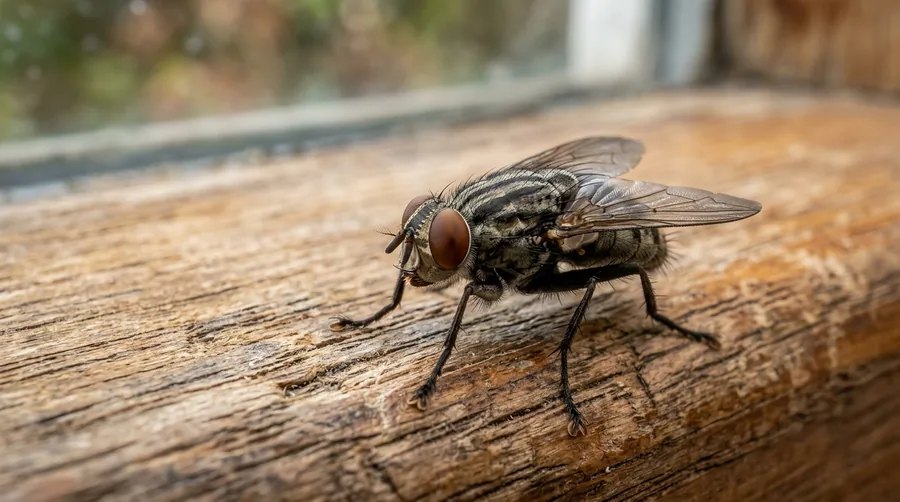
Gray house fly with red eyes and four dark thoracic stripes resting on a kitchen surface
Recommended Products
See the full ranking →


What it does
House flies are active by day, buzzing around food, garbage, and warm surfaces, and resting on walls and ceilings at night. Because they have sponging mouthparts and cannot chew or bite, they liquefy food by regurgitating saliva onto it, then sponge it up. This habit of vomiting and defecating as they feed is what makes them effective at spreading germs.
Where it lives
House flies breed in moist, decaying organic matter: garbage, manure, compost, rotting produce, and animal waste. Adults gather wherever food and filth are available, in kitchens, around trash and dumpsters, on farms, and near animals. They are found nationwide and follow warmth, entering homes through open doors and torn screens.
How it breeds
A female lays batches of eggs, up to several hundred over her life, in decaying material. Eggs hatch into pale maggots within a day, feed and grow, then pupate and emerge as adults. In warm weather the whole cycle can finish in about 7 to 10 days, allowing many overlapping generations in a single season.
What it eats
Adult house flies feed on a wide range of liquid or liquefiable foods, including sugary substances, decaying matter, garbage, feces, and food spills. They cannot eat solids directly, so they dissolve food with saliva first. Larvae feed on the decaying organic material where the eggs were laid.
Identification
Adults are about 1/4 inch, dull gray, with four lengthwise dark stripes on the thorax, large reddish eyes, and a single pair of wings. A sharp upward bend in one wing vein is a distinguishing detail. Unlike the biting stable fly, the house fly has soft sponging mouthparts and does not bite.
Signs of an infestation
- Adult flies repeatedly landing on food, counters, and windows
- Clusters of flies around garbage, drains, or pet waste
- Small dark specks (fly spots) on walls, ceilings, and light fixtures
- Pale maggots in garbage, compost, or decaying matter
- Persistent buzzing indoors, especially near sunny windows
Prevention tips
- Keep garbage in bins with tight lids and empty them often
- Clean up food spills, crumbs, and pet waste promptly
- Install and repair window and door screens
- Use tight-fitting lids on compost and green-waste bins
- Promptly remove decaying produce and clean recycling and drains
Professional solutions
Most house fly problems are solved by sanitation, screening, and eliminating breeding sites, supported by fly traps, baited stations, or fly swatters. For heavy or recurring infestations, especially near farms, dumpsters, or animal facilities, a professional can locate breeding sources and apply targeted baits or residual treatments. Follow the EPA label on any insecticide product used indoors or outdoors.
Health & safety
House flies do not bite, but they are important mechanical carriers of disease. As they move between filth and food, they can transfer bacteria and other pathogens that cause food poisoning and diarrheal illness, including Salmonella, E. coli, and Shigella. Risk is moderate and centers on food contamination, so keep flies off food and preparation surfaces.
Relevant Products




Frequently asked questions
Do house flies bite?
No. House flies have soft, sponging mouthparts and cannot bite or pierce skin. If a 'house fly' is biting you, it is likely a stable fly, which looks similar but bites. House flies are a concern because they spread germs by landing on food, not because of bites.
Why are house flies considered a health risk?
House flies move between garbage, feces, and food, and they vomit and defecate as they feed. That behavior lets them mechanically transfer bacteria such as Salmonella, E. coli, and Shigella onto food and surfaces, which can cause food poisoning and diarrheal illness.
How do I get rid of house flies?
Focus on sanitation: seal and empty garbage, clean up spills and pet waste, and remove decaying matter where flies breed. Add screens on windows and doors, and use traps or swatters for adults indoors. Heavy or recurring infestations near breeding sources may need a professional.
Fact-checked by Morgan Vance, Editorial Director (editorial review, not a professional pest-control or medical sign-off). Last reviewed July 22, 2026. We correct anything a reader shows us is wrong — see our corrections policy.