

What does a tick bite look like?
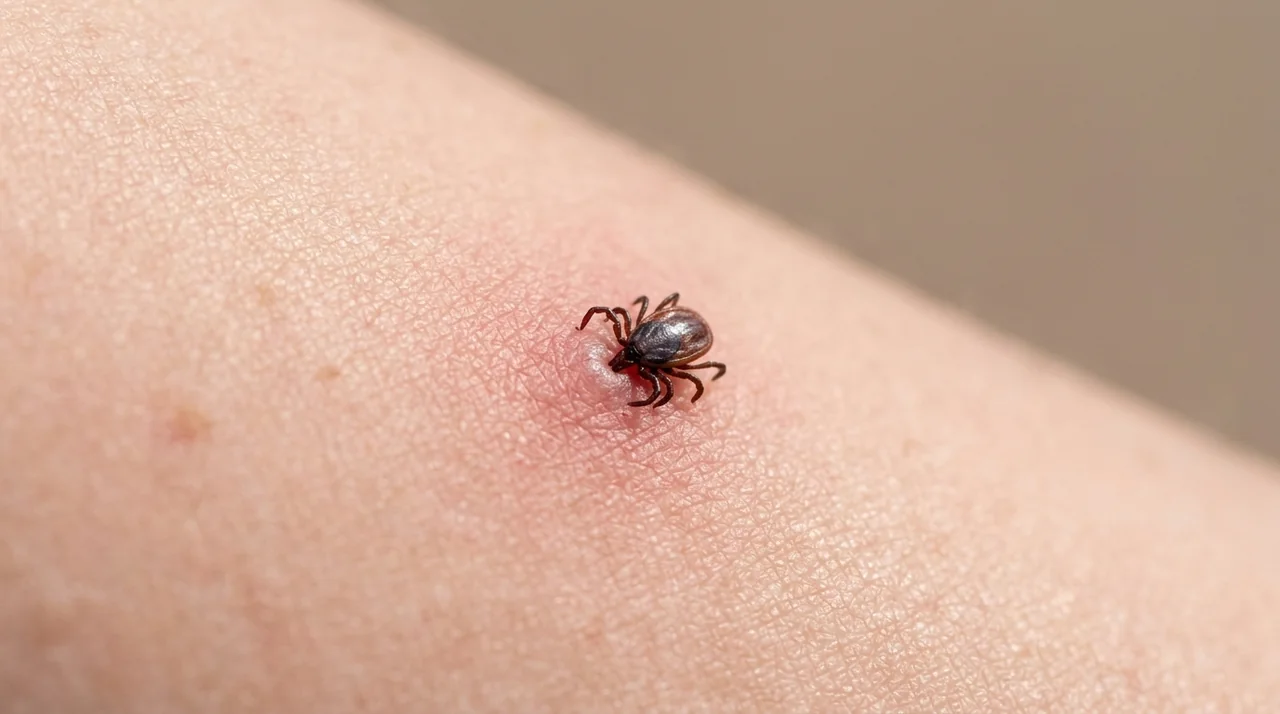
Most tick bites are painless and easy to overlook. Typically you see a small, firm red bump where the tick attached. Sometimes there is mild itching or a little swelling around it. Ticks feed slowly over hours or days. So the clearest sign is often the tick itself, still embedded in the skin. Its head is buried while its body sticks out. After you remove it, a small red spot commonly remains for a few days while the skin settles. This is a normal reaction and not necessarily a sign of illness.
What does a Lyme disease rash look like?
The rash worth knowing is erythema migrans. It is associated with Lyme disease carried by the blacklegged (deer) tick (Ixodes scapularis). It tends to appear days to a few weeks after the bite. Then it expands outward over time. Sometimes it clears in the center to form a target or bull's-eye pattern. Not every Lyme rash looks like a classic bull's-eye. And not every tick bite leads to Lyme. But an enlarging rash after a known or suspected bite is a clear reason to contact a doctor.
How is a tick bite different from other insect bites?
A tick bite has a few distinguishing features:
- The tick is often still attached, which no mosquito or flea leaves behind
- The bite is usually painless, so you may not feel it happen
- It tends to be a single bite rather than the clusters fleas or bed bugs leave
- It commonly turns up in warm, hidden spots such as the scalp, waistband, armpits, or behind the knees
How do I safely remove an attached tick?
The CDC advises a straightforward method:
Avoid folk remedies like petroleum jelly, nail polish, or a hot match. These can make the tick release more fluids rather than detach cleanly.
What symptoms should I watch for after a tick bite?
Monitor the area and how you feel for several weeks. Ticks such as the lone star tick (Amblyomma americanum) and American dog tick can transmit other illnesses beyond Lyme. So contact a doctor if you notice:
- An expanding rash around the bite
- Fever, chills, fatigue, headache, or body and joint aches
- A rash spreading elsewhere on the body
How do I prevent tick bites outdoors?
Ticks do not fly or jump. They wait on grass, leaf litter, and brush. Then they climb aboard when you brush past. Lower your risk in a few ways. Walk in the center of trails. Wear long pants tucked into socks. Use an EPA-registered repellent according to its label. Do a full-body tick check after being outdoors, including pets. Keep lawns trimmed and leaf litter cleared to make your yard less inviting.