
Black Fly
Simulium spp. (Simuliidae) · also called black flies, buffalo gnat, turkey gnat
Quick answer
Black flies (family Simuliidae) are tiny, humpbacked biting flies also called buffalo gnats. Females bite around the head and often draw a bead of blood, leaving itchy, slow-healing welts. Larvae develop only in clean, flowing streams, so black flies swarm worst in late spring near running water.
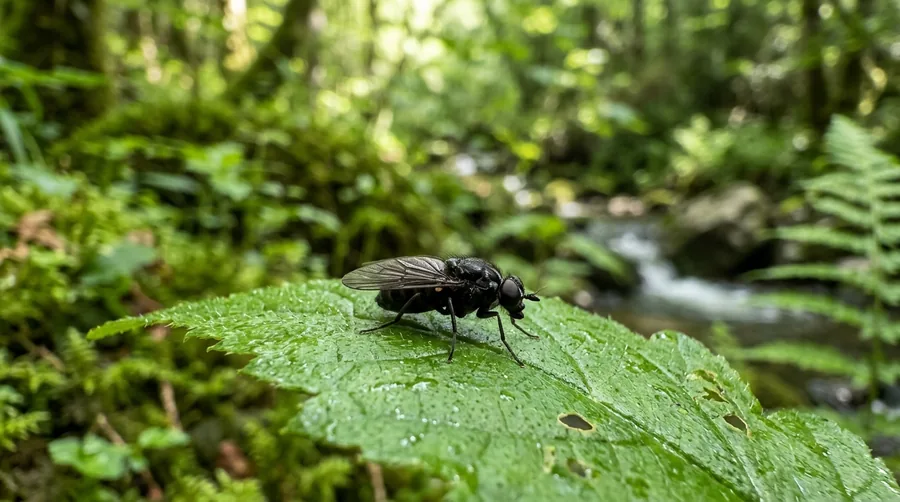
Small dark humpbacked black fly with short legs on a green leaf
Recommended Products


What it does
Only female black flies bite, feeding on blood to develop eggs while males take nectar. They are daytime feeders that swarm around the head and crawl into hair, ears, and cuffs, biting the scalp, hairline, and ankles. They can travel miles from breeding streams, making swarms hard to predict.
Where it lives
Black fly larvae require clean, cool, fast-flowing water and attach to rocks and vegetation in streams and rivers. Adults disperse widely over fields, yards, and trails downwind of that water. They are found across the US and are a notorious late-spring nuisance in the Northeast, upper Midwest, and mountain regions.
How it breeds
Females lay eggs on or near flowing water. Larvae anchor themselves in the current and filter-feed, then pupate underwater before adults emerge and float to the surface. Depending on species and region there may be one to several generations a year, with the heaviest biting in late spring and early summer.
What it eats
Adult females feed on the blood of birds, mammals, livestock, and people; males and non-biting females feed on nectar. The aquatic larvae filter tiny organic particles and microorganisms from flowing stream water.
Identification
Black flies are very small, 1-5 mm, with a stout, humpbacked body, short legs, broad clear wings, and no long mouthparts visible. Their tiny size, arched back, and swarming behavior near running water distinguish them from mosquitoes and other gnats.
Signs of an infestation
- Swarms of tiny dark flies around the head outdoors
- Itchy bites at the hairline, ears, ankles, and wrists
- Small bleeding spots or welts after being outside
- Peak activity on warm, calm late-spring days
- Restless, irritated livestock during outbreaks
Prevention tips
- Wear light-colored clothing with snug cuffs and a hat
- Apply an EPA-registered repellent to skin and clothing
- Avoid the outdoors on calm mornings during peak season
- Keep livestock sheltered during heavy swarms
- Screen windows and doors to keep strays out
Professional solutions
Black flies breed in flowing streams that cannot be treated by a homeowner, and adults travel long distances, so residential spraying is ineffective. Some regions run public black-fly programs that treat waterways with Bti larvicide. Individuals rely on repellents and protective clothing during the short peak season.
Health & safety
Black fly bites are itchy and can swell noticeably; heavy exposure sometimes causes a reaction called black fly fever with headache and swollen glands. In parts of Africa and Latin America black flies spread river blindness, but that disease does not occur in the US. Here they are a painful nuisance, not a disease vector; heavy swarms can harm livestock.
Relevant Products


Frequently asked questions
Do black flies spread disease in the US?
No. The river blindness disease black flies transmit occurs in parts of Africa and Latin America, not the United States. In the US, black flies are a painful, itchy nuisance and heavy swarms can stress livestock, but they are not known to spread disease to people here.
When are black flies worst?
Black flies peak in late spring and early summer, biting during the day, especially on warm, calm mornings near running streams and rivers. Numbers usually drop as summer heats up. Wind and rain reduce their activity, while still, humid conditions bring them out in force.
How do I protect myself from black flies?
Wear light-colored clothing with snug cuffs and collar, add a hat, and apply an EPA-registered repellent to skin and clothing. Because they breed in streams and travel far, area sprays do not help; personal protection during the short peak season is the practical defense.
Fact-checked by Morgan Vance, Editorial Director (editorial review, not a professional pest-control or medical sign-off). Last reviewed June 25, 2026. We correct anything a reader shows us is wrong — see our corrections policy.