
Deer Fly
Chrysops spp. (Tabanidae) · also called deer flies, yellow fly, banded fly
Quick answer
Deer flies (Chrysops species) are medium-sized biting flies with patterned wings and bright eyes. Females deliver a painful bite and often circle persistently around the head. Found near water and wooded trails in summer, they are the main US carrier of tularemia (rabbit fever), though transmission to people is uncommon.
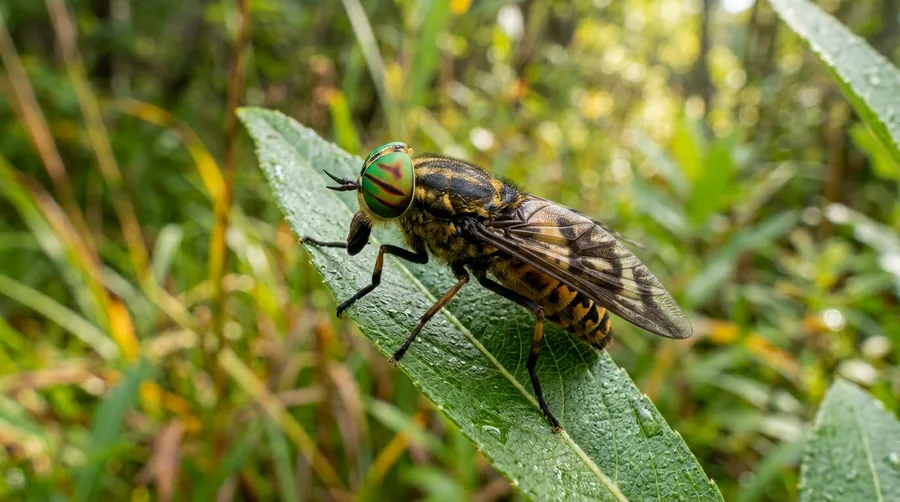
Deer fly with patterned wings and bright green eyes resting on a leaf
Recommended Products


What it does
Like horse flies, only female deer flies bite, cutting the skin to feed on blood while males take nectar. Deer flies are notorious for circling a person's head and landing to bite the scalp, neck, and shoulders. They are fast, daytime fliers attracted to movement, dark colors, and carbon dioxide.
Where it lives
Deer flies breed in the wet margins of ponds, streams, marshes, and moist woodland soil. Adults are common along shaded trails, forest edges, and near water, especially in the Northeast and upper Midwest. They range across the US wherever suitable wetlands and woods occur.
How it breeds
Females lay egg masses on vegetation overhanging water or wet ground. Larvae develop in the moist soil and mud below, usually over a single year and often overwintering, then pupate. Most species produce one generation per year, with adults emerging and biting through the summer.
What it eats
Adult females feed on the blood of mammals, including deer, livestock, and people. Males and non-biting females feed on nectar and pollen. The larvae are predatory, feeding on small organisms in wet soil and mud.
Identification
Deer flies are 8-15 mm, smaller than horse flies, with yellow-brown to black bodies, colorful patterned or banded wings, and bright golden or green eyes. Their dark wing bands and habit of circling the head help distinguish them from other biting flies.
Signs of an infestation
- Flies repeatedly circling and landing on your head
- Sharp, painful bites on the scalp, neck, or shoulders
- Itchy, swollen welts after time outdoors
- Many patterned-wing flies along shaded trails
- Increased biting near ponds and woodland edges
Prevention tips
- Wear a hat and light-colored long sleeves on trails
- Apply an EPA-registered repellent to skin and clothing
- Avoid wooded, watery areas during peak summer midday
- Try sticky patch traps worn on a hat brim
- Keep windows and doors screened against strays
Professional solutions
Deer flies breed over wide wetland areas and are difficult to control with sprays, so management focuses on personal protection and trapping rather than area treatment. There is generally no residential professional treatment; on farms, extension specialists can advise on protecting livestock and workers during peak season.
Health & safety
Deer fly bites are painful and can cause itchy welts or allergic reactions. Deer flies are the primary US insect vector of tularemia (Francisella tularensis), sometimes called deer fly fever, though human transmission is uncommon and the disease is treatable with antibiotics. Clean bites, avoid scratching, and see a clinician for spreading redness or fever.
Relevant Products


Frequently asked questions
Why do deer flies keep circling my head?
Deer flies are attracted to carbon dioxide, warmth, movement, and the highest point of a moving target, which is usually your head. Females circle before landing to bite the scalp and neck. A hat, light clothing, and repellent help, and sticky hat traps can catch persistent followers.
Can deer flies make you sick?
Deer flies are the main US carrier of tularemia, a bacterial illness, but transmission to people is uncommon and the infection is treatable with antibiotics. The usual concern is the painful bite and itchy welt. See a clinician if you develop fever or spreading redness after a bite.
What is the difference between deer flies and horse flies?
Deer flies are smaller, with dark-banded patterned wings and a habit of circling the head, while horse flies are larger with clear wings and huge eyes. Both have biting females that breed near water, and both are managed mainly through personal protection rather than sprays.
Fact-checked by Morgan Vance, Editorial Director (editorial review, not a professional pest-control or medical sign-off). Last reviewed July 16, 2026. We correct anything a reader shows us is wrong — see our corrections policy.