

Do mud daubers sting?
Mud wasps, commonly called mud daubers, do have a stinger and can sting. But they are among the least likely wasps you will ever encounter to use it. The key difference is social structure. Aggressive stinging wasps like yellowjackets, paper wasps, and hornets live in colonies with a queen and many workers. Those workers will swarm to defend the nest. Mud daubers are solitary. A single female builds and provisions her own mud nest, with no colony to protect, so she has little instinct to attack.
In practice, a mud dauber sting typically happens only when the wasp is:
- Grabbed or squeezed in a hand
- Stepped on with a bare foot
- Trapped against skin under clothing
How do I recognize a mud dauber and its nest?
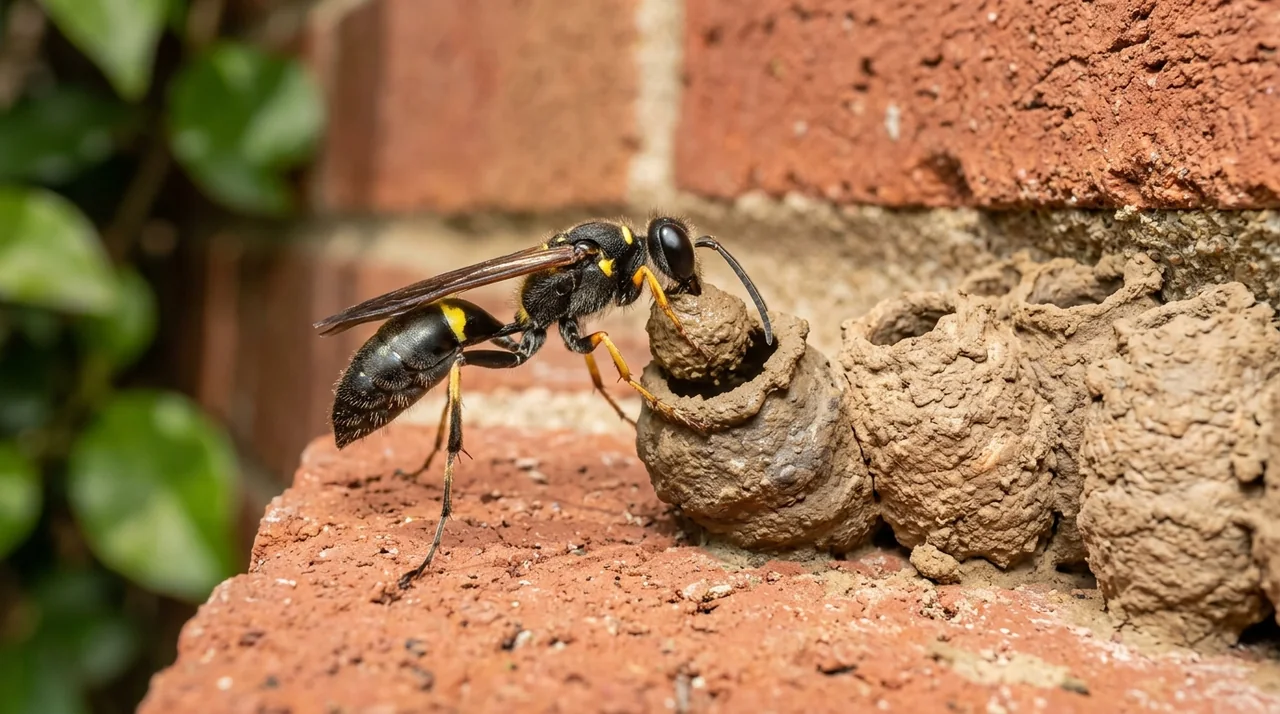
Mud daubers are easy to identify once you know the signs. The adults are often slender and long-waisted. Some are a glossy black or metallic blue, while others show yellow markings. Their real signature is the nest. These are small structures made of mud, shaped like tubes, pipes, or a lumpy pot. You will find them tucked under eaves and in sheds, garages, and protected walls. Social wasps build papery gray nests, but a mud dauber nest is literally dried mud.
Are those nests dangerous?
Not in the way a yellowjacket nest is. Because mud daubers do not defend their nests, walking past one carries little risk. An abandoned mud nest is sometimes taken over by other insects, but the structure itself is harmless.
Why mud daubers are worth keeping around
Mud daubers are beneficial predators, and their prey of choice is spiders. That includes species some homeowners would rather not have nearby, such as black widows. The female paralyzes spiders and seals them in her mud nest as living food for her single larva. A yard with mud daubers is often a yard with fewer problem spiders. They seldom sting, and they provide real spider control, so the usual advice is simply to leave them alone.
What if I want a nest gone, or I get stung?
If a mud nest is in an awkward spot, you can generally scrape it off once it is inactive. There is no colony to retaliate, so done calmly there is little risk.
If you are stung, basic care is usually enough:
- Wash the area with soap and water
- Apply a cold pack to reduce swelling
- Use an over-the-counter anti-itch product if needed
Will mud daubers keep coming back to the same spot?
Mud daubers tend to favor the same kinds of sheltered, protected surfaces year after year, such as eaves, porch ceilings, sheds, and garages. So it is common to see new nests appear in familiar areas each season. They are not, however, reusing an old nest as a colony; each female builds fresh. If you would rather they not settle in a spot, remove inactive nests, reduce the spiders they hunt, and keep the area less inviting. They are beneficial and rarely sting, so many people simply tolerate them in out-of-the-way places and only remove nests in high-traffic areas.