
Mud Dauber
Sceliphron caementarium · also called mud daubers, dirt dauber, mud wasp
Quick answer
Mud daubers (Sceliphron and related genera) are slender, thread-waisted solitary wasps, often black or metallic blue, that build small mud nests on walls and under eaves. They hunt spiders to stock their nests and are remarkably docile, rarely stinging people even when their nests are disturbed.
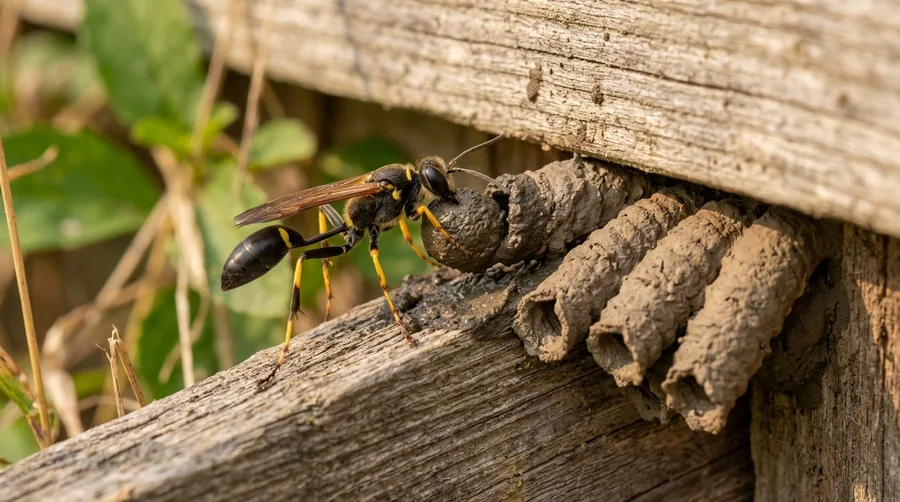
Slender black mud dauber wasp with a thread-thin waist building a tube nest of mud on a wall
Recommended Products


What it does
Mud daubers are solitary and non-aggressive; a female works alone gathering mud to build and provision her nest. She hunts spiders, paralyzes them with a sting, and seals them in mud cells as food for her larvae. Because they are not defending a shared colony, mud daubers almost never sting people and are considered beneficial spider predators.
Where it lives
Females build mud nests in sheltered spots: under eaves and porch ceilings, on walls, inside sheds, barns, garages, and attics, and under bridges. Nests appear as smooth mud lumps, side-by-side tubes resembling organ pipes, or a cluster of cells. They are found nationwide wherever mud and spiders are available.
How it breeds
The female builds mud cells, stocks each with paralyzed spiders, lays one egg per cell, and seals it. The larva feeds on the spiders, pupates inside the cell, and emerges as an adult, often the following spring after overwintering. There is typically one to two generations a year and no cooperative colony.
What it eats
Adults feed on flower nectar and honeydew. The larvae eat the paralyzed spiders their mother packs into each mud cell. This spider-hunting habit means a mud dauber presence often reflects, and helps reduce, a local spider population.
Identification
Mud daubers are about an inch long, slender, with an extremely long, thread-like waist connecting the thorax and abdomen. Depending on species they are black, black-and-yellow, or shiny metallic blue. The distinctive mud nest, smooth lumps or organ-pipe tubes, is the easiest way to identify them.
Signs of an infestation
- Smooth mud nests or organ-pipe tubes under eaves or on walls
- A slender, thread-waisted wasp carrying balls of mud
- Old, hollow mud cells with round exit holes
- Solitary wasps near sheds, porches, and garages
- Fewer visible spiders where daubers are active
Prevention tips
- Scrape off mud nests with a putty knife and clean the surface
- Seal gaps and screen vents on sheds, garages, and attics
- Reduce spider populations that daubers hunt and follow
- Knock down starter nests early before cells are provisioned
- Keep porch and eave surfaces clean and inspected in summer
Professional solutions
Mud daubers rarely need professional control. Nests can simply be scraped off by hand, ideally at night or when the wasp is away, and the area cleaned. Professional help is only worth considering for very heavy nest buildup or if abandoned mud nests are being reused by other, more aggressive stinging insects.
Health & safety
Mud daubers are among the most harmless wasps. They are solitary and non-defensive, so stings are very rare and usually happen only if a wasp is handled or trapped against skin. They pose little risk to most people, though anyone with a known wasp-venom allergy should still avoid handling them and seek care if a reaction occurs.
Relevant Products




Frequently asked questions
Do mud daubers sting?
They can, but they almost never do. Mud daubers are solitary and non-aggressive, so they do not swarm to defend a nest the way yellowjackets or hornets do. Stings are rare and usually only happen if the wasp is grabbed or pressed against skin. They are considered one of the most harmless wasps.
Are mud daubers good or bad to have around?
They are largely beneficial. Mud daubers hunt spiders, including some venomous ones, to feed their young, so they help keep spider numbers down. The main downside is the mud nests they leave on walls and eaves, which are easy to scrape off once the wasp is gone.
How do I get rid of mud dauber nests?
Simply scrape the mud nests off with a putty knife when the wasp is away or at night, then wipe the surface clean. Because mud daubers rarely sting and do not defend nests, no insecticide is usually needed. Sealing sheds and vents helps keep them from rebuilding indoors.
Fact-checked by Morgan Vance, Editorial Director (editorial review, not a professional pest-control or medical sign-off). Last reviewed July 22, 2026. We correct anything a reader shows us is wrong — see our corrections policy.