
Cicada Killer Wasp
Sphecius speciosus · also called cicada killers, eastern cicada killer, cicada hawk
Quick answer
The eastern cicada killer (Sphecius speciosus) is a huge solitary wasp up to two inches long, reddish-brown with yellow markings. Females dig burrows in bare, sandy soil and hunt cicadas to feed their young. Despite their alarming size, males cannot sting and females rarely do, so they are mostly harmless.
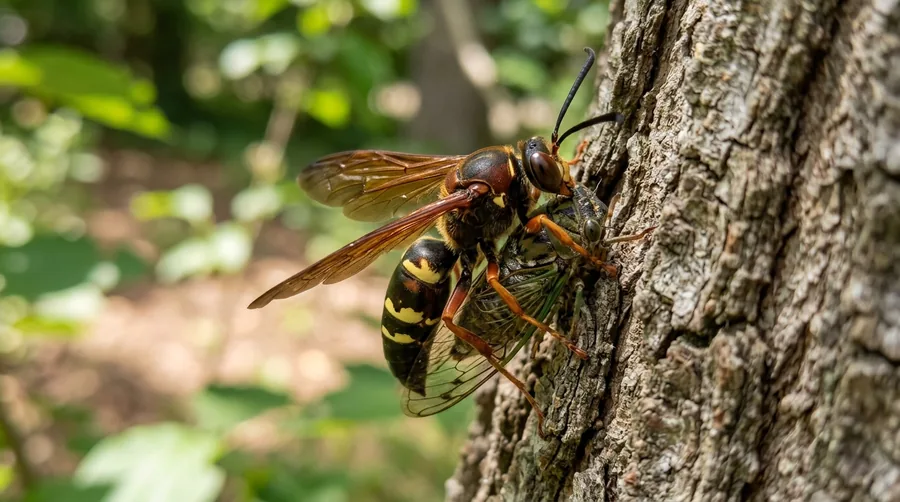
Large reddish-brown and yellow cicada killer wasp at the entrance of a burrow in bare soil
Recommended Products


What it does
Cicada killers are solitary and appear alarming because of their size and low, hovering flight, but they are not dangerous. Males patrol territories and dive-bomb passersby aggressively yet have no stinger at all. Females dig burrows and hunt cicadas, and they sting only if grabbed or stepped on. They ignore people going about a yard normally.
Where it lives
Females dig burrows in well-drained, bare or sparsely vegetated soil: sandy lawns, garden beds, along sidewalks and driveways, on slopes, and in sparched patches of turf. Each burrow has a small mound of excavated soil. They are common east of the Rocky Mountains and appear in mid to late summer when cicadas are active.
How it breeds
There is one generation a year. A female digs a burrow with cells, captures and paralyzes cicadas, drags them underground, and lays an egg on each. The larva eats the cicadas, then overwinters underground as a resting stage before pupating and emerging as an adult the following summer to repeat the cycle.
What it eats
Adults feed on flower nectar and plant sap. The larvae eat the paralyzed cicadas the female provisions in each burrow cell, sometimes one to three cicadas per cell. This dependence on cicadas is why the wasps appear each summer just as cicadas begin calling.
Identification
Cicada killers are very large, 1 to 2 inches, reddish-brown to black with yellow bands or blotches on the abdomen and amber-tinged wings, resembling an oversized yellowjacket or hornet. Their burrows with mounded soil in bare ground, plus low territorial flight in mid-summer, distinguish them from social wasps.
Signs of an infestation
- Large wasps hovering low over bare or sandy soil
- Pencil-to-thumb-sized burrow holes with mounds of excavated dirt
- A wasp dragging a paralyzed cicada across the ground
- Males repeatedly dive-bombing people near a burrow area
- Many burrows clustered in a dry, thin patch of lawn
Prevention tips
- Thicken thin, bare lawn areas with dense turf and mulch
- Water and fertilize sparse patches so soil is less exposed
- Cover bare soil in beds with mulch or ground cover
- Tolerate the wasps where possible, since they are short-lived and harmless
- Fill in old burrows once the season ends in fall
Professional solutions
Cicada killers rarely warrant professional treatment because they are solitary and harmless, and the population is temporary each summer. If burrows are numerous in a high-traffic area, an insecticidal dust applied to burrow openings can help, or a pro can treat them. Improving turf density is the most durable, non-chemical long-term fix.
Health & safety
Cicada killers pose little danger. Males, which do the aggressive dive-bombing, have no stinger and cannot hurt you. Females can sting but are docile and sting only if handled or trapped against skin, and their sting is used to paralyze cicadas, not to defend a nest. People allergic to wasp venom should still avoid handling them.
Relevant Products




Frequently asked questions
Are cicada killer wasps dangerous?
Not really. Despite their intimidating size, cicada killers are solitary and calm around people. The males that aggressively dive-bomb cannot sting at all, and females sting only if grabbed or stepped on. They pose little threat to most people, though those allergic to wasp stings should still avoid handling them.
Why do I have giant wasps digging holes in my yard?
Those are almost certainly female cicada killers, which dig burrows in bare, sandy, or thinly grassed soil to raise their young on captured cicadas. They favor exposed, dry patches, so thickening the turf and mulching bare ground makes the area less attractive to them the following summer.
How long do cicada killers stick around?
Cicada killers are active for only a few weeks in mid to late summer, timed to when cicadas emerge, and there is just one generation a year. The adults you see are short-lived, so in many cases simply waiting them out is a reasonable approach, especially in low-traffic areas.
Fact-checked by Morgan Vance, Editorial Director (editorial review, not a professional pest-control or medical sign-off). Last reviewed May 22, 2026. We correct anything a reader shows us is wrong — see our corrections policy.