Velvet Ant
Dasymutilla spp. · also called velvet ants, cow killer, cow ant
Quick answer
The velvet ant (Dasymutilla species), or 'cow killer,' is not an ant at all but a wingless female wasp covered in dense red-orange and black fur. Solitary and non-aggressive, it wanders lawns and sandy soil alone. Females deliver an intensely painful sting if handled, but they pose little real danger.
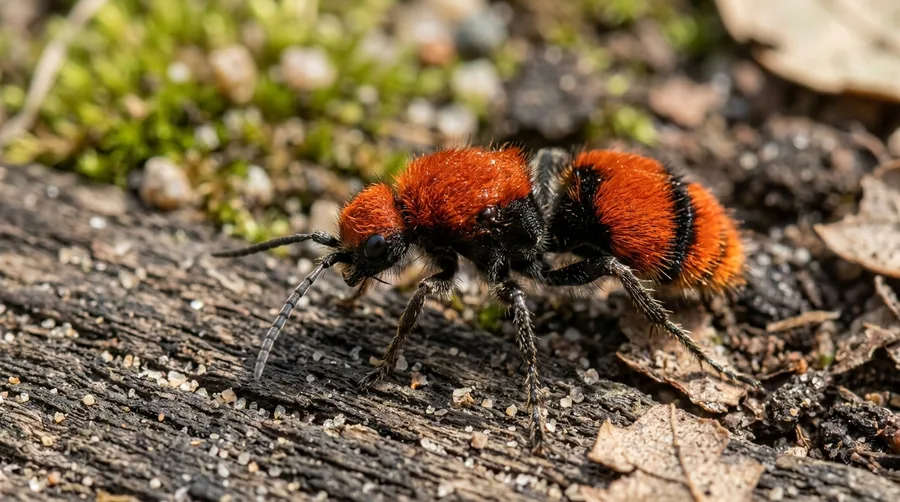
Bright red-orange and black furry velvet ant crawling across bare sandy ground
Recommended Products


What it does
Velvet ants are solitary and are most often seen as wingless females scurrying across open ground in summer. They are not aggressive and do not swarm or defend a nest, but a handled or trapped female can deliver a famously painful sting, which gives the 'cow killer' its exaggerated name. Males have wings and cannot sting.
Where it lives
They favor sunny, open, sandy or well-drained areas: lawns, pastures, gardens, roadsides, and desert scrub. Females roam the ground searching for the burrows of ground-nesting bees and wasps to parasitize. Velvet ants are most common in the southern and southwestern US and are seen singly rather than in groups.
How it breeds
Velvet ants are external parasites of other ground-nesting bees and wasps. A female enters a host's burrow and lays an egg on the host larva or pupa; her larva then consumes the host before pupating and emerging as an adult. There is generally one generation per year, and the wasps do not build nests of their own.
What it eats
Adult velvet ants feed on nectar and water. The larvae are parasitic, feeding on the larvae or pupae of ground-nesting bees and wasps inside the host's burrow, which is how the species reproduces without building a nest of its own.
Identification
Velvet ants are ant-sized to nearly an inch, densely covered in bright fur, usually red-orange and black, that makes them look velvety. The wingless females are the ones seen on the ground and resemble large hairy ants, but the constricted wasp waist and hard body give them away. Males have wings and look more wasp-like.
Signs of an infestation
- A single furry red-and-black 'ant' crawling across open ground
- The insect seen alone rather than in a trail like true ants
- A squeaking sound the insect makes when disturbed
- Activity in sunny, sandy yard or garden areas in summer
- No nest, mound, or colony associated with the insect
Prevention tips
- Avoid handling or stepping barefoot on them in sandy areas
- Wear shoes when walking on lawns and sandy ground in summer
- Teach children not to pick up brightly colored fuzzy 'ants'
- Reduce populations of the ground bees and wasps they parasitize
- Simply let them pass, since they are solitary and short-lived
Professional solutions
Velvet ants almost never require professional control. They are solitary, do not infest homes, and have no nest to treat. If they are frequently entering a yard, reducing the ground-nesting bees and wasps they parasitize helps indirectly. For the rare heavy presence in a play area, a pest professional can suggest targeted options.
Health & safety
The velvet ant's sting is extremely painful, which is the source of its 'cow killer' nickname, but the venom is not medically dangerous and the insect is not aggressive, stinging only when handled or trapped against skin. The main advice is simply not to touch them. Anyone with a known venom allergy should seek care if stung.
Relevant Products


Frequently asked questions
Is a velvet ant really an ant?
No. A velvet ant is actually a wingless female wasp, despite looking like a large, furry ant. The winged males look more like typical wasps. The 'ant' name comes only from the females' appearance as they crawl along the ground alone rather than in ant-like trails.
Why is it called a 'cow killer'?
The nickname comes from the female's intensely painful sting, exaggerated in folklore to be strong enough to kill a cow. In reality the sting is very painful but not medically dangerous or deadly. Velvet ants only sting if they are handled or trapped, so the simplest protection is not to touch them.
Do velvet ants infest homes?
No. Velvet ants are solitary, live outdoors, and have no nest or colony to infest a house. They occasionally wander into a yard or garage while searching for the ground-nesting bees and wasps they parasitize, but they do not establish indoors and rarely need any control.
Fact-checked by Morgan Vance, Editorial Director (editorial review, not a professional pest-control or medical sign-off). Last reviewed May 23, 2026. We correct anything a reader shows us is wrong — see our corrections policy.