
European Hornet
Vespa crabro · also called european hornets, brown hornet, giant hornet
Quick answer
The European hornet (Vespa crabro) is the only true hornet in North America, a large brown-and-yellow wasp up to 1.5 inches long. It nests in hollow trees, wall voids, and attics, forages at night, and is drawn to lights. It stings to defend the nest but is not especially aggressive away from it.
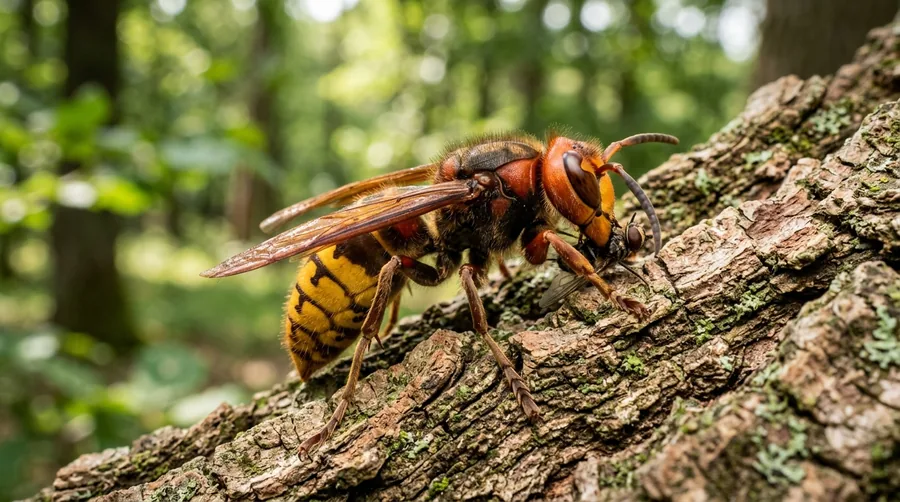
Large brown and yellow European hornet resting on tree bark at the entrance to a wall void
Recommended Products


What it does
European hornets are less aggressive than yellowjackets but will defend their nest vigorously and can sting repeatedly. Unusually among wasps, they forage at night and are attracted to porch lights and lit windows, sometimes alarming homeowners by bumping the glass. They hunt large insects and also strip bark from shrubs and trees for sap.
Where it lives
They nest in dark, enclosed cavities: hollow trees, wall voids, attics, barns, hollow porch columns, and abandoned outbuildings, often with a papery envelope built inside the cavity. Introduced from Europe, they are now established across much of the eastern and central US, favoring wooded suburban and rural areas.
How it breeds
A single overwintered queen begins the nest in spring and rears the first workers, who then expand it. The colony grows through summer to a few hundred workers. In fall, new queens and males are produced; only mated queens overwinter in sheltered spots, and the original nest dies out and is not reused the next year.
What it eats
Adults feed on tree sap, nectar, and fallen fruit, and prey on large insects such as grasshoppers, flies, and other wasps to feed the larvae. Their habit of girdling twigs and shrubs to reach sap can damage ornamental plants and lilacs.
Identification
European hornets are large, 1 to 1.5 inches, with a brown thorax, a yellow-and-brown banded abdomen, and reddish-brown markings, giving them a more amber tone than the black-and-yellow yellowjacket. Their large size and night flying are strong clues. They are much bigger than paper wasps or yellowjackets.
Signs of an infestation
- Large hornets flying at night around porch lights and windows
- Hornets entering a gap in a wall, soffit, or hollow tree
- Stripped bark or girdled twigs on shrubs and ornamental trees
- A papery nest visible inside an attic, void, or hollow trunk
- Loud, heavy-bodied wasps active around the home at dusk
Prevention tips
- Seal cracks and gaps into wall voids, soffits, and attics
- Screen or cap hollow porch columns, vents, and chimneys
- Reduce outdoor lighting or use bulbs less attractive to insects
- Cover garbage and clean up fallen fruit that draws foragers
- Inspect outbuildings and hollow trees for nests in early summer
Professional solutions
Nests inside wall voids, attics, or hollow trees are difficult and risky to treat and are best handled by a professional who can reach and treat the concealed cavity safely. Sealing the opening without treating the nest can drive hornets into living spaces. DIY treatment is not advised for concealed nests or for anyone with a sting allergy.
Health & safety
The European hornet's sting is painful and it can sting repeatedly, though it is less prone to sting than a yellowjacket. For most people a sting causes pain and swelling; for those allergic to wasp venom it can cause a severe reaction. Get emergency care for breathing trouble, widespread swelling, dizziness, or multiple stings.
Relevant Products




Frequently asked questions
Why is a large hornet flying around my lights at night?
European hornets are unusual among wasps because they forage at night and are strongly attracted to lights. Seeing a big brown-and-yellow hornet bumping a lit window or porch light is a classic sign of this species. Reducing outdoor lighting and sealing entry gaps helps limit the nuisance.
Is the European hornet the same as the 'murder hornet'?
No. The European hornet has been established in the US for over a century and is a different species from the northern giant hornet (once nicknamed 'murder hornet'). European hornets are large but not the invasive Asian species, and they are not a major threat to honey bee colonies in the same way.
Can I treat a European hornet nest myself?
It is usually not advisable. European hornets typically nest hidden inside wall voids, attics, or hollow trees, which are hard to reach and risky to disturb. Sealing the hole without treating the nest can force hornets indoors. A professional can locate and treat the concealed nest safely.
Fact-checked by Morgan Vance, Editorial Director (editorial review, not a professional pest-control or medical sign-off). Last reviewed June 8, 2026. We correct anything a reader shows us is wrong — see our corrections policy.