

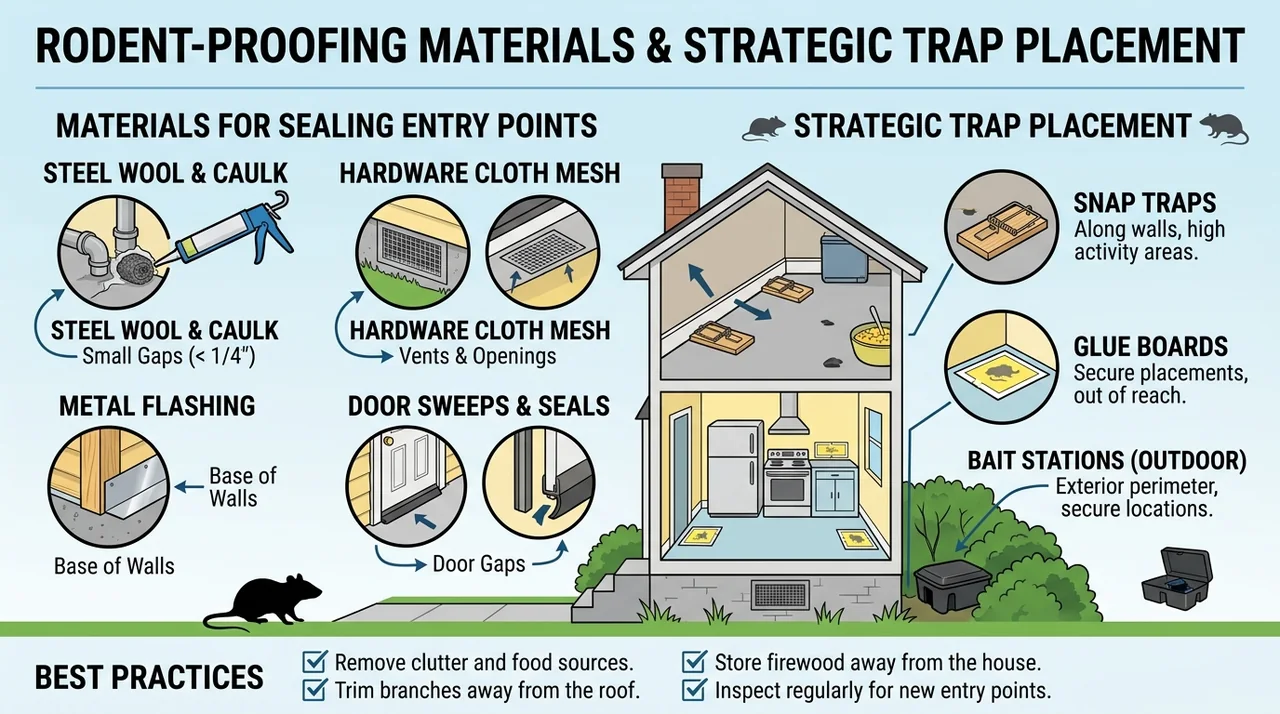


Rodent-proofing succeeds or fails on details: whether the material you stuffed in a gap can be chewed through, and whether your traps sit where rodents actually travel. This guide gets specific about which materials stop rodents and how to position traps for the best catch rate, building on the sealing-and-trapping overview in this section.
Materials That Actually Stop Rodents
Rodents have strong, continuously growing incisors and will gnaw through soft materials. The rule is simple: use metal or masonry for anything a rodent can reach, and never rely on soft filler alone.
- Coarse steel wool or copper mesh packed tightly into small gaps, then sealed over with caulk or foam to hold it in place. The metal fibers are what stop the rodent; the caulk just anchors them. Copper mesh resists rust and is a good choice in damp spots.
- Hardware cloth, quarter-inch galvanized metal mesh, cut and fastened over vents, weep holes, and larger openings so air still flows but rodents cannot pass.
- Sheet metal or metal flashing over chewed door corners, thresholds, and along the base of wooden structures.
- Cement, mortar, or concrete patch for foundation cracks and gaps in masonry.
- Door sweeps and metal-edged thresholds to close the gap under doors.
Trap Placement That Catches Rodents
The best trap in the wrong spot catches nothing. Rodent behavior dictates placement:
- Against the wall, perpendicular to it, with the trigger closest to the baseboard, so a rodent following the wall runs directly onto the trigger. For long snap traps, some setters place two back-to-back so a rodent is caught coming from either direction.
- Along established runways, identified by droppings, dark grease-rub marks, gnaw damage, and tracks.
- In concealed, sheltered spots rodents prefer: behind and under appliances, inside lower cabinets, along garage and basement walls, and in the attic if there is activity.
- Spaced appropriately: for mice, every few feet in active areas; for rats, which are more cautious, fewer traps spaced farther apart, sometimes left baited but unset for a few days first so wary rats lose their fear before you arm them.
Bait, Safety, and Follow-Through
Use small amounts of a sticky bait such as peanut butter, or nesting material like cotton, so the animal must tug and trigger the trap. Avoid over-baiting, which can let a rodent feed without setting off the trigger. Keep traps and any bait away from children and pets, using enclosed trap stations in accessible areas. Wear gloves to handle traps and carcasses, bag them for disposal, and avoid raising dust from droppings. Continue trapping until activity ceases, then maintain a few sentinel traps along known runways so a returning rodent is caught early. If you use rodenticides, follow the EPA-approved label exactly, deploy them only in tamper-resistant bait stations, and for any accidental exposure call Poison Control at 1-800-222-1222.