

Do all ants sting?
No. Stinging is not a universal ant trait. Ants come from the same insect order as bees and wasps. Only some kept the ancestral stinger. That stinger is a needle-like organ at the tip of the abdomen, and it injects venom. Many of the ants people meet indoors cannot sting at all. These include odorous house ants and Argentine ants. They may pinch with their jaws or spray a little formic acid. That is why a "bite" from these ants is usually mild and quickly forgotten.
Which ants sting, and how bad is it?
A handful of species in the United States deliver a genuine sting:
Fire ants
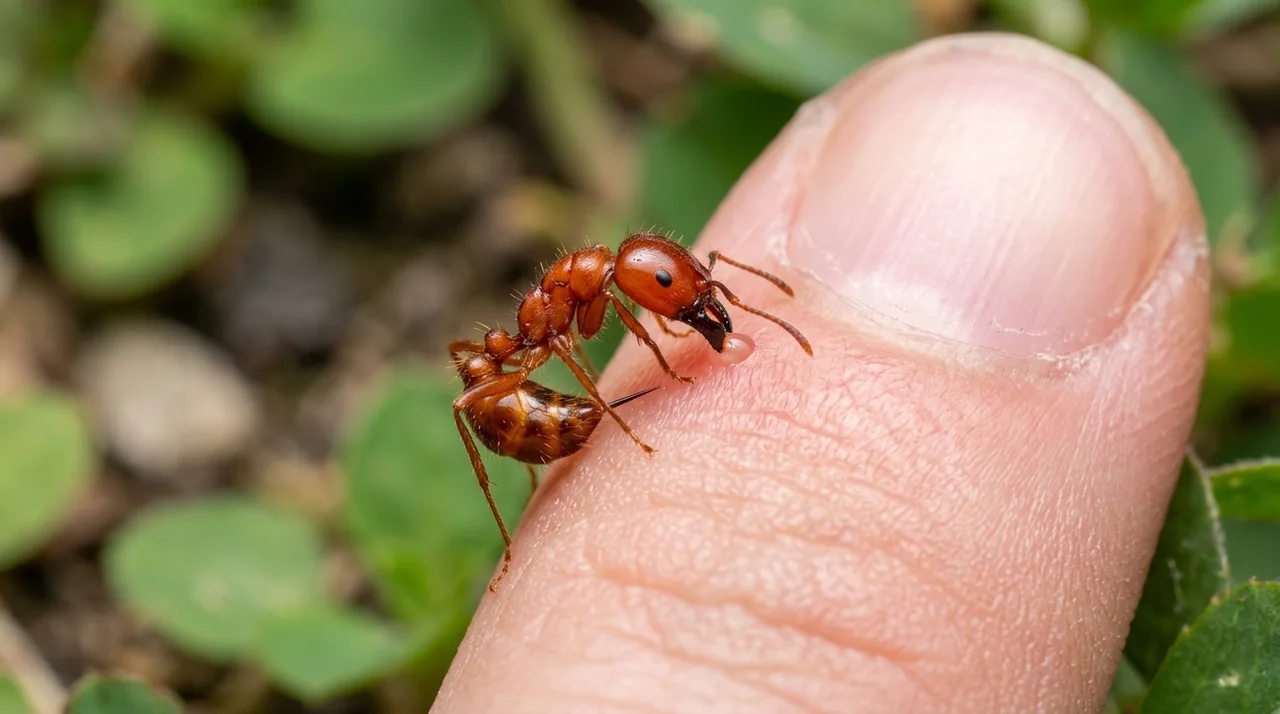
The red imported fire ant (Solenopsis invicta) is the most notorious. A fire ant grips the skin with its jaws for leverage. Then it pivots and stings several times in a circle. You feel an immediate burning sensation. Within a day or so, a raised, itchy, white-topped pustule forms. Fire ants defend their mounds fiercely. They can swarm quickly when the nest is disturbed.
Harvester ants and others
Harvester ants (Pogonomyrmex) deliver a sharp, painful sting, used mainly in defense. But they are far less aggressive than fire ants. They usually sting only when handled. A few other species can sting, though most people never notice.
What is the difference between an ant bite and an ant sting?
The words are often used interchangeably, but they describe different actions. A bite uses the mandibles (jaws) to pinch. Most ants can do this, and it rarely breaks skin. A sting injects venom through the abdomen. This is what causes the burning pain and pustules linked to fire ants. Knowing the difference helps. Say you have a cluster of itchy, blister-like bumps after standing near a mound. You were almost certainly stung, not bitten.
How do I treat an ant sting at home?
Most ant stings can be managed with simple care:
- Wash the area with soap and water.
- Apply a cold pack to ease burning and swelling.
- Use an over-the-counter anti-itch cream or an oral antihistamine for relief.
- Leave fire ant pustules alone. Scratching them open invites infection.
When is an ant sting a medical emergency?
A small number of people are allergic to fire ant venom. For them, a severe reaction is a medical emergency. Call 911 immediately if someone has any of these signs after being stung: trouble breathing; swelling of the face, lips, tongue, or throat; dizziness or fainting; a rapid heartbeat; or widespread hives spreading beyond the sting sites. People who know they are allergic to insect stings should carry any medication their doctor prescribes. They should seek care right away.
How do I avoid getting stung?
Prevention is mostly about awareness and colony control:
- Watch where you step, sit, and set down bags outdoors, especially in warm months.
- Keep fire ant mounds away from lawns, patios, and children's play areas. Treat them with a fire-ant bait per the EPA-registered label.
- Wear closed shoes, and consider gloves when gardening near known mounds.