Red Imported Fire Ant
Solenopsis invicta · also called fire ant, RIFA, red fire ant
Quick answer
The red imported fire ant (Solenopsis invicta) is an aggressive reddish-brown ant that builds dome-shaped dirt mounds across the South. Disturb a mound and hundreds swarm out to sting, causing a burning welt that forms a white pustule. Stings can trigger severe allergic reactions in sensitive people.
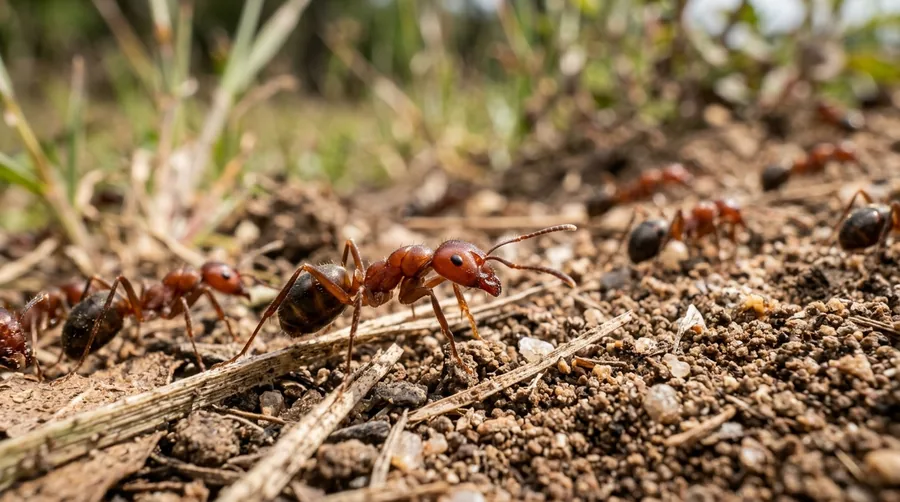
Reddish-brown red imported fire ants swarming a dome-shaped dirt mound in a lawn
Recommended Products
See the full ranking →

What it does
Red imported fire ants are highly aggressive when disturbed, boiling out of the mound and stinging in unison. They build dome mounds with no central opening, forage widely, relocate mounds after rain, and are drawn to electrical equipment, where they can cause shorts.
Where it lives
They favor open, sunny areas: lawns, pastures, roadsides, parks, and ground near foundations. Mounds form in soil, but they also nest in wall voids, electrical boxes, and air-conditioning units. They are established across the Southeast, Gulf Coast, and into the Southwest.
How it breeds
Colonies have one or multiple queens, and a queen can lay thousands of eggs. Winged reproductives swarm after rains to mate and found new mounds. Colonies grow to roughly 100,000 to 250,000 or more workers over time.
What it eats
Fire ants are omnivorous, eating insects, seeds, sweets, proteins, and oils. They tend aphids for honeydew and scavenge dead animals, and readily forage on pet food and household scraps left outdoors.
Identification
Workers are small reddish-brown ants of varying size within one nest, with a two-segmented waist and 10-segmented antennae ending in a two-segmented club. The dome-shaped dirt mound with no visible central opening, plus aggressive swarming, is the clearest field sign.
Signs of an infestation
- Dome-shaped dirt mounds, often appearing after rain
- Aggressive swarming when a mound is disturbed
- Painful stings that form white pustules
- Ants trailing to food and pet bowls
- Ants nesting in electrical boxes or equipment
Prevention tips
- Treat mounds with EPA-labeled fire ant baits per the label
- Broadcast bait for heavy or widespread infestations per label
- Keep lawns maintained and remove debris that shelters colonies
- Seal foundation gaps and around utility penetrations
- Avoid disturbing mounds, which triggers mass stinging
Professional solutions
Broadcast bait programs and mound treatments are the core of control. Large properties, farms, or repeated stinging incidents warrant a professional or a coordinated, area-wide bait program. Always read and follow the EPA label, and keep children and pets away from treated areas as directed.
Health & safety
Stings cause a burning welt that forms a white pustule, and multiple stings are common. Some people have severe allergic reactions, including anaphylaxis, which is a medical emergency. If someone has trouble breathing, swelling, or dizziness after stings, call 911, and you can reach Poison Control at 1-800-222-1222. Household risk is high.
Relevant Products


Frequently asked questions
What should I do if I'm stung by fire ants?
Move away from the mound, brush off any ants, wash the area, and use a cold compress to ease swelling. Most stings just burn and itch, but if you have trouble breathing, widespread swelling, or dizziness, seek emergency care or call Poison Control at 1-800-222-1222.
Why do fire ant mounds appear after rain?
Rain softens and floods the soil, so colonies push up fresh mound material and relocate near the surface, making mounds more visible after a storm. This is also when swarming reproductives may fly to start new colonies.
Why should I bait fire ants instead of just pouring on insecticide?
Pouring products only on the surface often fails to reach the queen deep in the mound, and it can scatter the colony. EPA-labeled baits are carried down to the queen, which is more effective for lasting control. Always follow the product label.
Fact-checked by Morgan Vance, Editorial Director (editorial review, not a professional pest-control or medical sign-off). Last reviewed May 26, 2026. We correct anything a reader shows us is wrong — see our corrections policy.