


Can ticks jump or fly?
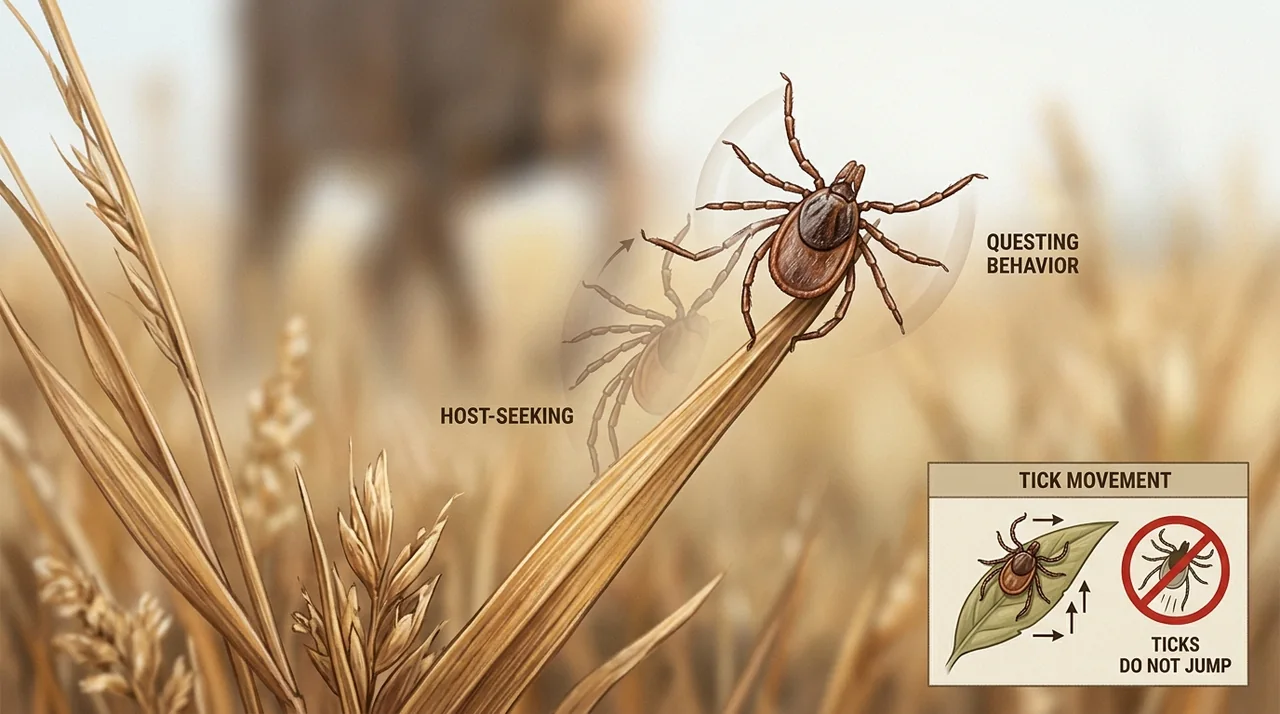
No. Ticks have no wings and cannot jump. This is one of the most useful facts to know about them. They are arachnids, relatives of spiders and mites, and they can only crawl. Every story about a tick leaping onto someone is a misunderstanding of how they actually work. A tick cannot come to you through the air. It has to wait for you to come to it.
What is questing, and how do ticks find hosts?
The waiting behavior is called questing. Take a tick such as the blacklegged (deer) tick (Ixodes scapularis). It climbs to the tip of a grass blade, leaf, or twig. It anchors itself with its back legs and stretches its front legs out into the air. Those front legs carry sensors. They detect the carbon dioxide you exhale, your body heat, vibration, and shadow. When a warm body brushes the vegetation, the tick simply grabs hold and climbs aboard. This is why ticks are most often picked up at ankle, shin, or knee height as you walk through grass or brush.
Do ticks drop from trees onto your head?
This is a common myth, but it is largely untrue. Ticks are not tree-dwellers. They do not fall from branches to target your scalp. Most questing happens low to the ground, in grass, leaf litter, and shrubs. When a tick ends up on your head or neck, it almost always crawled there after latching onto your lower body first. That crawling habit is good news. It gives you time to find and remove a tick before it settles in.
How fast do ticks move, and how long before they attach?
Ticks are slow crawlers. After grabbing on, a tick often wanders over clothing and skin for a while — sometimes an hour or more. It is searching for a warm, protected spot to feed, such as behind the knee, the groin, the waistline, the armpit, or the hairline. This delay is your window. A prompt, thorough body check can catch many ticks before they ever bite. And removing an attached tick sooner lowers the chance of disease transmission.
How do I lower my risk outdoors?
A few simple habits make a real difference in tick country:
- Walk in the center of trails and avoid brushing against tall grass and leaf litter.
- Wear long pants and tuck them into your socks, so questing ticks stay on the outside of your clothing.
- Wear light-colored clothing, which makes crawling ticks easier to spot.
- Use an EPA-registered insect repellent on skin or clothing, following the label directions exactly.
- Do a full-body tick check within a couple of hours of coming indoors, and check children, pets, and gear too.
How do I remove an attached tick?
If you find an attached tick, remove it promptly and correctly:
Skip folk methods like burning the tick or coating it in petroleum jelly. These can cause it to release more fluid into the wound.
When should I see a doctor?
Ticks can transmit Lyme disease and several other illnesses. So watch the bite area, and how you feel, for a few weeks afterward. Contact your doctor if you develop a rash after a tick bite, especially an expanding "bull's-eye" pattern. Also call for fever, chills, fatigue, headache, or joint aches, or if you could not remove the tick's mouthparts cleanly. Tell your doctor when and where the bite likely happened, as this helps guide care.