


Spiders are arachnids, not insects
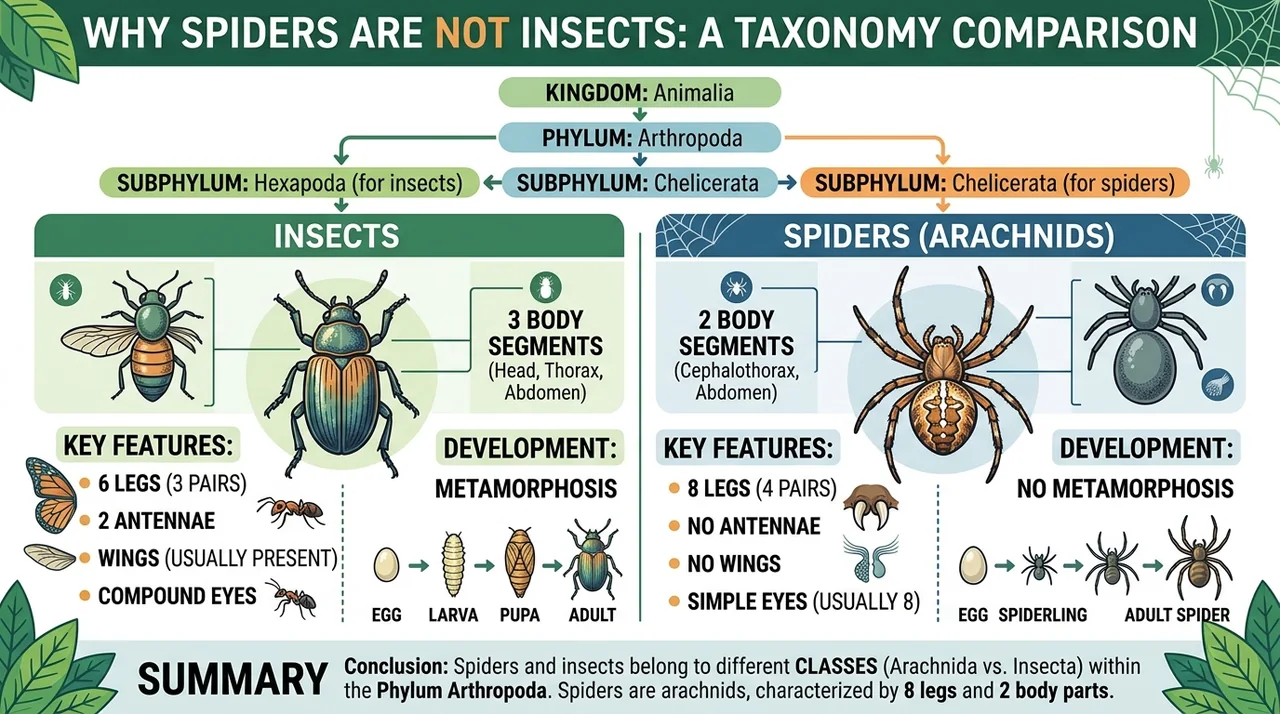
Spiders and insects are both arthropods, with jointed legs and hard exoskeletons. But spiders belong to a different class called Arachnida. That group also includes ticks, mites, scorpions, and harvestmen. This is not just a technicality. Spiders and insects (class Insecta) differ in several clear, easy-to-see ways.
What's the difference between a spider and an insect?
The easiest way to tell the two groups apart is to look at the body and count the legs:
- Legs: spiders have eight; insects have six
- Body segments: spiders have two (a fused head-and-thorax called the cephalothorax, plus an abdomen); insects have three (head, thorax, abdomen)
- Antennae: insects have them; spiders do not
- Wings: many insects fly; no spider has wings
- Eyes: spiders usually have several simple eyes, often eight, while insects typically have compound eyes
Are all spiders dangerous?
No. The great majority of spiders are harmless to people. Their fangs are too small, or their venom too mild, to cause more than minor, short-lived irritation if they bite at all. In the United States, only a small number of species are considered medically significant. These are chiefly widow spiders and the recluse group. Even those bite defensively and rarely. This is general information, not medical advice. If you develop a spreading wound, severe pain, or signs of a strong reaction after a suspected bite, contact a healthcare provider. For questions about symptoms or medications, you can call Poison Control at 1-800-222-1222.
Are spiders helpful or harmful indoors?
Most household spiders are quietly helpful. As predators, they feed on flies, mosquitoes, and other insects. In effect, they act as natural pest control. Common indoor spiders such as the common house spider and the cellar spider are shy and prefer to stay out of the way. If you would rather keep them out, the simplest long-term approach has three parts. Reduce the insects they hunt, seal gaps around doors and windows, and clear away webbing so the space is less inviting.
What other creatures are often confused with insects?
The eight-leg rule helps with more than spiders. Ticks and mites are also arachnids, not insects. That is why an adult tick has eight legs like a spider rather than six. This matters for pest identification. A tick is an arachnid, closely related to spiders, so insect-focused assumptions about it can be misleading. Scorpions and harvestmen (daddy longlegs) round out the familiar arachnids. Some many-legged crawlers get lumped in with "bugs," such as centipedes and millipedes. They are neither insects nor arachnids. They belong to still other arthropod groups entirely.
Common spider myths
Several widely repeated claims do not hold up:
- "You swallow spiders in your sleep." There is no good evidence for this; spiders avoid a warm, breathing, moving sleeper.
- "All spiders make webs to catch prey." Many, such as wolf spiders and jumping spiders, actively hunt instead of spinning snares.
- "Every spider bite needs treatment." Most suspected spider bites turn out to be other skin conditions, and true bites usually clear up on their own.