
Jumping Spider
Family Salticidae · also called jumping spiders, bold jumper, salticid
Quick answer
Jumping spiders (family Salticidae) are small, compact, often fuzzy spiders famous for their large forward-facing eyes and their ability to leap on prey. Active by day, they hunt insects without webs and are curious rather than aggressive. Harmless to people and beneficial in the garden, they are among the most agile and visually acute spiders.
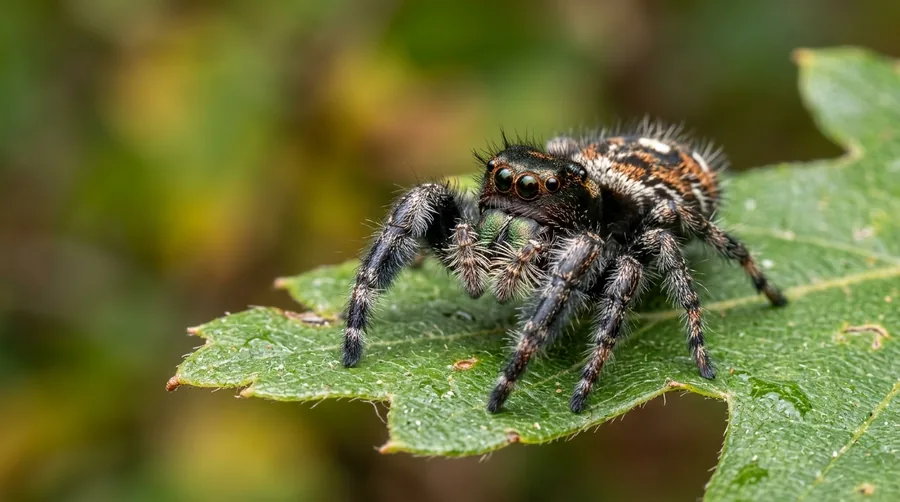
Small fuzzy black jumping spider with large forward-facing eyes perched on a leaf
Recommended Products


What it does
Jumping spiders are daytime hunters with exceptional vision. They stalk and pounce on prey, leaping several times their body length and trailing a silk dragline for safety. They are alert and curious, often turning to watch a person, but they are not aggressive and retreat rather than confront, biting only if trapped.
Where it lives
They live on sunlit surfaces where prey is active: exterior walls, fences, window frames, decks, tree trunks, and among plants. Indoors they patrol sunny windowsills and walls. Jumping spiders are found throughout the US and are among the most commonly noticed small spiders because they are active in daylight.
How it breeds
Females lay eggs in a silk retreat, often in a curled leaf, under bark, or in a wall crack, and guard them until the spiderlings hatch. The young disperse and mature over the warm season. Most jumping spiders live about a year, sheltering in silk retreats at night and in cold weather.
What it eats
Jumping spiders prey on insects and other small arthropods, including flies, mosquitoes, and small caterpillars, and occasionally other spiders. As active daytime predators they are beneficial around homes and gardens. They do not feed on people or on household materials.
Identification
They are small and compact with short legs and a distinctive block of four large eyes facing forward, giving a big-eyed appearance, plus smaller eyes on the head. Many are hairy and boldly patterned; the common bold jumper is black with pale abdominal spots. Their jerky, hopping movement is a giveaway.
Signs of an infestation
- A small spider that jumps or hops when approached
- A compact, big-eyed spider active in daylight
- Spiders on sunny walls, windowsills, fences, and decks
- Small silk retreats tucked in cracks or curled leaves
- A spider that turns to face and watch you
Prevention tips
- Vacuum or capture and release individual spiders outdoors
- Seal gaps around windows and doors if entry is a concern
- Reduce indoor insects that provide their food
- Remove small silk retreats from window frames and corners
- Keep screens intact on windows and doors
Professional solutions
Jumping spiders essentially never require professional pest control; they are harmless, beneficial, and present in small numbers. Simple removal and relocation is appropriate. If someone wants fewer spiders overall, reducing the insects they hunt and sealing entry points is far more sensible than chemical treatment for these helpful hunters.
Health & safety
Jumping spiders are harmless to people. A bite is very rare and only defensive, causing at most mild, brief local irritation, and they transmit no disease. Given their appetite for flies, mosquitoes, and other pests, they are best regarded as beneficial and simply relocated outdoors if unwanted.
Relevant Products




Frequently asked questions
Do jumping spiders bite, and is it dangerous?
Jumping spiders can bite defensively if trapped against skin, but bites are very rare and cause at most mild, brief irritation. They have no medically significant venom and carry no disease. They are considered harmless and even beneficial for controlling other insects.
Why does a jumping spider seem to watch me?
Jumping spiders have excellent eyesight from their large forward-facing eyes and will turn to track movement, including people. This curiosity is a hunting adaptation, not aggression. They are simply assessing their surroundings and will usually hop away if you get too close.
Should I get rid of jumping spiders?
There is little reason to. Jumping spiders are harmless and helpful, preying on flies, mosquitoes, and other pests. If one is indoors and unwanted, gently capture and release it outside. Reducing insects and sealing gaps limits how many wander in.
Fact-checked by Morgan Vance, Editorial Director (editorial review, not a professional pest-control or medical sign-off). Last reviewed May 31, 2026. We correct anything a reader shows us is wrong — see our corrections policy.