Cellar Spider
Family Pholcidae · also called cellar spiders, daddy long-legs spider, long-bodied cellar spider
Quick answer
Cellar spiders (family Pholcidae), often called daddy long-legs spiders, are pale spiders with tiny bodies and very long, thin legs that hang in loose, tangled webs in basements, garages, and ceiling corners. They are harmless to people, and the popular claim that they have deadly venom too weak to break skin is a myth.
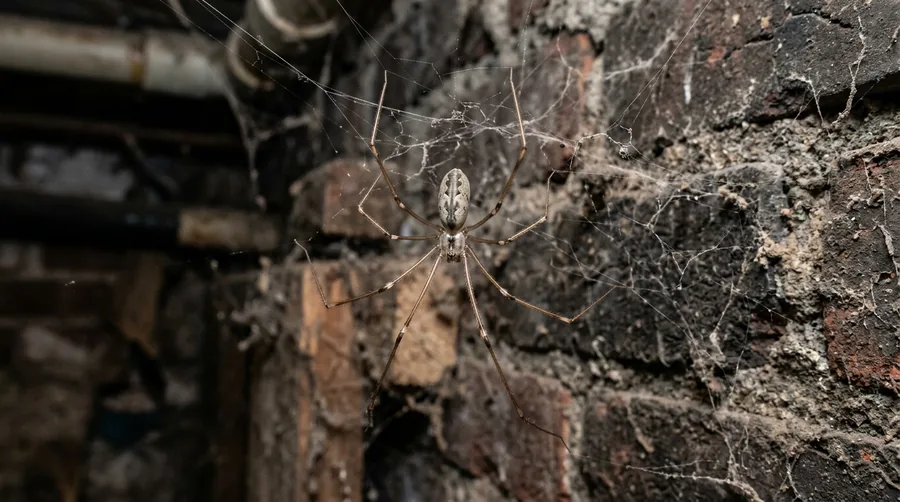
Pale long-legged cellar spider hanging in a loose tangled web in a basement corner
Recommended Products
See the full ranking →


What it does
Cellar spiders hang upside down in loose, irregular webs and, when disturbed, whirl or vibrate rapidly in the web to blur their outline against predators. They build messy webs that accumulate over time. They are harmless and non-aggressive, and are known to prey on other spiders, including some larger ones.
Where it lives
They prefer cool, damp, undisturbed spaces: basements, cellars, crawl spaces, garages, closets, and high ceiling corners. Their webs collect in quiet, low-traffic areas and gather dust and debris. Cellar spiders are found nationwide and are among the most common web spiders in homes and outbuildings.
How it breeds
The female carries her cluster of eggs in her jaws, wrapped in a thin layer of silk, until the spiderlings hatch, rather than leaving an egg sac in the web. The young disperse and mature over several months. Cellar spiders can live around two years, so their webs persist and expand.
What it eats
Cellar spiders eat insects and other spiders caught in their tangled webs, including some larger or more dangerous spiders, which makes them beneficial. They invade other spiders' webs to take the resident spider as prey. They do not feed on people.
Identification
They have small oval or elongated bodies and extremely long, thin, delicate legs, and are pale tan, gray, or translucent. They are often confused with harvestmen (true daddy long-legs), which are not spiders and have a single fused body. The loose, messy web and vibrating behavior help identify cellar spiders.
Signs of an infestation
- Loose, tangled, messy webs in ceiling corners and basements
- Pale, long-legged spiders hanging upside down in webs
- Spiders that vibrate rapidly when the web is disturbed
- Accumulating dusty webbing in low-traffic areas
- Concentration in damp, cool basements, garages, and crawl spaces
Prevention tips
- Remove webs regularly with a vacuum or broom
- Reduce indoor humidity in basements and crawl spaces
- Seal gaps around windows, doors, and the foundation
- Reduce clutter that provides undisturbed web sites
- Cut down insects that draw spiders by managing lights and entry points
Professional solutions
Cellar spiders almost never need professional treatment because they are harmless and easy to manage. Routine web removal, reducing humidity, and sealing gaps keep numbers down. If a homeowner wants broader spider control, a professional can apply EPA-labeled perimeter treatments, but that is rarely warranted for cellar spiders alone.
Health & safety
Cellar spiders are harmless to people. The widespread claim that they have extremely potent venom but fangs too small to bite is a myth; their venom is not dangerous to humans and they very rarely bite. They pose no disease risk and are beneficial, preying on other insects and spiders indoors.
Relevant Products




Frequently asked questions
Is it true cellar spiders are the most venomous spider but can't bite?
No, that is a well-known myth. Cellar spiders do not have uniquely powerful venom, and studies have not shown their venom to be dangerous to people. They can bite but almost never do, and any bite would be harmless. The claim has been repeatedly debunked.
Are cellar spiders and daddy long-legs the same thing?
Not exactly. 'Daddy long-legs' is used for both cellar spiders and harvestmen. Cellar spiders are true spiders with two body segments and webs. Harvestmen have a single fused body and no web or venom for prey. Both are harmless to people.
How do I get rid of cellar spiders?
Vacuum away their webs regularly, reduce basement and crawl-space humidity, seal entry gaps, and cut down the insects that attract them. Because they are harmless and prey on other spiders, chemical treatment is rarely necessary; consistent web removal usually keeps them in check.
Fact-checked by Morgan Vance, Editorial Director (editorial review, not a professional pest-control or medical sign-off). Last reviewed July 19, 2026. We correct anything a reader shows us is wrong — see our corrections policy.