Harvestman
Opiliones (order) · also called daddy longlegs, daddy-longlegs, harvestmen
Quick answer
The harvestman (order Opiliones), or daddy-longlegs, is a round-bodied arachnid with long legs that is not a spider. It has no venom glands, no fangs that can pierce skin, and no silk. The claim that it is the world's most venomous animal is a myth. It is entirely harmless and eats small insects.
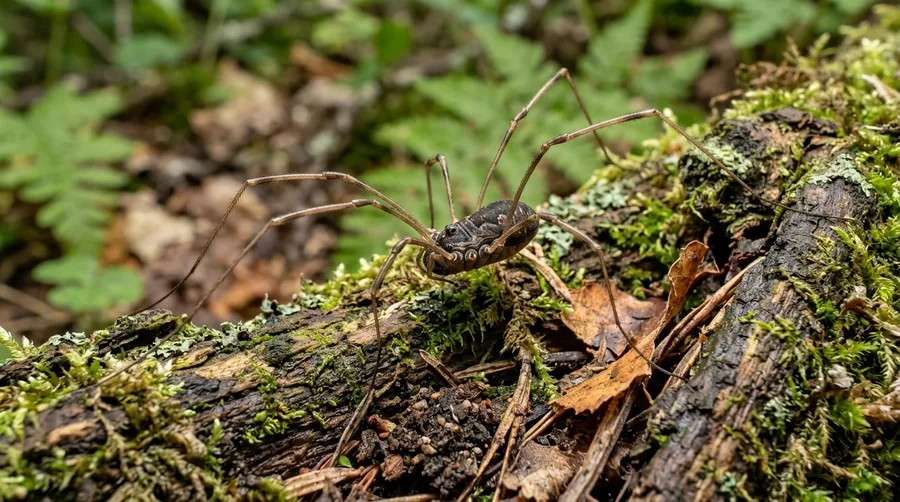
Small round-bodied harvestman with very long thin legs on a shaded wall
Recommended Products


What it does
Harvestmen are slow-moving, non-aggressive arachnids that scavenge and hunt tiny prey. They cannot spin webs and do not build them. When threatened they may bob their bodies, play dead, release a mild defensive odor, or drop a leg to escape. They often gather in loose clusters in humid, sheltered spots and are harmless to people.
Where it lives
They live in gardens, leaf litter, woodpiles, and on shaded walls, fences, and foundations, favoring damp, cool spots. Indoors they turn up in basements, garages, crawl spaces, and shaded corners, especially in late summer and fall. They are found nationwide and are among the most familiar backyard arachnids.
How it breeds
Most species live about a year. Females lay eggs in soil or damp crevices in fall, and these hatch into nymphs that resemble tiny adults and molt several times as they grow. In much of the country a single generation matures over the season, with adults most visible in late summer and autumn.
What it eats
Harvestmen are omnivores, feeding on small insects, mites, aphids, and other tiny invertebrates, as well as decaying plant and animal matter and fungi. This diet makes them modest natural helpers in gardens rather than a threat to plants or people.
Identification
A harvestman has a single, oval, one-piece body (no visible 'waist') with two eyes on a small turret and, usually, extremely long thin legs. This one-piece body separates it from true spiders, which have two body segments. Note that 'daddy longlegs' is also used for cellar spiders and crane flies, which are different animals.
Signs of an infestation
- Small round-bodied arachnids with very long legs on walls
- Loose clusters in shaded, humid corners
- No webs present, since harvestmen do not spin silk
- Sightings increasing in late summer and fall
- Harmless individuals in basements, garages, and gardens
Prevention tips
- Reduce dampness in basements, crawl spaces, and garages
- Clear leaf litter, woodpiles, and debris from against the house
- Seal gaps around doors, windows, and the foundation
- Sweep or gently relocate individuals rather than spraying
- Reduce exterior lighting that attracts the insects they eat
Professional solutions
Harvestmen almost never need professional control. They are beneficial, harmless, and easily swept up or guided outside. If large numbers gather in a damp basement or crawl space, reducing moisture and clutter resolves it. Pesticides are unwarranted for an animal that poses no risk and helps control smaller pests.
Health & safety
There is a persistent myth that daddy-longlegs are the most venomous creatures alive but cannot bite through skin. For true harvestmen this is doubly false: they have no venom glands at all and no fang-like mouthparts capable of injecting anything. They cannot harm people or pets, carry no disease, and are entirely safe to be around.
Relevant Products




Frequently asked questions
Are daddy-longlegs the most venomous spiders in the world?
No, this is a well-known myth. True harvestmen are not even spiders, and they have no venom glands and no fangs capable of piercing skin. They cannot poison or meaningfully bite a person. The claim is false, and harvestmen are completely harmless.
Is a harvestman a spider?
No. A harvestman (Opiliones) has a single one-piece body, two eyes, no venom, and no silk glands, while true spiders have two body segments, venom, and spin webs. 'Daddy longlegs' is also used loosely for cellar spiders and crane flies, which are different creatures.
Fact-checked by Morgan Vance, Editorial Director (editorial review, not a professional pest-control or medical sign-off). Last reviewed May 30, 2026. We correct anything a reader shows us is wrong — see our corrections policy.