
Fishing Spider
Dolomedes spp. · also called fishing spiders, dock spider, raft spider
Quick answer
The fishing spider (Dolomedes species) is a large brown, mottled spider that lives near ponds and streams, where it can run across water and dive to catch prey. Some wander into homes and basements, especially near water. It looks alarming and resembles a big wolf spider, but it is shy and not dangerous.
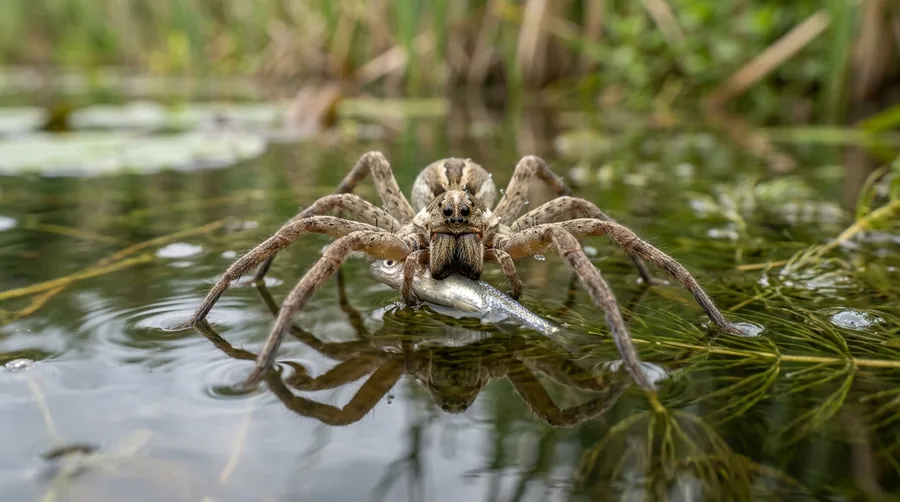
Large brown mottled fishing spider with long legs perched at the edge of still water
Recommended Products


What it does
Fishing spiders are semi-aquatic ambush hunters. They perch at the water's edge with front legs on the surface, sensing ripples, then sprint across the water or dive under it to seize prey. They do not build snare webs to catch food. They are shy and flee from people, biting only if trapped or handled.
Where it lives
They live along the margins of ponds, lakes, streams, and wetlands, on docks, rocks, and shoreline vegetation. Some species, like the dark fishing spider, range well away from water onto tree trunks and into homes. Indoors they appear in basements, garages, and bathrooms, often near moisture. They occur across the US.
How it breeds
There is generally one generation a year. The female carries her large round egg sac in her jaws, then builds a silken nursery web among vegetation and guards the spiderlings after they hatch. Young mature over the season; adults are most visible in the warmer months near water.
What it eats
Fishing spiders eat aquatic and terrestrial insects, and larger individuals occasionally take tiny fish, tadpoles, and other small aquatic animals. Away from water they hunt insects and other spiders. Their prey capture relies on speed and ambush rather than webs.
Identification
These are large spiders, with a body around 15-26 mm and a leg span that can reach about 75 mm (roughly 3 inches). They are brown to grayish with mottled bands and pale markings, closely resembling wolf spiders. Being found near water, and their ability to run on the surface, help distinguish them.
Signs of an infestation
- A large mottled spider near a pond, dock, or shoreline
- Big spiders appearing in basements, garages, or bathrooms
- Spiders resting on walls or tree trunks near water
- A female carrying a round egg sac or guarding a nursery web
- No snare web, since they hunt rather than trap prey
Prevention tips
- Seal gaps around basement windows, doors, and the foundation
- Reduce indoor dampness in basements and crawl spaces
- Clear shoreline clutter and vegetation against the house
- Remove insect prey by managing exterior lighting
- Capture and release indoor spiders outdoors rather than crushing them
Professional solutions
Fishing spiders rarely need professional control. Individuals that wander indoors are easily captured with a cup and card and released outside. If they enter repeatedly, exclusion and reducing moisture and prey insects near the home resolve it. General perimeter pest treatment that lowers their insect prey can indirectly reduce sightings.
Health & safety
Fishing spiders are not aggressive and are not considered dangerous to people. Like nearly all spiders they have venom to subdue prey, and a bite (only if handled or trapped) can cause temporary local pain, redness, and swelling, similar to a bee sting, without serious effects for most people. Seek medical care if a reaction is severe or spreading.
Relevant Products




Frequently asked questions
Are fishing spiders dangerous or venomous?
Fishing spiders have venom to subdue prey but are not considered dangerous to people. They are shy and bite only if handled or trapped, and a bite typically causes brief local pain and swelling like a bee sting. Seek medical care only if a reaction is severe or spreading.
Why is there a huge spider in my basement near the water heater?
Fishing spiders are drawn to moisture and sometimes wander indoors, turning up in damp basements, garages, and bathrooms, especially if your home is near a pond or stream. They are harmless; capture with a cup and card and release outside, then seal gaps and reduce dampness.
Fact-checked by Morgan Vance, Editorial Director (editorial review, not a professional pest-control or medical sign-off). Last reviewed June 26, 2026. We correct anything a reader shows us is wrong — see our corrections policy.