
Grass Spider
Agelenopsis spp. · also called grass spiders, funnel weaver, funnel-web grass spider
Quick answer
Grass spiders (Agelenopsis species) are fast brown funnel-weavers that build sheet-like webs with a funnel retreat in lawns, shrubs, and along foundations. Their dew-covered webs are a familiar morning sight on grass. They are quick to flee, harmless to people, and beneficial, catching insects that wander onto the web sheet.
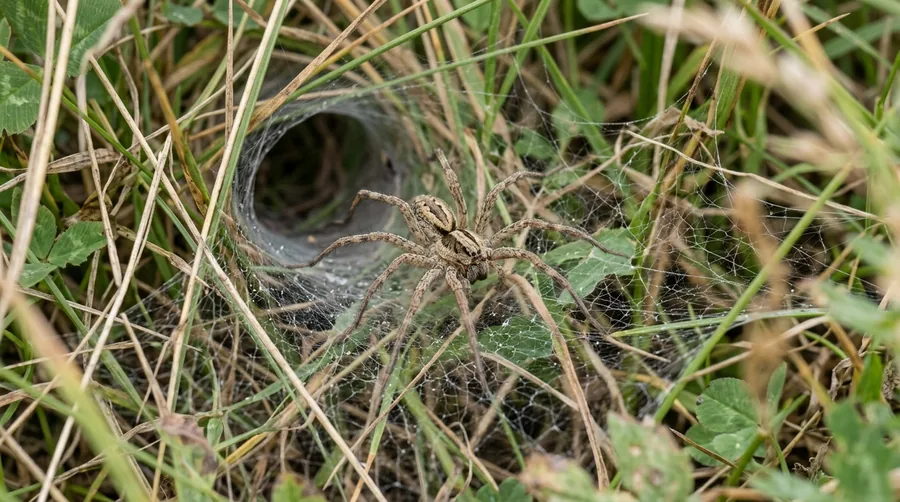
Brown grass spider with long spinnerets at the mouth of a sheet funnel web in dewy grass
Recommended Products
See the full ranking →


What it does
Grass spiders build a horizontal, sheet-like web with a funnel retreat at one edge, waiting inside for insects to land on the sheet, then dashing out to seize them. They are extremely fast and shy, retreating into the funnel or fleeing when approached. They do not chase or menace people and bite only if trapped.
Where it lives
Their sheet-and-funnel webs blanket lawns, ground cover, shrubs, and the base of foundations, steps, and window wells, and are most obvious on dewy mornings. Grass spiders live outdoors and only occasionally wander inside near ground level. They occur throughout the US in yards and gardens.
How it breeds
Females produce a disc-shaped egg sac in fall, often attaching it to bark, siding, or sheltered surfaces, and typically die with the first hard frosts. Spiderlings emerge in spring and grow through summer, building progressively larger funnel webs and maturing by late summer, completing a one-year cycle.
What it eats
Grass spiders prey on insects that stumble onto the web sheet, including ants, beetles, flies, and other small arthropods. They rely on speed rather than sticky silk to catch prey. As predators of lawn and garden insects, they are beneficial and do not feed on people.
Identification
They are brown to grayish with two lengthwise dark stripes on the front body section and often a patterned abdomen, resembling small wolf or hobo spiders. A distinctive feature is a pair of long spinnerets projecting from the rear. The sheet web with a side funnel is the clearest identifier.
Signs of an infestation
- Flat, sheet-like webs with a funnel retreat in grass and shrubs
- Webs made obvious by dew on cool mornings
- A fast brown spider darting into a funnel when disturbed
- Webs along foundations, steps, and low vegetation
- Long spinnerets visible projecting from the rear
Prevention tips
- Trim grass, ground cover, and shrubs near the foundation
- Remove webs from doorways, steps, and window wells
- Seal gaps at ground level to limit indoor wandering
- Reduce outdoor lighting that draws their insect prey
- Keep leaf litter and debris cleared from along the house
Professional solutions
Grass spiders seldom require professional treatment because they are harmless, beneficial, and stay outdoors. Trimming vegetation and clearing webs near entries manages them easily. If ground-level entry becomes a nuisance, a professional can apply an EPA-labeled perimeter treatment and advise on sealing, though this is rarely necessary for grass spiders.
Health & safety
Grass spiders are not dangerous to people. They are shy and fast to flee, and a rare defensive bite causes only minor, short-lived local irritation, with no medically significant venom or disease. As active predators of yard insects, they are beneficial and are best left alone outdoors.
Relevant Products




Frequently asked questions
Are grass spiders dangerous to people or pets?
No. Grass spiders are harmless and shy, fleeing rather than confronting. A rare defensive bite causes only minor local irritation, with no medically significant venom or disease risk. They are beneficial, preying on insects in lawns and gardens, and are best left alone.
What are all the funnel webs in my lawn?
Those flat, sheet-like webs with a funnel at one edge, most visible with morning dew, are made by grass spiders. The spider waits in the funnel and rushes out to catch insects that land on the sheet. They are harmless and help control yard pests.
How can I tell a grass spider from a hobo spider?
They look very similar, but grass spiders (Agelenopsis) have prominent long spinnerets projecting from the rear and two dark lengthwise stripes on the front body. Reliable separation from hobo spiders often needs magnification and a specialist, since the two are easily confused.
Fact-checked by Morgan Vance, Editorial Director (editorial review, not a professional pest-control or medical sign-off). Last reviewed July 20, 2026. We correct anything a reader shows us is wrong — see our corrections policy.