
Cottony Cushion Scale
Icerya purchasi · also called cottony cushion scale, fluted scale
Quick answer
Cottony cushion scale (Icerya purchasi) is a soft scale insect famous for the large, white, fluted cottony egg sac the female trails behind her. It sucks sap from citrus and many ornamentals, weakening branches and coating leaves in honeydew and sooty mold. A landmark of biological control, it harms plants, not people.
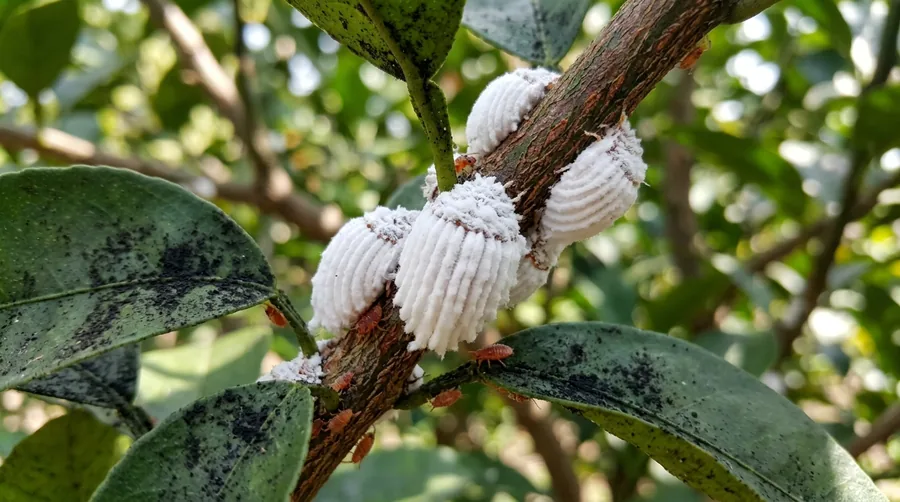
Cottony cushion scale with white fluted egg sacs on a citrus twig
Recommended Products


What it does
Females settle on twigs, branches, and leaf veins to suck sap, then secrete a distinctive ribbed white egg sac two to three times their body length. Mobile young crawlers spread to new growth. Heavy feeding drains vigor, yellows leaves, and drips honeydew that grows black sooty mold, dulling foliage.
Where it lives
Cottony cushion scale attacks citrus most notably, plus pittosporum, acacia, rose, boxwood, magnolia, and many ornamentals. It favors warm regions and is common in California, the Gulf Coast, Florida, and the Southeast, on landscape and orchard plants outdoors and in greenhouses.
How it breeds
Each hermaphroditic female produces hundreds of red eggs inside the cottony sac. Eggs hatch into crawlers that settle and feed, molting to adults. There are two to three overlapping generations a year in warm climates, so populations can build over a growing season if predators are absent.
What it eats
It feeds solely on plant sap from the twigs, branches, and leaves of its woody hosts. It does not damage structures or stored goods and poses no threat to food in the home.
Identification
The unmistakable feature is the white, fluted (ribbed) egg sac attached to an orange-brown, waxy female, together up to about 15 mm long, on twigs and leaf midribs. Young crawlers are reddish and tiny. The ridged sac separates it from smoother mealybugs and other scales.
Signs of an infestation
- White fluted, ribbed egg sacs on twigs and leaf veins
- Sticky honeydew on leaves and surfaces below
- Black sooty mold coating foliage
- Yellowing leaves and dieback on heavily infested branches
- Ants tending the colonies for honeydew
Prevention tips
- Inspect new nursery plants before bringing them home
- Protect and encourage vedalia beetles and lacewings
- Prune out and destroy heavily encrusted twigs
- Rinse light infestations off with a firm water spray
- Avoid broad-spectrum sprays that kill natural predators
Professional solutions
Cottony cushion scale is a classic biological-control success: the vedalia beetle and a parasitic fly usually keep it in check, so chemical sprays are often unnecessary and can backfire by killing those predators. For heavy cases, horticultural oil applied to crawlers per label, or professional advice, is preferred.
Health & safety
Cottony cushion scale does not bite, sting, or transmit disease to humans or pets. It feeds only on plants, and the cottony material is wax, not a hazard. The only real impact is on plant health and appearance.
Relevant Products


Frequently asked questions
What is the white cottony scale on my citrus tree?
A ribbed white cushion trailing from an orange-brown insect on citrus twigs is cottony cushion scale, and the white part is its egg sac. It sucks sap and drips honeydew. It is a well-known pest usually controlled naturally by the introduced vedalia beetle.
Do I need to spray cottony cushion scale?
Often not. Natural predators, especially the vedalia beetle, usually control cottony cushion scale, and broad sprays can make things worse by killing those beneficial insects. For heavy infestations, horticultural oil timed to the crawler stage per label is the gentler option.
Is cottony cushion scale dangerous to people?
No. It does not bite, sting, or carry disease. It only feeds on plant sap. The concern is the plant's health and the sticky honeydew and sooty mold it produces, not any risk to people or pets.
Fact-checked by Morgan Vance, Editorial Director (editorial review, not a professional pest-control or medical sign-off). Last reviewed May 28, 2026. We correct anything a reader shows us is wrong — see our corrections policy.