Euonymus Scale
Unaspis euonymi · also called euonymus scale
Quick answer
Euonymus scale (Unaspis euonymi) is an armored scale that heavily infests euonymus, pachysandra, and holly. The females are brown and oyster-shaped while the smaller males are white and elongated, often crusting stems and leaves so densely they look whitewashed. It weakens and can kill plants but does not bite, sting, or affect people.
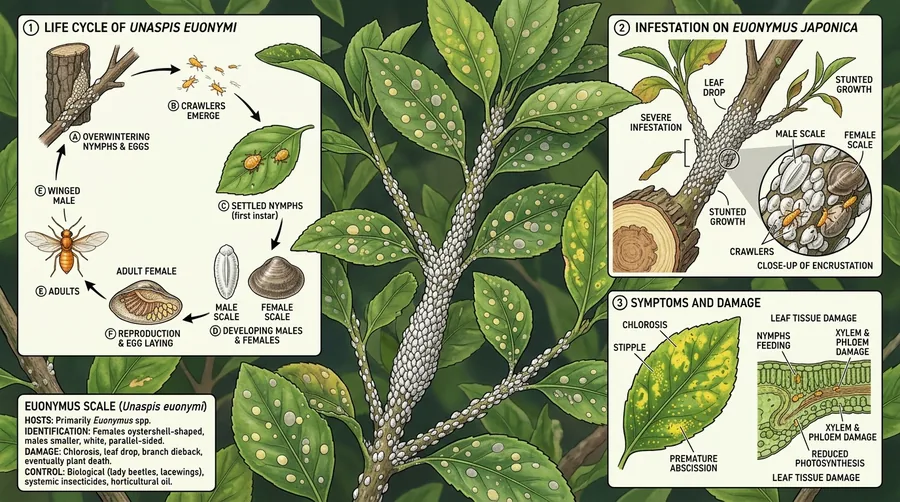
White male and brown female euonymus scales encrusting the stems and leaves of a euonymus shrub
Recommended Products


What it does
Euonymus scale settles on stems and leaves and sucks sap under protective covers. The contrast of brown females and abundant white males makes a heavy infestation look like the plant has been dusted with white. Feeding causes yellow or whitish leaf spots, leaf drop, dieback, and sometimes death of the plant.
Where it lives
It favors evergreen euonymus (especially Euonymus japonica and wintercreeper), plus pachysandra, holly, boxwood, and bittersweet, in foundation plantings and hedges. It thrives in warm, sheltered spots against buildings and is found across the US wherever these ornamentals are grown.
How it breeds
There are usually two to three generations a year. Females overwinter on the bark and lay eggs beneath their covers in spring. Crawlers hatch, disperse to new stems and leaves, settle, and form their own covers. Overlapping generations mean crawlers can be present through much of the growing season.
What it eats
The scale feeds only on the sap of its host plants, drawn from stems and the surfaces and undersides of leaves. It does not feed on anything in the home.
Identification
Females are brown, oyster-shell shaped, about 2 mm, often on stems; males are smaller, white, and elongated with lengthwise ridges, clustering on leaves and stems. Dense white males give infested wintercreeper and euonymus a frosted look. Yellow leaf spots above feeding sites are common.
Signs of an infestation
- White, elongated specks crusting stems and leaves
- Brown, oyster-shaped scales on bark and twigs
- Yellow or whitish spots on leaves above feeding sites
- Leaf drop, thinning, and branch dieback
- A frosted, whitewashed look on heavily infested shrubs
Prevention tips
- Choose resistant plants or replace chronically infested euonymus
- Prune out and destroy heavily encrusted stems
- Improve air circulation and avoid hot, dry, sheltered sites
- Apply horticultural oil timed to crawler emergence per label
- Encourage predatory beetles and parasitic wasps
Professional solutions
Because euonymus scale overlaps generations and hides under covers, control usually needs repeated, well-timed horticultural oil or crawler-targeted treatments. For badly infested plantings, a professional can time sprays to crawler activity and advise whether a chronically infested shrub is worth replacing.
Health & safety
Euonymus scale is harmless to people and pets. It does not bite, sting, or spread human disease, and it stays on outdoor plants. The concern is purely the survival and appearance of the affected shrubs and ground covers.
Relevant Products


Frequently asked questions
Why does my euonymus look like it's covered in white specks?
A frosted, white-speckled look on euonymus or wintercreeper is usually the white male euonymus scale. The brown, oyster-shaped females sit on the stems while the smaller white males crowd stems and leaves. Heavy crusting causes yellow leaf spots and dieback.
How do I treat euonymus scale?
Prune out heavily encrusted stems, then apply horticultural oil timed to the crawler stage in late spring, repeating for later generations. Improving air flow and plant vigor helps. Chronically infested euonymus is sometimes best replaced with a more resistant shrub.
Will euonymus scale spread to my other shrubs?
It can. The crawler stage disperses to nearby euonymus, pachysandra, holly, and boxwood. Removing infested wood, treating at crawler time, and monitoring neighboring plants reduces the chance of it moving through a planting.
Fact-checked by Morgan Vance, Editorial Director (editorial review, not a professional pest-control or medical sign-off). Last reviewed July 26, 2026. We correct anything a reader shows us is wrong — see our corrections policy.