San Jose Scale
Diaspidiotus perniciosus · also called San Jose scale, Quadraspidiotus perniciosus
Quick answer
San Jose scale (Diaspidiotus perniciosus) is a tiny armored scale, barely 2 mm, that encrusts the bark of fruit and ornamental trees and sucks their sap. Heavy infestations kill twigs and branches and mark fruit with red-ringed spots. A major orchard pest, it damages trees and crops but does not bite, sting, or affect people.
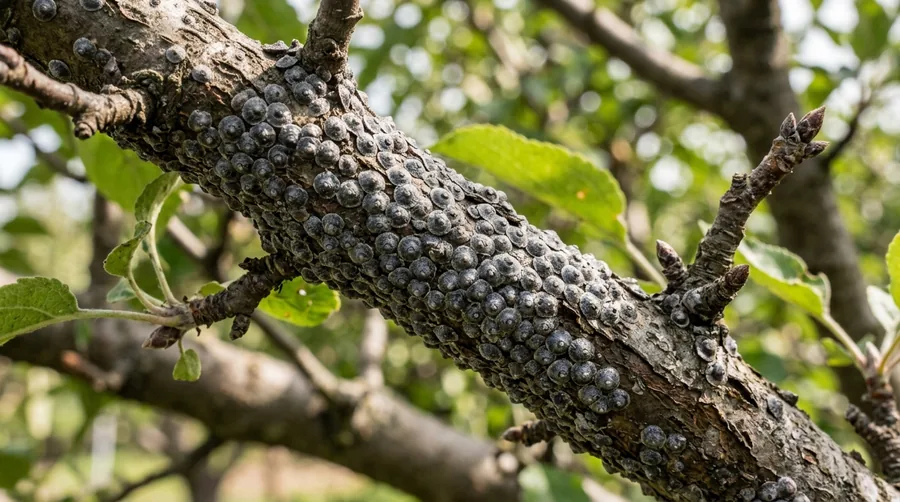
Gray circular San Jose scales encrusting an apple twig with reddish halos on the fruit
Recommended Products


What it does
San Jose scale inserts its mouthparts into bark and fruit and feeds on sap while sheltered under a small gray cover. Its saliva is toxic to plant tissue, so feeding sites often show red or purple halos, especially on fruit. Dense colonies can girdle twigs and branches, causing dieback and even tree death.
Where it lives
It attacks a wide range of deciduous trees and shrubs: apple, pear, peach, plum, cherry, and many ornamentals such as cotoneaster, flowering fruit trees, and rose. Found across the US, it is a significant pest in commercial orchards and backyard fruit trees alike, living on bark, twigs, and fruit.
How it breeds
Females give live birth to crawlers rather than laying eggs. There are typically two or more generations a year. Crawlers settle within a day, insert their mouthparts, and secrete a gray cover, becoming immobile. Overwintering occurs as immature scales on the bark, resuming growth in spring.
What it eats
San Jose scale feeds solely on sap from the bark, twigs, and fruit of its host trees. It does not feed on leaf-surface debris, structures, or household food.
Identification
Mature covers are circular, gray, and only about 1-2 mm with a slightly raised nipple in the center, so an infestation can look like a fine ashy crust on bark. Reddish rings around feeding spots on fruit or green bark are a helpful clue. A hand lens is often needed to see individuals.
Signs of an infestation
- Fine gray, ashy encrustation on bark and twigs
- Red or purple halos around feeding spots on fruit
- Twig and branch dieback and reduced vigor
- Cracked, roughened bark on older infestations
- Tiny yellow crawlers on bark in late spring and summer
Prevention tips
- Buy and plant only clean, scale-free nursery stock
- Prune out and destroy heavily infested wood in winter
- Apply dormant horticultural oil before bud break per label
- Monitor for crawlers with sticky tape on branches
- Preserve parasitic wasps and predatory beetles that attack it
Professional solutions
San Jose scale is hard to control once established because the covers shield it, and it can build resistance. Professionals and orchardists rely on well-timed dormant oil plus crawler-stage insecticides guided by monitoring, following labels. For fruit trees, extension or a licensed applicator can plan the spray timing.
Health & safety
San Jose scale poses no health risk to people or pets. It does not bite, sting, or transmit human disease, and it never infests homes. Its impact is economic and horticultural, damaging trees and marking fruit rather than harming anyone.
Relevant Products


Frequently asked questions
What are the red-ringed spots on my apples?
Small red or purple spots ringing feeding sites on apples or pears often indicate San Jose scale. This tiny armored scale injects toxic saliva as it feeds on the fruit and bark. Look for a fine gray crust on nearby twigs to confirm it.
Why is San Jose scale so hard to control?
Its waxy cover shields the settled insect from many sprays, it produces multiple overlapping generations a year, and some populations resist certain insecticides. Effective control depends on precise timing: dormant oil before bud break and treatments aimed at the mobile crawler stage.
Can San Jose scale kill a tree?
Yes. Left unchecked, heavy infestations can girdle twigs and branches, cause progressive dieback, and eventually kill young or stressed trees. Early detection, pruning out infested wood, and well-timed dormant oil greatly reduce that risk.
Fact-checked by Morgan Vance, Editorial Director (editorial review, not a professional pest-control or medical sign-off). Last reviewed August 12, 2026. We correct anything a reader shows us is wrong — see our corrections policy.