Magnolia Scale
Neolecanium cornuparvum · also called magnolia scale
Quick answer
Magnolia scale (Neolecanium cornuparvum) is one of the largest soft scales in the US, reaching about half an inch. The shiny brown, dome-shaped adults cluster on magnolia twigs, sucking sap and dripping copious honeydew that blackens leaves with sooty mold. Heavy infestations weaken and disfigure trees but pose no risk to people.
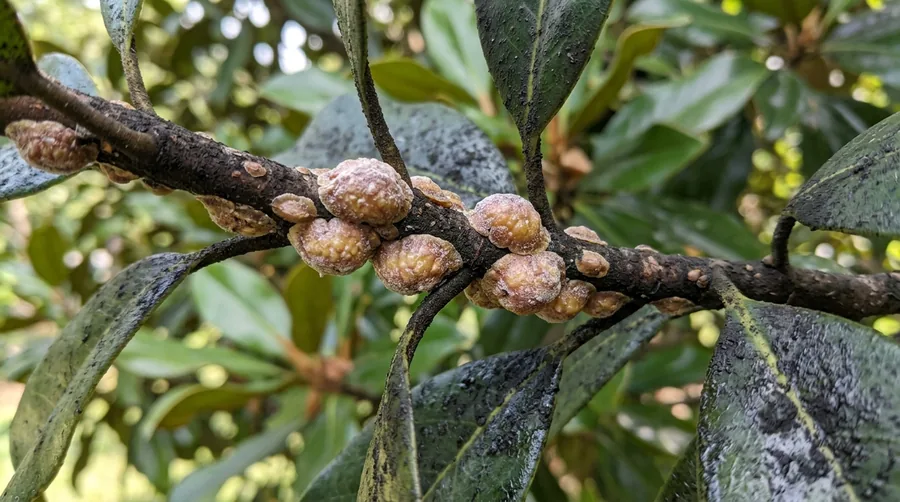
Large shiny brown magnolia scales on a magnolia twig with sticky honeydew and black sooty mold
Recommended Products


What it does
Magnolia scale attaches to twigs and small branches and feeds on sap, growing into large, shiny brown domes. It excretes large amounts of sticky honeydew that coats leaves and anything below, where black sooty mold then grows. Severe infestations cause branch dieback, reduced flowering, and a generally sickly tree.
Where it lives
It feeds on magnolia species, especially star, saucer, and lily magnolias, and occasionally on tulip trees, in yards, parks, and streetscapes. It is found across much of the eastern and central US and anywhere susceptible magnolias are planted, living on the bark of twigs and young branches.
How it breeds
There is one generation per year. Immature scales overwinter on twigs, resume feeding and mature by spring to summer, and females produce live crawlers in late summer to fall. The crawlers settle on new twigs to overwinter. Adults are largest and most obvious in early to mid-summer.
What it eats
Magnolia scale feeds only on the sap of magnolia and related trees, drawn from twigs and young branches. It does not feed on leaf surfaces, structures, or food.
Identification
Mature scales are unusually large for a soft scale, up to about 12 mm, smooth, shiny, and brown, sometimes dusted with a white waxy bloom, crowded along twigs. The abundant sticky honeydew and resulting black sooty mold on the foliage below are strong supporting clues.
Signs of an infestation
- Large, shiny brown bumps crowding twigs and small branches
- Sticky honeydew on leaves, sidewalks, or cars beneath the tree
- Black sooty mold darkening leaves and stems
- Branch dieback and sparse, weak flowering
- Ants, wasps, and flies drawn to the honeydew
Prevention tips
- Inspect magnolias yearly in summer for developing scales
- Prune out and destroy heavily encrusted twigs
- Keep trees vigorous with proper watering and mulch
- Apply horticultural oil timed to the fall crawler stage per label
- Encourage predators and parasitic wasps that attack the scale
Professional solutions
Because the adult covers resist many sprays, control targets the fall crawler stage with horticultural oil or a labeled insecticide, sometimes over successive years. For large or valuable magnolias, an arborist can time treatments, prune infested wood, and consider systemic options where appropriate.
Health & safety
Magnolia scale does not bite, sting, or carry disease and never enters homes. The stickiness and the stinging insects it attracts (wasps and bees feeding on honeydew) are the only indirect nuisance. Its real impact is on the tree's health and appearance, not human health.
Relevant Products


Frequently asked questions
What are the big brown bumps on my magnolia branches?
Large, shiny brown, dome-shaped bumps crowding magnolia twigs are magnolia scale, one of the biggest soft scales in the country. They suck sap and produce heavy sticky honeydew, so nearby leaves often turn black with sooty mold.
Why is everything under my magnolia sticky and black?
Magnolia scale excretes large amounts of sugary honeydew that coats leaves, walkways, and cars below, and black sooty mold grows on that residue. Controlling the scale, mainly at the fall crawler stage, is what stops the stickiness and mold.
When is the best time to treat magnolia scale?
Target the crawler stage in late summer to fall, when the tiny mobile young are exposed and vulnerable to horticultural oil. The large adult covers resist many sprays, so timing to crawlers, sometimes over two seasons, gives the best results.
Fact-checked by Morgan Vance, Editorial Director (editorial review, not a professional pest-control or medical sign-off). Last reviewed June 1, 2026. We correct anything a reader shows us is wrong — see our corrections policy.