Cottony Maple Scale
Pulvinaria innumerabilis · also called cottony maple scale
Quick answer
Cottony maple scale (Pulvinaria innumerabilis) is a soft scale best known for the white, cottony egg masses females deposit along the undersides of twigs, making branches look strung with popcorn. It sucks sap from maple and other shade trees, dripping honeydew and sooty mold. It weakens trees but is harmless to people and pets.
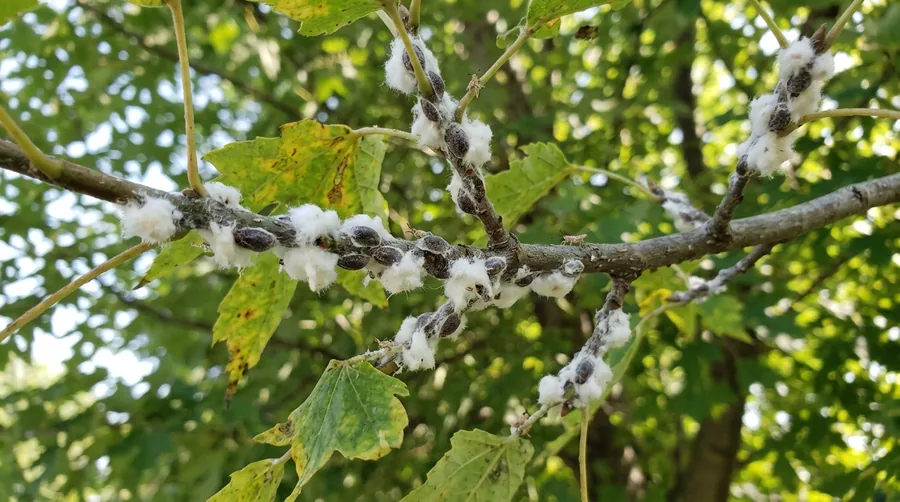
White cottony egg masses of cottony maple scale lining the undersides of maple twigs
Recommended Products


What it does
Overwintered females on twigs swell in spring and secrete a large white, cottony egg sac, so infested branches look lined with bits of popcorn. Crawlers hatch and move to leaf undersides to feed on sap for the summer, dripping honeydew that fosters sooty mold. Heavy years cause leaf yellowing and twig dieback.
Where it lives
Despite its name it attacks many trees: silver and other maples most of all, plus honeylocust, linden, elm, dogwood, and even some shrubs and fruit trees. It is common across the northern and central US in yards, parks, and along streets, living on twigs and the undersides of leaves.
How it breeds
There is one generation per year. Fertilized females overwinter on twigs, then produce the conspicuous cottony egg mass in late spring, each holding hundreds to over a thousand eggs. Crawlers emerge in early summer, feed on leaves, then move back to twigs in fall to overwinter as young females.
What it eats
Cottony maple scale feeds solely on plant sap, taken from twigs in the dormant season and from leaf undersides while feeding in summer. It does not feed on any household materials.
Identification
The signature sign is the white, cottony egg masses, up to about 12 mm, strung along the undersides of twigs in late spring; the brown female sits at one end. In summer, flat brownish crawlers dot leaf undersides. Abundant honeydew and sooty mold accompany heavy infestations.
Signs of an infestation
- White, cottony popcorn-like masses along twig undersides
- Sticky honeydew on leaves and surfaces below
- Black sooty mold on foliage and bark
- Yellowing leaves and early leaf drop
- Twig dieback in heavily infested trees
Prevention tips
- Monitor twigs in late spring for developing egg masses
- Prune out and destroy heavily infested twigs
- Keep trees vigorous with proper watering and mulch
- Encourage natural predators and parasitic wasps
- Apply horticultural oil timed to the summer crawler stage per label
Professional solutions
Natural enemies often crash cottony maple scale populations within a year or two, so patience and predator conservation are usually enough. For persistent, heavy infestations on valuable trees, a professional can time horticultural oil to the crawler stage or use a labeled systemic, plus prune out dieback.
Health & safety
Cottony maple scale is not a health hazard: it does not bite, sting, or spread disease and never comes indoors. The white masses are wax and eggs, not a threat. Its impact is limited to the vigor and appearance of the trees it feeds on.
Relevant Products


Frequently asked questions
What are the white cottony bumps under my maple twigs?
White, cottony, popcorn-like masses lining the undersides of maple twigs in late spring are the egg sacs of cottony maple scale. Each holds hundreds of eggs, with a brown female at one end. The crawlers later feed on the leaves and drip honeydew.
Is cottony maple scale going to kill my tree?
Rarely. Established shade trees usually tolerate it, and natural predators often knock populations back within a season or two. Heavy, repeated infestations can cause twig dieback and stress, so monitoring and conserving beneficial insects is the usual approach.
How do I control cottony maple scale?
Prune out heavily infested twigs, conserve natural predators, and if needed apply horticultural oil timed to the summer crawler stage per the label. On large or high-value trees, an arborist can time treatments and address any dieback.
Fact-checked by Morgan Vance, Editorial Director (editorial review, not a professional pest-control or medical sign-off). Last reviewed July 29, 2026. We correct anything a reader shows us is wrong — see our corrections policy.