Scale Insect
Coccoidea spp. · also called scale insects, plant scale, armored scale
Quick answer
Scale insects are small sap-feeders that look like tiny bumps or shell-like crusts stuck to stems, leaves, and bark rather than moving bugs. They weaken plants, and soft scales excrete sticky honeydew that leads to sooty mold. Found on houseplants, ornamentals, and crops nationwide, they pose no direct risk to people.
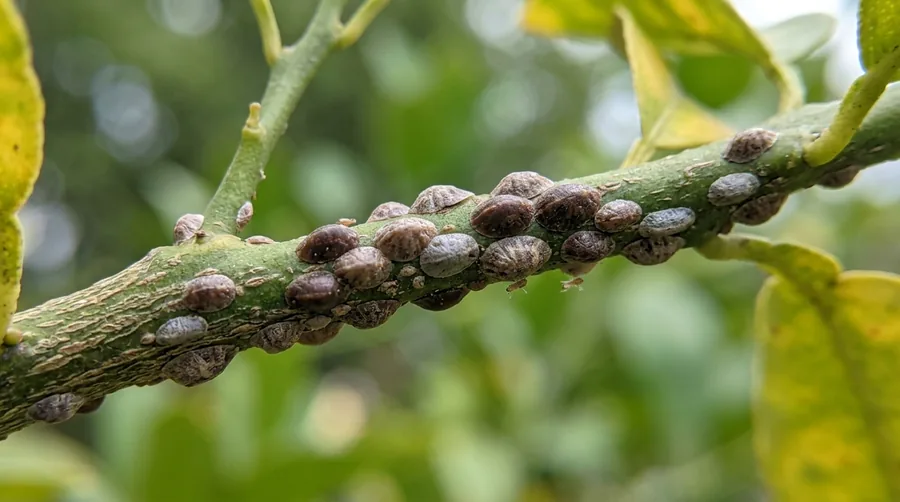
Brown crusty scale insects lined along a plant stem and leaf vein
Recommended Products


What it does
Scale insects settle in one spot and feed on plant sap under a protective covering, so they look more like bumps than bugs. Armored scales secrete a hard, separate shell; soft scales have a waxy body and excrete sticky honeydew that leads to sooty mold. Heavy feeding yellows leaves and can kill branches.
Where it lives
Scales live on the stems, leaves, and bark of trees, shrubs, houseplants, and crops. They favor sheltered spots along twigs and leaf veins and stay active year-round on indoor and greenhouse plants. Different species occur across the US on ornamentals, fruit trees, and interior plants.
How it breeds
Females lay eggs beneath their covering or body. Tiny mobile crawlers hatch, wander to a feeding site, and settle, losing their legs in many species as they mature under a growing shell. Depending on species and climate there are one to several generations a year; the crawler stage is the main window for control.
What it eats
Scale insects feed only on plant sap, drawn from the stems, leaves, twigs, or bark of their host. Hosts include citrus and other fruit trees, many ornamental shrubs and trees, and indoor foliage plants.
Identification
Scales look like small, immobile bumps or crusty specks, about 1/16 to 1/4 inch, stuck to stems and leaves. Armored scales have a hard, gray-to-brown plate that lifts off the body; soft scales are rounded, waxy, and often produce honeydew. Their stillness and firm attachment set them apart from other insects.
Signs of an infestation
- Small bumps or crusty specks firmly attached to stems and leaves
- Yellowing leaves and dieback of twigs or branches
- Sticky honeydew and black sooty mold (with soft scales)
- Ants trailing along branches to tend soft scales
- Reduced vigor or leaf drop on affected plants
Prevention tips
- Inspect new plants for bumps on stems and leaves before buying
- Prune out and destroy heavily infested twigs and branches
- Keep plants healthy and well-watered to resist scale
- Encourage natural enemies like lady beetles and parasitic wasps
- Control ants that protect soft scales from predators
Professional solutions
Time treatments to the vulnerable crawler stage, using horticultural oil to smother scales and insecticidal soap on crawlers, repeated as needed. Dormant oil helps on deciduous trees. Established armored-scale infestations resist control; an arborist or licensed applicator can advise on systemic insecticides and correct timing per the product label.
Health & safety
Scale insects do not bite, sting, or spread disease to people, so they present no direct human health risk. They are a plant pest: prolonged sap feeding weakens hosts and can kill branches or whole plants, and soft-scale honeydew fosters sooty mold that further reduces plant health and appearance.
Relevant Products


Frequently asked questions
Are those bumps on my plant stems insects?
Quite possibly. Scale insects feed under a protective covering and look like small, firmly attached bumps or crusty specks rather than moving bugs. Yellowing leaves, dieback, and sticky honeydew with sooty mold are common accompanying signs.
Do scale insects harm people?
No. Scale insects do not bite, sting, or carry human disease. They damage only plants, weakening trees, shrubs, and houseplants through sap feeding, and soft scales produce honeydew that leads to unsightly sooty mold.
How do I treat scale on a plant or tree?
Prune out heavily infested growth, then apply horticultural oil to smother scales, targeting the mobile crawler stage and repeating as needed. Insecticidal soap helps on crawlers, and stubborn infestations may need an arborist's advice on systemic options.
Fact-checked by Morgan Vance, Editorial Director (editorial review, not a professional pest-control or medical sign-off). Last reviewed July 31, 2026. We correct anything a reader shows us is wrong — see our corrections policy.