


How many ants are there on Earth?
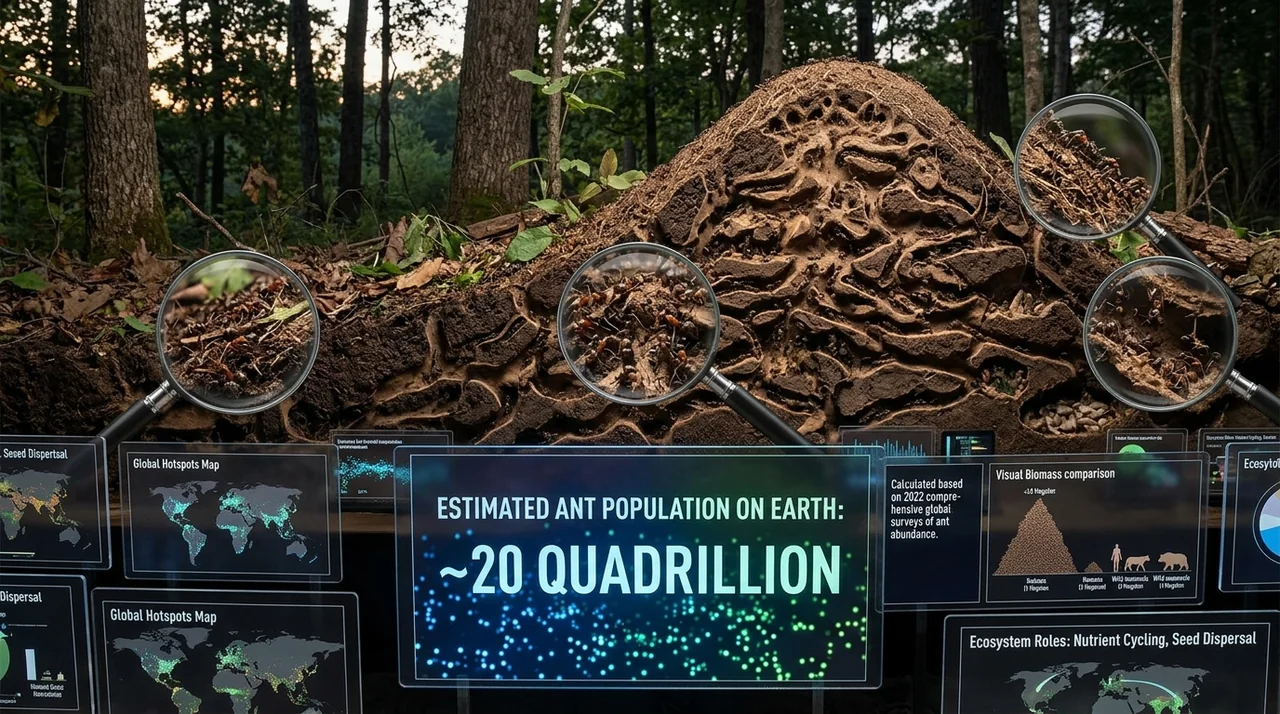
The best available estimate comes from a broad analysis published in the journal PNAS (Proceedings of the National Academy of Sciences) in 2022. It puts the total at roughly 20 quadrillion ants. That is 20 followed by 15 zeros. It is an estimate, not an exact count. Still, it shows just how dominant ants are among land animals.
How was the 20 quadrillion figure calculated?
Researchers did not count ants one by one. Instead, they gathered data from thousands of separate field studies around the world. In those studies, scientists had sampled ants from soil and leaf litter, or from plants using standardized traps. The team then combined those surveys and scaled the densities up across the planet's land area. This produced a global estimate. Because it relies on modeling and extrapolation, the true number could be higher or lower. Even so, it is the most rigorous figure available.
How much do all the ants weigh?
The same analysis estimated the combined dry weight of the world's ants. That weight rivals or exceeds the total mass of all wild birds and wild mammals put together. Put another way, this one family of small insects carries a biomass comparable to some of the largest animal groups on Earth. That is a striking measure of their ecological weight. And if you divide the estimate across the human population, it works out to well over a million ants for every person alive. That is a helpful way to picture just how outnumbered we are.
How many ant species are there?
There are more than 12,000 described ant species in the family Formicidae. Scientists believe many more remain unnamed. This diversity is part of why ants thrive nearly everywhere:
- They live on every continent except Antarctica
- They occupy forests, deserts, grasslands, wetlands, and cities
- Colonies range from a few dozen individuals to many millions
Why do so many ants matter?
Ants are ecological powerhouses. They aerate soil, spread seeds, recycle nutrients, and prey on other insects. In these quiet ways, they shape the environments around them. Their success comes from living in cooperative colonies with a division of labor. This lets them find and use resources far more efficiently than a lone insect could.
Why do only some ants become household pests?
Only a small fraction of the world's ant species ever bother people. The vast majority stay outdoors doing beneficial work. The handful that come indoors, such as the odorous house ant or the pavement ant, are drawn by easy food, water, and shelter. That same colony-based efficiency is what makes them persistent. A few scouts can quickly recruit many workers to a spill or a leaky pipe. If ants come inside, focus on removing food and moisture, sealing entry points, and using slow-acting baits per the EPA label so foragers carry the product back to the nest. Wiping up the trail you see rarely solves the problem, because the colony behind it is far larger than the ants on your counter.