


Do ants have brains?
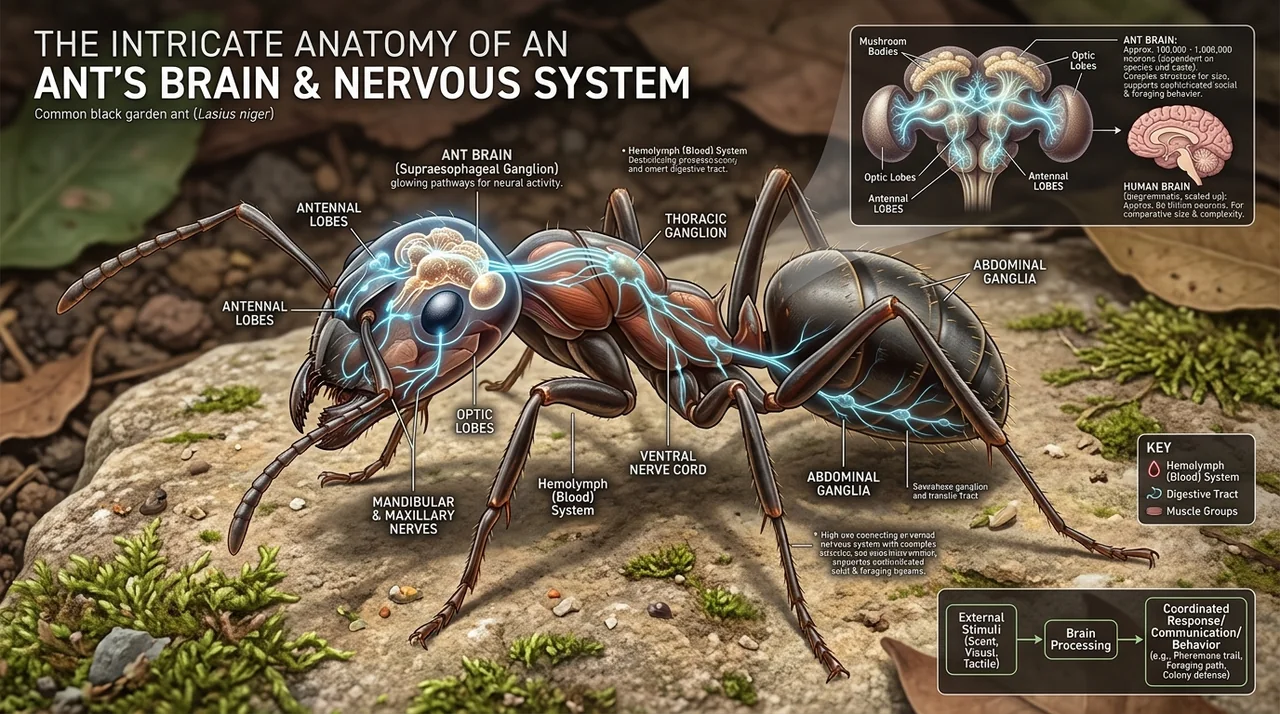
Despite their size, ants have genuine brains. An ant's brain sits in its head and contains a large number of neurons, on the order of a couple hundred thousand nerve cells. That is enough to run its senses, coordinate its six legs, process smells, and guide complex behaviors like foraging, nest-building, and caring for the young. That is a lot of processing power packed into a head smaller than a pinhead.
Beyond the brain, a nerve cord runs the length of the body. It carries clusters of nerve cells called ganglia that help control movement and reflexes. In other words, an ant's nervous system is spread along its body rather than packed entirely into its head. This is common in insects.
What does an ant use its brain for?
Ants lean heavily on smell and touch rather than sight. A large share of their brainpower goes into detecting and reading chemical signals called pheromones, which they pick up with their antennae. With those signals, a single ant can:
- Follow a trail its nestmates laid down to food.
- Recognize whether another ant belongs to its own colony.
- React to alarm signals that warn of danger.
- Tell apart the scents of queens, workers, and brood.
Is the colony a bigger 'brain'?
No single ant is in charge. Yet a colony behaves in remarkably intelligent ways, which is why biologists often call a colony a superorganism. The group-level intelligence comes from many simple individuals following simple rules:
- Foragers lay pheromone trails that guide nestmates to food, and the strongest trails win out.
- Alarm pheromones rally defenders when the nest is threatened.
- Simple individual behaviors add up to organized, adaptive group decisions.
Are ants actually smart, or just automatic?
A little of both. Individual ants are not solving problems the way a person does. Much of their behavior is instinctive and rule-based. But those rules, multiplied across thousands of ants and tuned by evolution, produce flexible, problem-solving behavior at the colony level. Ants can find efficient paths, assign workers to tasks, and adapt to obstacles, all without a leader directing them.
Why does this matter for getting rid of ants?
That colony-level intelligence is exactly why ants are so persistent in homes. Wiping away a trail removes the scent guide only for a while, and scouts soon rebuild it. Squashing the ants you see does nothing about the queen and brood tucked safely away in the nest.
Effective control works with ant biology instead of against it:
- Keep food sealed and wipe surfaces to remove the scent trails and attractants that draw them in.
- Seal cracks and gaps ants use to enter.
- Use EPA-registered ant baits according to the label. Because workers share food, they carry slow-acting bait back to the nest, reaching the queen and colony you cannot see.