

Are tarantulas dangerous to people?
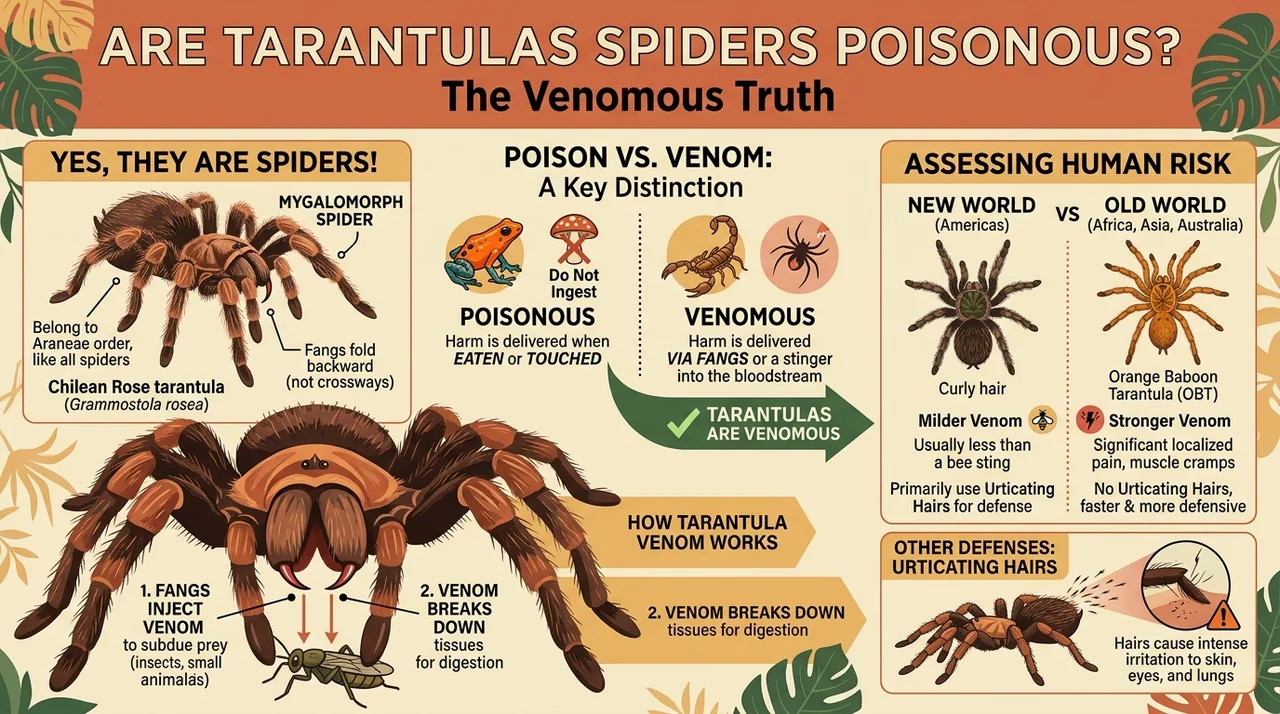
Tarantulas (family Theraphosidae) are venomous, in the sense that they use venom to overpower insect prey. But for humans, their bite is medically minor. Most people who are bitten report pain, redness, and swelling roughly comparable to a bee sting. The species kept as pets, and the ones found in the southern and southwestern United States, are generally slow-moving and mild-tempered. They would rather retreat or give a warning display than bite. Serious reactions are uncommon. They are usually tied to an individual allergy rather than to the venom being potent.
What actually happens if a tarantula bites?
A defensive tarantula bite typically causes:
- Localized pain at the puncture site, sometimes with brief throbbing.
- Redness and mild swelling around the bite.
- Symptoms that stay local and fade over hours to a day or so.
What are urticating hairs, and why do they matter?
For many people, the hairs are more of a problem than the fangs. Most New World tarantulas, meaning those from the Americas, have a patch of tiny barbed hairs on the abdomen. These are called urticating hairs. When threatened, the spider uses its back legs to flick a cloud of them toward the perceived attacker. On skin, they can cause itching and a stinging rash. If they reach the eyes or airways, they can cause more significant irritation. Rubbing your eyes after contact makes it worse. Old World tarantulas from Africa and Asia lack these hairs. But they tend to be faster and more defensive, relying on a bite instead.
Why are tarantulas so often misunderstood?
Their size and hairy appearance make tarantulas look far more threatening than they are. Movies and folklore have long cast big spiders as deadly. But the reality is different. A tarantula is a shy ambush hunter that spends most of its time hidden in a burrow or retreat. It has no interest in people and gains nothing from confrontation. Most bites happen only when a spider is cornered, stepped on, or picked up. So simply leaving one alone almost always resolves the encounter without incident.
How should I handle a tarantula safely?
The safest approach is to avoid handling wild or unfamiliar tarantulas at all:
- If one is indoors, guide it into a container and release it outside rather than grabbing it.
- If you are flicked with hairs, wash the area, avoid rubbing, and use a cool compress. Flush eyes with water if they are affected, and seek care for persistent eye irritation.
- After a bite, wash the site, apply a cold compress, and monitor for an allergic reaction.
How do tarantulas compare with truly dangerous spiders?
Perspective helps here. A tarantula looks alarming, but it is far less of a medical concern than a small, reclusive species. The black widow and brown recluse are the U.S. spiders health authorities take most seriously. If you keep finding large spiders indoors, or want help identifying one, our pest library is a good starting point. A licensed professional can assess an ongoing concern. For a single tarantula, giving it space and gently relocating it is almost always the right call.