
Brown Recluse Spider
Loxosceles reclusa · also called brown recluse, violin spider, fiddleback spider
Quick answer
The brown recluse (Loxosceles reclusa) is a light-brown spider with a dark violin-shaped mark behind its head and six eyes in three pairs. Native to the central and southern US, it hides in undisturbed indoor spaces and bites defensively. Most bites heal on their own, but some cause a slow-healing skin lesion, so medical evaluation is advised.
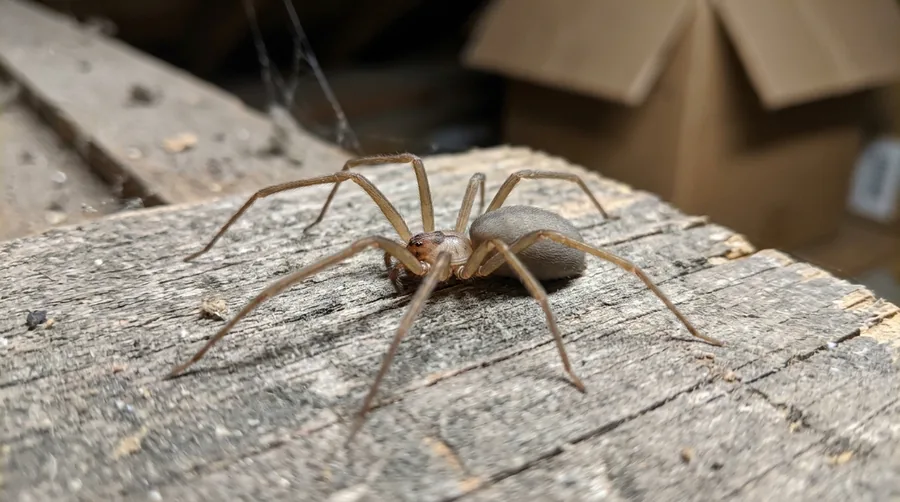
Light brown recluse spider with a dark violin-shaped mark on its back on a wooden surface
Recommended Products
See the full ranking →


What it does
Brown recluses are reclusive and non-aggressive, hiding by day and roaming at night to hunt. They spin only loose, irregular retreat webbing rather than capture webs. Bites are defensive and usually occur when a spider is trapped against skin in clothing, bedding, shoes, or stored items that go undisturbed for long periods.
Where it lives
They shelter in dark, dry, undisturbed places: closets, attics, basements, storage boxes, behind furniture, and in seldom-worn clothing and shoes. Their established range is the central and southern US, roughly from Nebraska to Ohio and south to Texas and Georgia. They are rare outside that native region.
How it breeds
Females deposit off-white egg sacs holding around 40-50 eggs in their retreat, producing several sacs over a lifetime. Spiderlings mature over several months to a year. Brown recluses are long-lived, often surviving one to two years or more, and can endure long stretches without food or water.
What it eats
Brown recluses hunt and scavenge small insects such as crickets, cockroaches, and other soft-bodied prey, often taking dead insects. They do not feed on people; bites are strictly defensive and not related to feeding.
Identification
It is light tan to brown with a darker violin shape pointing back from behind the eyes, uniformly colored legs, and no stripes or banding. A distinctive feature is six eyes arranged in three pairs, versus eight in most spiders. Its uniform tan body and violin mark separate it from look-alikes.
Signs of an infestation
- A tan spider with a dark violin-shaped marking
- Spiders in undisturbed storage, closets, and boxes
- Loose, irregular webbing used as a retreat, not a capture web
- Off-white, cottony egg sacs in hidden corners
- Sightings concentrated in the central and southern US
Prevention tips
- Store clothing and bedding in sealed containers, not on the floor
- Reduce clutter in closets, attics, basements, and garages
- Shake out clothing, shoes, gloves, and bedding before use
- Seal cracks, gaps, and entry points around the home
- Use sticky glue-board traps to monitor and reduce numbers
Professional solutions
Because recluses hide deep in voids and resist casual control, persistent infestations are best handled by a professional using glue-board monitoring, targeted EPA-labeled treatments, and exclusion. DIY steps like decluttering, sealing, and glue traps help, but confirmed heavy infestations in living areas usually warrant professional assessment.
Health & safety
Most brown recluse bites cause only mild irritation and heal without incident, but some develop into a slow-healing necrotic ulcer, and rare cases have systemic effects. Many suspected 'recluse bites' outside its range are actually other conditions. If a bite blisters or worsens, seek medical care and you can call Poison Control at 1-800-222-1222.
Relevant Products




Frequently asked questions
How can I tell a brown recluse from other brown spiders?
Look for a uniform tan-to-brown body, a dark violin-shaped mark pointing back from behind the eyes, plain (non-banded) legs, and six eyes in three pairs rather than eight. Many brown spiders are mistaken for recluses, so identification of these features matters.
Are brown recluse bites always dangerous?
No. Most bites cause only mild irritation and heal on their own, though a minority develop a slow-healing skin ulcer. Serious systemic reactions are rare. If a bite blisters, darkens, or worsens, seek medical care; you can also call Poison Control at 1-800-222-1222.
Do brown recluses live all over the US?
No. Their established range is the central and southern US, roughly Nebraska to Ohio and south to Texas and Georgia. They are uncommon elsewhere, so many 'brown recluse' bites reported outside that region are actually other spiders or unrelated skin conditions.
Fact-checked by Morgan Vance, Editorial Director (editorial review, not a professional pest-control or medical sign-off). Last reviewed July 26, 2026. We correct anything a reader shows us is wrong — see our corrections policy.