
Western Tent Caterpillar
Malacosoma californicum · also called western tent caterpillar moth
Quick answer
The western tent caterpillar (Malacosoma californicum) is a native caterpillar of the western United States that spins silken tents in the forks of branches in spring. Colonies feed on the leaves of many trees and shrubs and can defoliate them in outbreak years. The hairy caterpillars and their tents are conspicuous, but established trees typically recover.
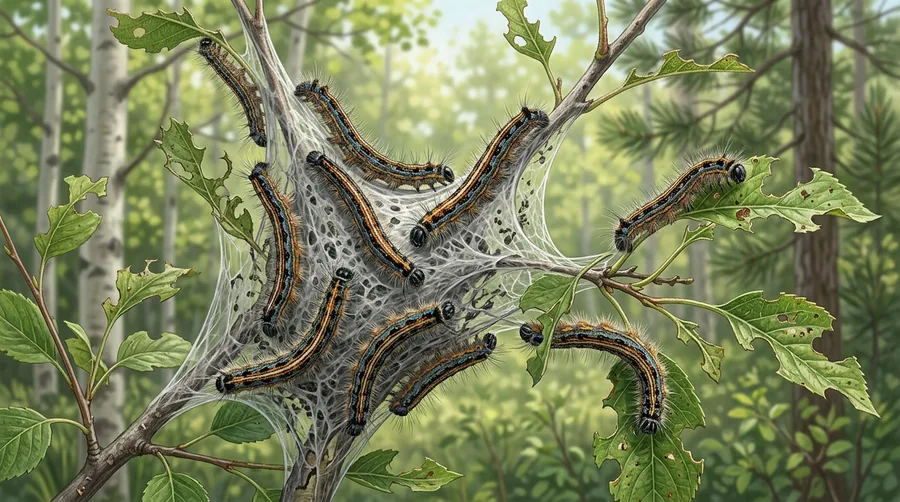
Silken western tent caterpillar nest in a branch fork with hairy orange-and-blue caterpillars
Recommended Products



What it does
Western tent caterpillars hatch in spring and build a silken tent in the crotch or fork of branches, using it as a base from which they crawl out to feed on nearby leaves and return to rest. The colony enlarges the tent as it grows. In outbreak years the caterpillars can defoliate host trees and shrubs, and the conspicuous webbed nests draw attention even when populations are moderate.
Where it lives
The caterpillars feed on a wide range of broadleaf trees and shrubs, including willow, aspen, cottonwood, oak, alder, and fruit trees, in yards, orchards, riparian areas, and woodlands throughout the western United States. Nests are built in the branch forks of these hosts. Populations rise and fall in multi-year cycles, with occasional widespread outbreaks.
How it breeds
There is one generation per year. Females lay eggs in a foam-covered band encircling a twig in summer, and these overwinter. Eggs hatch in spring near budbreak, and larvae live communally in the tent, feeding for several weeks before dispersing to spin cocoons in sheltered spots. Adults are tan to orange-brown moths that emerge in early to midsummer, mate, and lay the overwintering egg bands.
What it eats
The caterpillars feed on the leaves of many broadleaf trees and shrubs, such as willow, aspen, cottonwood, oak, and fruit trees. The adult moths do not feed on foliage. The insect depends on host-tree leaves in spring, and heavy colonies can strip branches of their new growth.
Identification
Mature caterpillars are up to about two inches long, hairy, and generally orange-brown with rows of blue and orange markings, varying by population. The unmistakable sign is the silken tent in a branch fork, which distinguishes it (with the eastern tent caterpillar) from the tent-less forest tent caterpillar. Egg masses are foam-covered bands around twigs, and cocoons are yellowish and sheltered.
Signs of an infestation
- Silken tents built in the forks and crotches of branches
- Hairy caterpillars crawling out from the tent to feed
- Defoliated or chewed leaves near the nests
- Foam-covered egg bands encircling twigs in winter
- Yellowish cocoons in sheltered spots after larvae disperse
- Multiple nests in a tree during outbreak years
Prevention tips
- Prune out and destroy tents while caterpillars are inside, ideally in the morning or evening when they are home
- Remove foam-covered egg bands from twigs in winter
- Handpick or knock caterpillars into soapy water on small trees
- Encourage birds, predators, and parasites that attack the colonies
- Keep trees vigorous so they recover from spring defoliation
Professional solutions
Western tent caterpillar rarely needs professional control, since outbreaks are cyclical and healthy trees recover from spring defoliation. Pruning out or removing tents (with the caterpillars inside) and treating young larvae with Bacillus thuringiensis (Bt) are effective on most landscape trees. For large or highly valued trees during severe outbreaks, a certified arborist can apply properly timed treatments. Never burn tents in a tree, which harms the wood.
Health & safety
Western tent caterpillars do not bite or sting and spread no disease, so they pose essentially no risk to people or pets, though their hairs may mildly irritate very sensitive skin. The main impacts are cosmetic defoliation, the unsightliness of the tents, and temporary stress to trees defoliated for several years in a row, from which most established trees recover.
Relevant Products


Frequently asked questions
How do I get rid of tent caterpillar nests in my tree?
Prune out and destroy the tents while the caterpillars are inside, which is usually early morning or evening. On small trees you can also knock caterpillars into soapy water, and Bt controls young larvae. Never burn the tents in the tree, since the heat damages the bark and wood more than it helps.
Are western tent caterpillars harmful to people?
They do not bite or sting and carry no disease, so they are essentially harmless, though their hairs can mildly irritate very sensitive skin. The nuisance is mainly the unsightly tents and the leaf loss on host trees, not any risk to people or pets.
Will western tent caterpillars kill my trees?
Usually not. They defoliate trees and shrubs in spring, but established plants typically releaf and recover. Several consecutive years of heavy defoliation can stress a tree, and outbreaks tend to collapse on their own after a few years as natural enemies increase.
Fact-checked by Morgan Vance, Editorial Director (editorial review, not a professional pest-control or medical sign-off). Last reviewed June 24, 2026. We correct anything a reader shows us is wrong — see our corrections policy.