
Forest Tent Caterpillar
Malacosoma disstria · also called forest tent caterpillar moth, armyworm (regional misnomer)
Quick answer
The forest tent caterpillar (Malacosoma disstria) is a native caterpillar that feeds on hardwood leaves in spring and, in outbreak years, defoliates large areas of forest and shade trees. Despite its name it builds no tent, instead spinning silk mats and trails. It is blue with white keyhole-shaped spots down its back. Established trees usually recover.
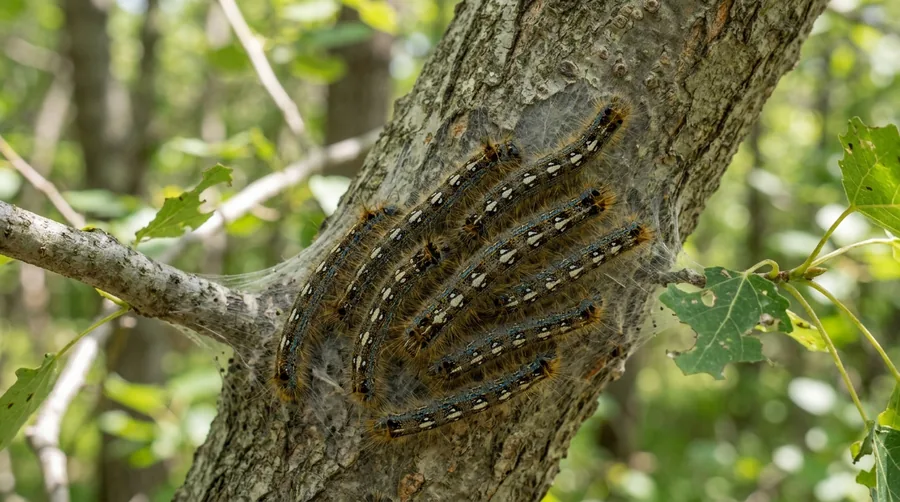
Bluish forest tent caterpillar with white keyhole-shaped spots down its back on a tree trunk
Recommended Products


What it does
Forest tent caterpillars hatch in spring as leaves open and feed together on the new foliage. Unlike the eastern tent caterpillar, they do NOT build a silken tent; instead they lay down silk mats on trunks and branches where they cluster to rest and molt, following silk trails to feeding sites. In outbreak years they can defoliate large stands, and masses of caterpillars crawl over trunks, structures, and roads.
Where it lives
The caterpillars feed on many hardwoods, favoring aspen, oak, sweetgum, sugar maple, tupelo, and others, depending on region. They occur across much of the United States and Canada, in forests, yards, and along streets. Periodic regional outbreaks build over several years, during which caterpillars become a major nuisance on homes, decks, and vehicles as well as on trees.
How it breeds
There is one generation per year. Females lay eggs in a shiny, encircling band around small twigs in summer, and these overwinter. Eggs hatch in spring as host leaves emerge, and larvae feed for five to six weeks before spinning yellowish cocoons in folded leaves or sheltered spots. Adults are tan, stout moths that emerge in early summer, mate, and lay the overwintering egg bands.
What it eats
The caterpillars feed on the leaves of hardwood trees, with preferred hosts varying by region, from aspen and oak to sugar maple, sweetgum, and tupelo. The adult moths do not feed on foliage. The insect depends on hardwood leaves in spring, and heavy outbreaks can strip trees of their new foliage.
Identification
Mature caterpillars are up to about two inches long, bluish with fine hairs, and marked by a row of distinctive white, keyhole- or footprint-shaped spots down the center of the back (unlike the eastern tent caterpillar's solid white stripe). Egg masses are dark, glossy bands wrapped around twigs. The absence of a silken tent, despite the name, is itself a useful identification clue.
Signs of an infestation
- Bluish caterpillars with white keyhole-shaped spots on trunks and leaves
- Silk mats on trunks and branches, but no tent
- Defoliated hardwoods in spring, especially aspen, oak, and maple
- Masses of caterpillars crawling on siding, decks, and roads
- Dark, glossy egg bands encircling twigs in winter
- Yellowish cocoons in folded leaves and sheltered spots
Prevention tips
- Prune off and destroy twigs bearing dark egg bands in winter
- Scrape egg masses from ornamental and small trees
- Handpick or knock caterpillars into soapy water on small trees
- Encourage birds, predators, and the parasitic 'friendly fly' that follow outbreaks
- Keep trees healthy so they recover from spring defoliation
Professional solutions
Forest tent caterpillar outbreaks are usually temporary, and healthy trees leaf out again after spring defoliation, so professional control is seldom necessary. On small or valued trees, removing egg bands and treating young larvae with Bacillus thuringiensis (Bt) works well. For large shade trees during heavy outbreaks, a certified arborist can apply properly timed treatments, and natural enemies typically collapse outbreaks after a few years.
Health & safety
Forest tent caterpillars do not bite or sting and carry no disease, so they pose essentially no health risk to people or pets, though their hairs may mildly bother very sensitive skin. The main issues are cosmetic defoliation, temporary stress to repeatedly defoliated trees, and the significant nuisance of caterpillar masses on homes and vehicles during outbreaks.
Relevant Products


Frequently asked questions
Why do forest tent caterpillars have no tent?
Despite the name, forest tent caterpillars never build the silken tent that eastern and western tent caterpillars make. Instead they spin flat silk mats on trunks and branches where they cluster to rest and molt, and follow silk trails to feed. The missing tent is actually a good identification clue.
Will forest tent caterpillars kill my trees?
Rarely on healthy, established trees. They defoliate hardwoods in spring, but the trees usually put out a new set of leaves and recover. Several consecutive years of heavy defoliation can stress and weaken trees, but outbreaks typically collapse on their own after a few years as natural enemies build up.
How do I keep forest tent caterpillars off my house?
During outbreaks, the caterpillars wander widely. Removing dark egg bands from nearby twigs in winter reduces local numbers, and knocking caterpillars off siding and into soapy water helps. The nuisance is temporary, ending when larvae pupate in early summer and as outbreaks naturally subside over a few years.
Fact-checked by Morgan Vance, Editorial Director (editorial review, not a professional pest-control or medical sign-off). Last reviewed June 13, 2026. We correct anything a reader shows us is wrong — see our corrections policy.