
Tussock Moth
Orgyia leucostigma · also called white-marked tussock moth, tussock moth caterpillar, Douglas-fir tussock moth
Quick answer
Tussock moths (Orgyia species) are caterpillars named for the distinctive tufts, or tussocks, of hair along their backs. They feed on many shade and forest trees and can defoliate them during outbreaks. The caterpillars are mostly a nuisance, but their hairs can cause an itchy skin rash in sensitive people, so it is best not to handle them.
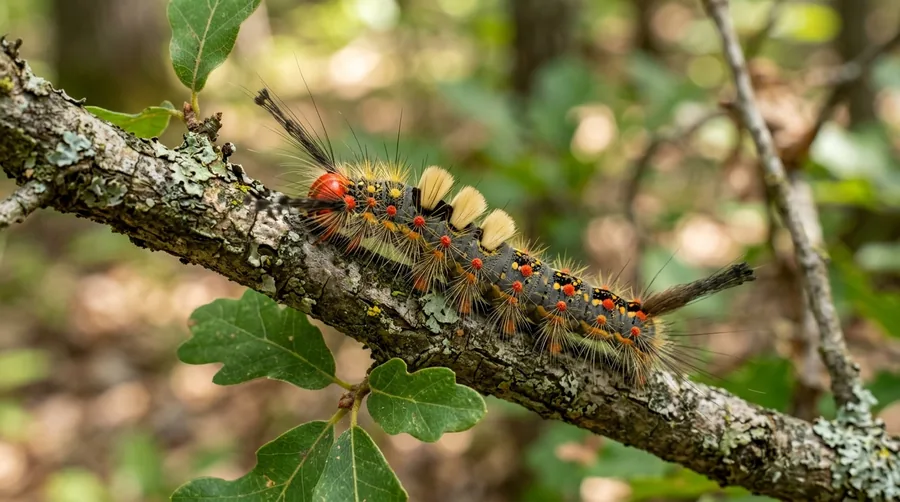
Hairy tussock moth caterpillar with four white tufts, a red head, and long black hair pencils on a leaf
Recommended Products


What it does
Tussock moth caterpillars feed on foliage, chewing leaves and, at high numbers during outbreaks, defoliating branches or whole trees. They are the conspicuous stage, crawling on trunks, leaves, and sometimes house walls. The adults are less noticed: males are drab moths, while females of many species are wingless and stay near their cocoon, laying eggs on it. Populations rise and fall in multi-year cycles.
Where it lives
Different tussock moth species feed on a wide range of trees. The white-marked tussock moth attacks many hardwoods and some conifers across the eastern United States, while the Douglas-fir tussock moth defoliates true firs and Douglas-fir in the West. They are found in yards, parks, and forests, and caterpillars often wander onto fences, walls, and outdoor furniture.
How it breeds
There are one or more generations per year depending on species and climate. Eggs, laid in a froth-covered mass on the female's cocoon, hatch into larvae that feed and pass through several molts. Mature larvae spin hair-covered cocoons in bark crevices or sheltered spots. Many species overwinter as eggs, so egg masses on bark and structures are a target for control.
What it eats
The caterpillars feed on the leaves or needles of their host trees, with the specific hosts depending on the species, ranging from oaks, maples, and other hardwoods to firs and Douglas-fir. The short-lived adult moths do not feed on foliage. The insect depends on tree leaves and needles to develop.
Identification
Tussock moth caterpillars are unmistakable: hairy, with four dense, brush-like tufts ('tussocks') on the back, longer hair 'pencils' projecting forward and back, and often bright colors. The white-marked tussock moth has a red head and yellow markings. Adult males are grayish moths; females of many species are wingless. Egg masses are covered in whitish froth on the old cocoon.
Signs of an infestation
- Hairy, tufted caterpillars on leaves, trunks, and walls
- Chewed or defoliated leaves and branches
- Froth-covered egg masses on bark, cocoons, or structures
- Hair-covered cocoons tucked in bark crevices and sheltered spots
- Caterpillars wandering on fences, siding, and outdoor furniture
- Frass (droppings) accumulating beneath infested trees
Prevention tips
- Scrape off and destroy frothy egg masses in fall and winter
- Handpick caterpillars using gloves, since the hairs can irritate skin
- Wrap sticky bands on trunks to intercept climbing caterpillars where practical
- Encourage birds and parasitic insects that attack tussock moths
- Keep trees healthy so they recover from occasional defoliation
Professional solutions
Most tussock moth infestations do not require professional help, since populations are cyclical and trees usually recover from a year of defoliation. For small trees, removing egg masses and handpicking larvae (with gloves) works well, and Bacillus thuringiensis (Bt) or other labeled products control young caterpillars. During severe outbreaks on large or valued trees, a certified arborist can apply properly timed treatments.
Health & safety
Tussock moths do not bite or sting, but their barbed hairs can cause an itchy skin rash or, rarely, eye or respiratory irritation in sensitive people who handle the caterpillars, cocoons, or egg masses. The reaction is a localized irritation, not venom, so the sensible precaution is to avoid bare-skin contact and wear gloves. Damage to trees is usually temporary.
Relevant Products




Frequently asked questions
Can tussock moth caterpillars hurt you?
They do not bite or sting, but the fine barbed hairs on the caterpillars, cocoons, and egg masses can cause an itchy rash or, less often, eye or airway irritation in people sensitive to them. It is best to avoid touching them with bare skin and to wear gloves if you need to remove them.
How do I control tussock moth caterpillars?
On small trees, scrape off the frothy egg masses in winter and handpick caterpillars while wearing gloves. Bt or other products labeled for caterpillars control young larvae. Because outbreaks are cyclical and trees usually recover, large-scale spraying is rarely needed except on highly valued trees.
What tree has hairy caterpillars with colorful tufts on it?
Caterpillars with four brush-like tufts on the back and longer hair pencils are tussock moths. The white-marked tussock moth, common in the East, has a red head and feeds on many hardwoods, while the Douglas-fir tussock moth defoliates firs in the West. They are showy but mostly a temporary nuisance.
Fact-checked by Morgan Vance, Editorial Director (editorial review, not a professional pest-control or medical sign-off). Last reviewed June 11, 2026. We correct anything a reader shows us is wrong — see our corrections policy.