
Orangestriped Oakworm
Anisota senatoria · also called orange-striped oakworm, oakworm
Quick answer
The orangestriped oakworm (Anisota senatoria) is a caterpillar that feeds in groups on oak leaves in late summer, sometimes defoliating branches or whole trees. Black with orange stripes and a pair of curved 'horns,' the caterpillars are dramatic but come late in the season, so established oaks usually recover. The spiny caterpillars can mildly irritate sensitive skin.
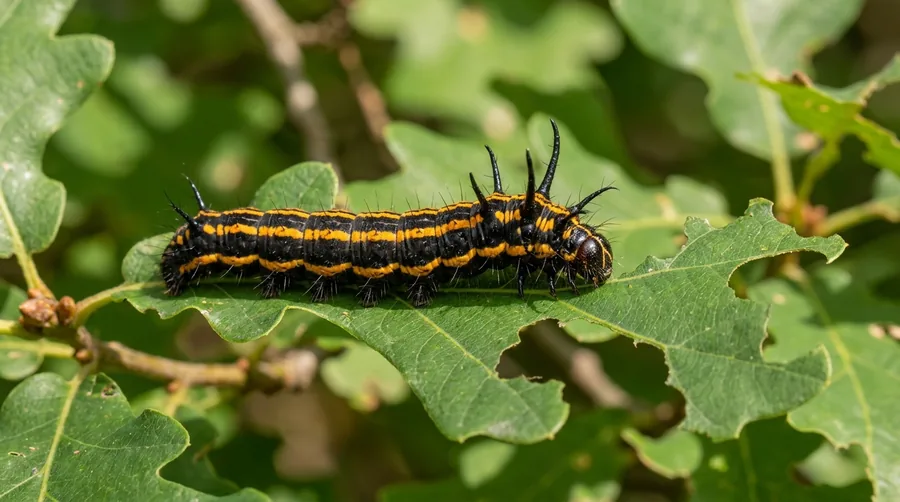
Black orangestriped oakworm caterpillar with orange stripes and two curved horns behind its head on an oak leaf
Recommended Products


What it does
Orangestriped oakworms hatch and feed together in large groups on oak foliage. Young caterpillars skeletonize leaves, while older ones eat entire leaves except the midrib and can strip branches or whole small trees late in the season. Because the heaviest feeding comes in late summer and fall, after oaks have already stored energy for the year, mature trees typically tolerate the defoliation and leaf out normally the next spring.
Where it lives
The caterpillars feed mainly on oaks, and sometimes hickory, birch, maple, and other hardwoods, in yards, parks, streets, and woodlands across the eastern, southeastern, and midwestern United States. Groups of caterpillars are often noticed on ornamental and street oaks, and wandering mature larvae and their droppings can become a nuisance on patios, walks, and driveways beneath infested trees.
How it breeds
There is generally one generation per year, sometimes two in the South. Adults, which are orange-brown moths, emerge in early to midsummer and lay egg masses on the undersides of oak leaves. Larvae hatch and feed gregariously for several weeks into fall, then crawl down and burrow into the soil to pupate, overwintering as pupae before emerging the following summer.
What it eats
The caterpillars feed on the leaves of oak and occasionally other hardwoods, chewing them down to the midrib as they mature. The adult moths do not feed on foliage. The insect depends on hardwood leaves, especially oak, to develop, and heavy colonies can consume a great deal of foliage late in the season.
Identification
Mature caterpillars are up to about two inches long, black with narrow orange-yellow stripes running the length of the body, and bear a pair of long, curved, horn-like spines just behind the head plus shorter spines along the body. Young larvae are more yellow-orange. The adult is a medium-sized orange-brown moth. Egg masses appear on the undersides of oak leaves.
Signs of an infestation
- Groups of black, orange-striped caterpillars on oak foliage
- Skeletonized leaves from young larvae, whole leaves eaten by older ones
- Defoliated branches or small trees in late summer
- Abundant frass (droppings) on decks, walks, and driveways
- Mature caterpillars wandering down trunks and across the ground
- Egg masses on the undersides of oak leaves
Prevention tips
- Monitor oaks in late summer for young caterpillar colonies
- Prune off and destroy branches holding feeding groups on small trees
- Knock or handpick colonies into soapy water using gloves
- Encourage birds and parasitic insects that attack the caterpillars
- Keep oaks vigorous so they recover from late-season feeding
Professional solutions
Orangestriped oakworm rarely needs professional control because the damage is late and established oaks recover. On small trees, pruning out or knocking off colonies works, and Bacillus thuringiensis (Bt) or other products labeled for caterpillars control young larvae. For large street or shade oaks with severe, repeated defoliation, or where wandering caterpillars and frass are a persistent nuisance, a certified arborist can treat effectively.
Health & safety
Orangestriped oakworms do not bite or sting and spread no disease, so they pose little risk to people or pets. Their spines and bristles can cause mild skin irritation or itching in sensitive people who handle them, so wearing gloves is wise. The main impacts are cosmetic defoliation and the nuisance of caterpillars and droppings beneath trees.
Relevant Products


Frequently asked questions
Are orangestriped oakworm caterpillars dangerous?
They do not bite or sting or carry disease, so they are essentially harmless. The spines can cause mild itching or skin irritation in sensitive people who handle them, so it is best to wear gloves. Their main nuisance is defoliating oaks and dropping frass on patios and walkways below.
Will orangestriped oakworms kill my oak tree?
Almost never on an established, healthy oak. The heaviest feeding comes in late summer, after the tree has done most of its growing for the year, so it leafs out normally the next spring. Small, young, or already-stressed trees face more risk, and repeated defoliation can add stress.
How do I get rid of oakworms?
On small trees you can prune out or knock the clustered caterpillars into soapy water while wearing gloves. Bt and other products labeled for caterpillars work on young larvae. Because damage is late and trees usually recover, large-scale treatment is mainly reserved for valued shade trees or severe nuisance situations.
Fact-checked by Morgan Vance, Editorial Director (editorial review, not a professional pest-control or medical sign-off). Last reviewed June 10, 2026. We correct anything a reader shows us is wrong — see our corrections policy.