
Twolined Chestnut Borer
Agrilus bilineatus · also called two-lined chestnut borer, oak borer
Quick answer
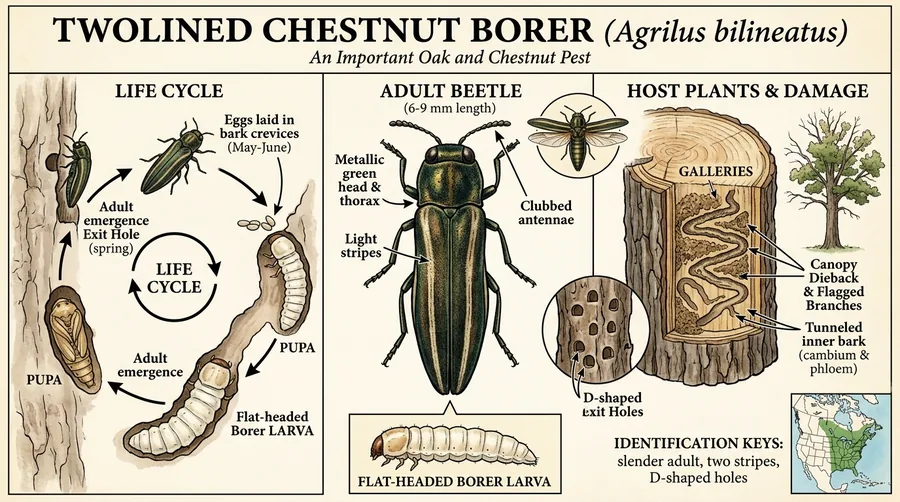
The twolined chestnut borer (Agrilus bilineatus) is a native flatheaded beetle that attacks stressed oaks, and formerly American chestnut. Larvae tunnel winding galleries under the bark, girdling limbs and killing oaks weakened by drought, defoliation, or construction. Crown dieback progresses from the top down, and D-shaped exit holes mark where adults emerged.
Slender black twolined chestnut borer beetle with two faint yellow stripes on oak bark
Recommended Products


What it does
Adults feed lightly on oak leaves, but the larvae do the killing. They bore into the inner bark and carve winding, zigzag galleries that girdle branches and the trunk, cutting off water and nutrients. The beetle targets trees already weakened by drought, root damage, soil compaction, or repeated defoliation, so dieback typically begins in the upper crown and advances downward over one to three years.
Where it lives
The twolined chestnut borer attacks oaks (Quercus) of many kinds and historically American chestnut. It is native across the eastern and midwestern United States and is found in yards, parks, and forests. Outbreaks often follow stress events, such as droughts, construction damage, or heavy defoliation by caterpillars, that weaken oak trees and make them susceptible.
How it breeds
There is usually one generation per year, sometimes two years farther north. Adults emerge in late spring and summer, feed on foliage, and lay eggs in bark cracks, favoring stressed trees. Larvae tunnel and feed under the bark through the season, overwinter as larvae, and pupate in spring. Emerging adults leave the characteristic D-shaped exit holes in the bark.
What it eats
Larvae feed on the inner bark and cambium of oak trees, the tissue carrying water and nutrients. Adults do minor feeding on oak leaves. The insect depends on living, and typically stressed, oaks to complete its development.
Identification
Adults are slender, 6 to 13 mm, black beetles with two faint yellowish stripes down the wing covers, though the stripes can be hard to see. Diagnosis is easier from the tree: D-shaped exit holes about 1/8 inch wide, winding zigzag galleries packed with frass under the bark, and progressive top-down crown dieback, often with brown, clinging leaves on dead branches.
Signs of an infestation
- D-shaped exit holes about 1/8 inch across in the bark
- Winding, zigzag larval galleries under the bark
- Crown dieback that starts at the top and progresses downward
- Brown, wilted leaves clinging to dead branches
- Sparse or undersized foliage in the upper canopy
- Rapid decline of oaks following drought or defoliation
Prevention tips
- Keep oaks vigorous by watering deeply during drought
- Protect roots and trunks from construction and soil compaction
- Avoid injuring the trunk and root flare with equipment
- Mulch the root zone and avoid piling soil over roots
- Prune out and destroy infested, dying branches in fall or winter
Professional solutions
Because the borer attacks stressed trees and works under the bark, prevention through good tree care is the most effective approach. A certified arborist can diagnose the problem, remove infested wood, and improve growing conditions, and may apply systemic or bark insecticides to protect high-value oaks before or early in an attack. Trees with extensive crown dieback usually cannot be saved and are removed for safety.
Health & safety
The twolined chestnut borer poses no risk to people or pets; it does not bite, sting, or spread disease to humans. Its impact is on tree health and property, as it can kill valuable shade oaks weakened by stress and leave dead, hazardous limbs, so reducing tree stress and removing dead wood are the main concerns.
Relevant Products


Frequently asked questions
Why is my oak tree dying from the top down?
Top-down crown dieback in an oak, especially after a drought or heavy caterpillar defoliation, often points to twolined chestnut borer attacking a stressed tree. Look for D-shaped exit holes and zigzag tunnels under the bark. Reducing stress and consulting an arborist promptly gives the best chance of saving the tree.
Does the twolined chestnut borer attack healthy trees?
It strongly favors stressed and weakened oaks, so vigorous, well-cared-for trees are much less likely to be killed. Drought, construction damage, soil compaction, and repeated defoliation are the usual triggers that make a tree vulnerable, which is why good tree care is the best defense.
Can an oak with twolined chestnut borer be treated?
Trees caught very early, with only minor upper-crown dieback, can sometimes be helped by reducing stress, pruning infested wood, and professionally applied insecticides. Once major crown dieback has occurred, the tree usually cannot be saved and is removed to prevent falling limbs.
Fact-checked by Morgan Vance, Editorial Director (editorial review, not a professional pest-control or medical sign-off). Last reviewed May 29, 2026. We correct anything a reader shows us is wrong — see our corrections policy.