
Emerald Ash Borer
Agrilus planipennis · also called EAB, ash borer
Quick answer
The emerald ash borer (Agrilus planipennis) is an invasive metallic-green beetle from Asia whose larvae tunnel beneath ash bark, cutting off the tree's water and nutrients. It has killed tens of millions of ash trees across North America since 2002 and reliably kills untreated ash. Telltale signs are D-shaped exit holes and canopy dieback.
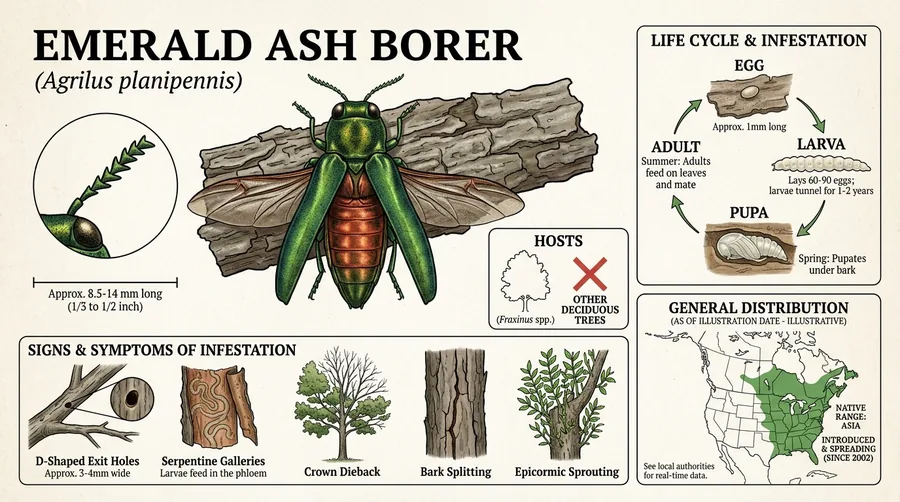
Metallic emerald-green emerald ash borer beetle on ash bark beside a D-shaped exit hole
Recommended Products


What it does
Adult beetles nibble ash foliage but cause little harm; the damage is done by the larvae. After hatching, larvae bore through the bark and feed in the living tissue just beneath it, carving S-shaped (serpentine) galleries that girdle the tree. This cuts off the flow of water and nutrients, killing branches and eventually the whole tree.
Where it lives
Emerald ash borer attacks all native North American ash species (Fraxinus), including green, white, black, and blue ash, as well as white fringetree. It is found in yard trees, street trees, woodlots, and forests. Since its 2002 discovery near Detroit it has spread through the Midwest, Northeast, South, and into parts of the West, largely by people moving infested firewood and nursery stock.
How it breeds
Females lay eggs in bark crevices in summer. Larvae feed under the bark through fall, overwinter there, and pupate in spring. Emerging adults chew a distinctive D-shaped exit hole about 1/8 inch wide. The cycle usually takes one year, sometimes two in cooler areas or healthier trees, with a single generation per year.
What it eats
Larvae feed on the phloem and outer sapwood of ash trees, the layer that carries nutrients. Adults feed lightly on ash leaves. The insect relies entirely on ash (and the related fringetree) to complete its life cycle.
Identification
Adults are slender, 8.5-14 mm, bright metallic emerald-green beetles with a coppery-red abdomen under the wing covers. Look-alikes include native Agrilus and the six-spotted tiger beetle, but the exit holes are diagnostic: crisp D-shapes, unlike the round holes of most native borers. Larvae are cream-colored and flat with bell-shaped body segments.
Signs of an infestation
- Crisp D-shaped exit holes about 1/8 inch across in the bark
- S-shaped larval galleries packed with frass under loose bark
- Canopy thinning and dieback starting at the top of the tree
- Vertical bark splits over old galleries
- Heavy woodpecker activity ('flecking') stripping bark to reach larvae
- Sprouts (epicormic shoots) growing from the trunk and roots
Prevention tips
- Never move firewood; buy and burn it where you use it
- Have valued ash trees inspected and consider preventive treatment before infestation
- Learn to identify ash trees and monitor them yearly for dieback
- Report suspected emerald ash borer to your state agriculture agency or extension office
- Remove and properly dispose of dead or heavily infested ash promptly
Professional solutions
Emerald ash borer control is a job for a certified arborist. High-value ash can be protected with systemic insecticide treatments (such as trunk-injected emamectin benzoate) repeated on a set schedule, but treatment must start before the tree is badly damaged. Trees more than about half dead are usually not savable and should be removed by professionals before they become brittle and hazardous.
Health & safety
Emerald ash borer poses no direct health risk to people or pets; it does not bite, sting, or spread disease to humans. The danger is to property and safety: it reliably kills ash trees, and dead ash become brittle quickly, creating a falling-limb hazard and costly removals. This makes early decisions about treatment or removal important.
Relevant Products


Frequently asked questions
How can I tell if my ash tree has emerald ash borer?
The clearest signs are D-shaped exit holes about 1/8 inch wide, S-shaped tunnels under the bark, canopy dieback starting at the top, and heavy woodpecker damage. Sprouts along the trunk are another clue. A certified arborist can confirm an infestation and advise on treatment or removal.
Can an ash tree be saved from emerald ash borer?
Yes, if you act early. Certified arborists can protect valuable ash with systemic insecticide treatments repeated on schedule, but this works best before the canopy is more than about a third gone. Trees that are already heavily infested are usually removed rather than treated.
Is there still a federal quarantine for emerald ash borer?
The USDA lifted the federal domestic emerald ash borer quarantine in 2021 and shifted its focus to biological control. Some states still have their own rules, and the strongest thing you can do is not move firewood, which is how the beetle spreads to new areas.
Fact-checked by Morgan Vance, Editorial Director (editorial review, not a professional pest-control or medical sign-off). Last reviewed May 15, 2026. We correct anything a reader shows us is wrong — see our corrections policy.