
Asian Longhorned Beetle
Anoplophora glabripennis · also called ALB, starry sky beetle
Quick answer
The Asian longhorned beetle (Anoplophora glabripennis) is a large, glossy black beetle with white spots and long black-and-white banded antennae. This invasive wood-borer attacks maples and many other hardwoods, tunneling deep into the wood and killing trees. It is under active federal eradication, so any sighting should be reported immediately.
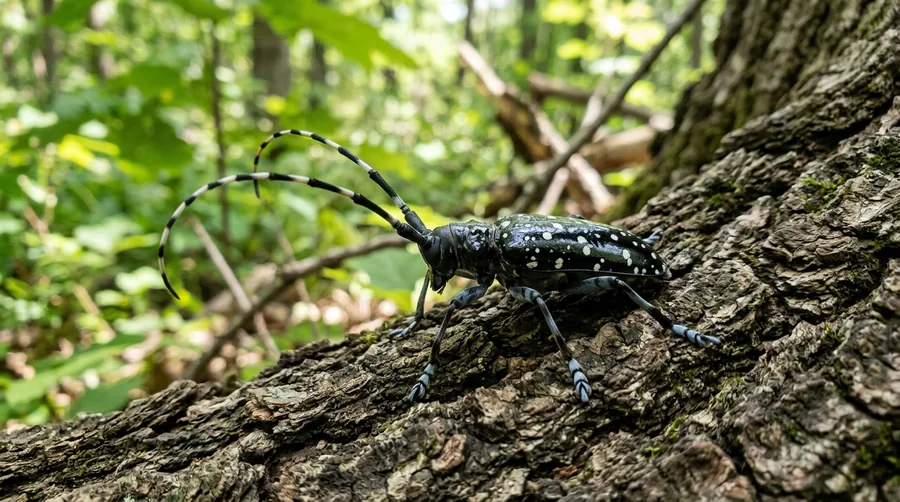
Large glossy black Asian longhorned beetle with white spots and long black-and-white banded antennae
Recommended Products


What it does
Adults chew on twigs and leaves but the serious damage comes from the larvae, which bore deep into the heartwood. Their large tunnels weaken limbs and trunks, disrupt the tree's plumbing, and eventually kill it. Unlike bark beetles that stay near the surface, these larvae carve wide galleries through the solid wood, making infested limbs prone to breaking.
Where it lives
The beetle attacks many hardwoods, with maple its favorite, along with birch, elm, willow, poplar, horsechestnut, and others. It infests yard, street, and forest trees. In the US it exists only in isolated, quarantined pockets, such as areas of New York, Massachusetts, Ohio, and South Carolina, where eradication programs are working to wipe it out.
How it breeds
Females chew oval pits in the bark and lay eggs singly. Larvae tunnel first under the bark, then deep into the wood, feeding for one to two years before pupating. Emerging adults bore straight, round exit holes about 3/8 inch across, roughly the diameter of a pencil. There is usually one generation per year, sometimes two years in cooler climates.
What it eats
Larvae feed on the inner bark and then the solid wood (heartwood) of host hardwood trees. Adults do minor feeding on the bark of young twigs, leaves, and leaf stalks. The insect depends on living hardwoods to complete development.
Identification
Adults are large, 1 to 1.5 inches long, shiny jet-black with distinct white spots and very long antennae banded in black and white, often longer than the body. Look for round (not D-shaped) exit holes about 3/8 inch wide, oval egg-laying pits in the bark, and coarse sawdust-like frass at the base of the tree or in branch crotches.
Signs of an infestation
- Round exit holes about 3/8 inch across in trunks and branches
- Oval or round chewed pits in the bark where eggs are laid
- Coarse sawdust (frass) piled at branch bases and on the ground
- Seeping sap around egg sites and holes
- Dead or dying limbs and premature yellowing leaves
- Large black-and-white spotted beetles seen in summer
Prevention tips
- Learn to recognize the beetle and check maples and other hardwoods, especially in late summer
- Report any suspected beetle, hole, or damage to USDA APHIS or your state agriculture agency at once
- Do not move firewood, which can carry hidden larvae to new areas
- Comply with local quarantine rules on moving wood and nursery stock
- Capture a suspect beetle in a jar and freeze it for identification rather than releasing it
Professional solutions
There is no do-it-yourself fix for Asian longhorned beetle. Because eradication is the goal, response is handled by government programs: officials survey the area, remove and chip infested trees, and may apply preventive treatments to nearby host trees. The single most valuable action a homeowner can take is prompt reporting so the outbreak can be contained.
Health & safety
The Asian longhorned beetle does not bite, sting, or spread disease to people or pets, so it poses no direct health risk. Its threat is to trees and property: infested limbs are structurally weak and can drop, and unchecked spread could devastate hardwood forests and shade trees. Reporting sightings protects both your property and the wider landscape.
Relevant Products




Frequently asked questions
What should I do if I find an Asian longhorned beetle?
Report it right away to USDA APHIS or your state agriculture department. If you can, capture the beetle in a sealed jar and place it in the freezer to preserve it for identification. Note the exact location and the tree it was on. Prompt reporting is critical to eradication efforts.
How is the Asian longhorned beetle different from native beetles?
It is large (1 to 1.5 inches), glossy black with clear white spots, and has very long antennae banded black and white. Its exit holes are perfectly round and about 3/8 inch wide, unlike the D-shaped holes of emerald ash borer. Several harmless native beetles look similar, so confirmation matters.
Does the Asian longhorned beetle only attack one kind of tree?
No. Maple is its preferred host, but it also attacks birch, elm, willow, poplar, horsechestnut, and other hardwoods. This wide host range is part of why it is treated as such a serious threat and why eradication programs remove and replace infested trees.
Fact-checked by Morgan Vance, Editorial Director (editorial review, not a professional pest-control or medical sign-off). Last reviewed June 21, 2026. We correct anything a reader shows us is wrong — see our corrections policy.