Oak Gall Wasp
Family Cynipidae (Callirhytis, Amphibolips spp.) · also called gall wasp, oak apple gall wasp, cynipid gall wasp
Quick answer
Oak gall wasps (family Cynipidae) are tiny wasps whose feeding chemicals make oak trees grow galls, abnormal woody or spongy swellings on leaves, twigs, and stems that shelter the developing larvae. Most galls, such as oak apples, are harmless and cosmetic. A few twig galls can cause dieback in heavy infestations. The wasps do not sting people.
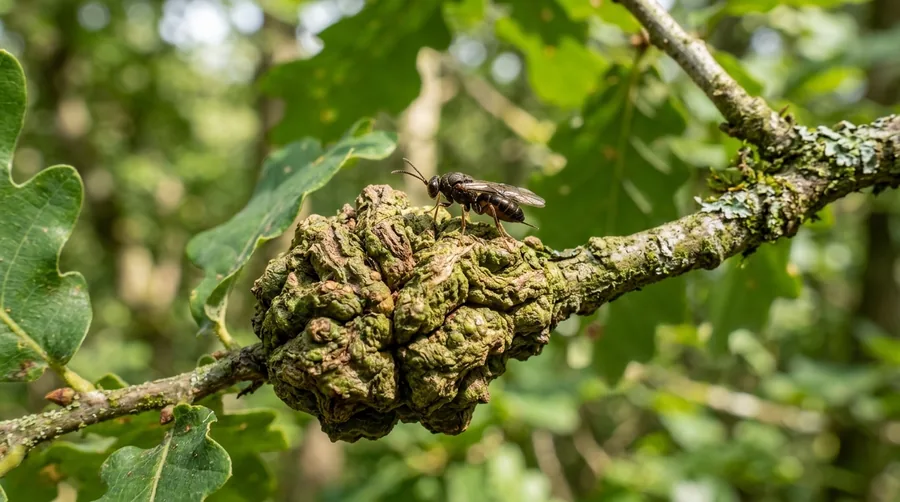
Round woody oak apple gall attached to an oak twig, caused by a tiny gall wasp
Recommended Products


What it does
Oak gall wasps do not chew or bore the tree directly. Instead, a female lays eggs in oak tissue, and chemicals from the eggs and feeding larvae hijack the tree's growth, causing it to form a gall, a swelling that both houses and feeds the larva inside. Each wasp species produces a characteristic gall on a specific oak part. Most galls are harmless, but some twig and stem galls can girdle and kill small branches when abundant.
Where it lives
Oak gall wasps live only on oaks (Quercus), and with hundreds of species across North America, galls of some kind appear on oaks almost everywhere oaks grow, nationwide. Galls form on leaves, twigs, buds, stems, acorns, and roots depending on the species. They are seen on yard, park, street, and forest oaks, and the galls often persist on the tree long after the wasps have left.
How it breeds
Many oak gall wasps have complex life cycles that alternate between a sexual generation and an all-female (asexual) generation, often on different parts of the tree and producing different-looking galls. Females lay eggs in oak tissue, the gall forms and the larva develops inside, then the adult chews its way out. Cycles can span one or two years, with galls persisting even after emergence.
What it eats
The larvae feed on the specialized nutritive tissue inside the gall, which the tree is chemically induced to produce. The insect depends entirely on oak trees. It does not feed on other plants, stored products, people, or animals, and the adult wasps are short-lived and take little or no food.
Identification
The wasps themselves are tiny, 1 to 8 mm, dark, and rarely seen; you identify them by their galls. Galls take remarkable forms depending on species: round 'oak apples,' woody twig knots, spiky or spongy balls, wool-like tufts, and bumps on leaves or veins, in shades of green, tan, pink, or brown. Cutting a gall open often reveals one or more small larval chambers inside.
Signs of an infestation
- Round, woody, or spongy galls on oak leaves, twigs, or stems
- Apple-like 'oak apple' galls attached to leaves or twigs
- Knobby woody swellings (twig galls) on branches
- Fuzzy, wool-like, or spiky growths on oak foliage
- Small exit holes where adult wasps have chewed out
- Twig dieback in heavy infestations of certain stem-gall species
Prevention tips
- Tolerate most leaf galls, which are harmless and need no action
- Prune out and destroy heavily galled twigs to reduce stem-gall wasps
- Rake and dispose of fallen galled leaves where practical
- Keep oaks healthy so they tolerate galling
- Encourage the many natural parasites that attack gall wasps
Professional solutions
The great majority of oak galls are cosmetic and require no treatment at all; insecticides are generally ineffective because the larvae are protected inside the gall. For the few twig- and stem-gall species that cause noticeable dieback on valued oaks, a certified arborist can assess the tree, prune out galled wood, and improve the tree's vigor. Otherwise, oak galls are best regarded as a curiosity rather than a problem.
Health & safety
Oak gall wasps pose no risk to people or pets; despite being wasps, they are tiny, do not sting, and spread no disease. Most galls are purely cosmetic novelties on the tree. Only certain twig- and stem-gall species cause real harm, and even then the impact is limited to branch dieback on the oak, not any threat to human health.
Relevant Products




Frequently asked questions
What are the round balls growing on my oak tree?
Those are galls, abnormal growths the oak produces in response to tiny gall wasps laying eggs in its tissue. The larvae develop inside. Round 'oak apple' galls and woody twig knots are common. Most galls are harmless and cosmetic, so they usually need no treatment at all.
Do oak galls hurt the tree?
Most do not. The many leaf galls are cosmetic and harmless. A few twig- and stem-gall species can girdle and kill small branches when they are very abundant, so heavy twig galling on a valued oak is worth an arborist's look, but the majority of galls are simply a curiosity.
Will the wasps from oak galls sting me?
No. Oak gall wasps are tiny, non-stinging insects that develop inside the galls and chew their way out as harmless adults. They do not sting people or pets and spread no disease, so the galls on your oak pose no risk to your family.
Fact-checked by Morgan Vance, Editorial Director (editorial review, not a professional pest-control or medical sign-off). Last reviewed May 19, 2026. We correct anything a reader shows us is wrong — see our corrections policy.