
Aster Leafhopper
Macrosteles quadrilineatus · also called aster leafhopper, six-spotted leafhopper
Quick answer
The aster leafhopper (Macrosteles quadrilineatus) is a small green, wedge-shaped insect that sucks plant sap and, more importantly, spreads aster yellows, a phytoplasma plant disease. It infects lettuce, carrots, asters, and many other crops and flowers. Harmless to humans, it matters mainly to gardeners and growers as a disease carrier.
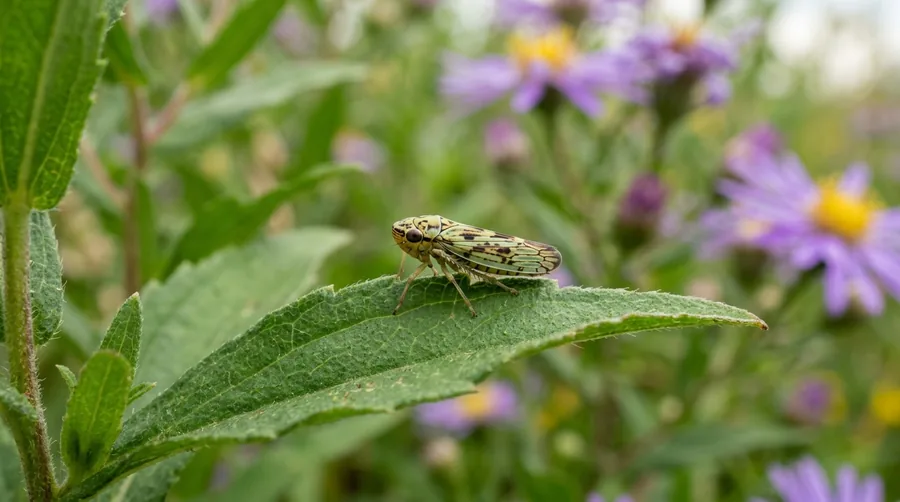
Small greenish aster leafhopper with dark spots on its head resting on a carrot leaf
Recommended Products


What it does
Aster leafhoppers feed by piercing leaves and sucking sap, and they jump or fly readily when disturbed. Their feeding causes little direct harm, but as they move plant to plant they transmit the aster yellows phytoplasma. Once a plant is infected, the leafhopper's real damage, disease, spreads through the crop.
Where it lives
The insect overwinters in the southern US and migrates north each spring on wind, arriving in the Midwest and northern states. It feeds on hundreds of plants including lettuce, carrot, celery, potato, grains, asters, coneflowers, and many weeds, in vegetable fields, flower gardens, and grassy field edges.
How it breeds
In warmer regions it breeds year-round, and migrants produce several generations over a northern summer. Females insert eggs into plant tissue; nymphs pass through several stages before becoming winged adults in a few weeks. Each new generation can acquire and spread aster yellows if infected plants are present.
What it eats
Aster leafhoppers feed only on plant sap from a very wide range of vegetables, flowers, grains, and weeds. They do not feed on people, animals, or household items.
Identification
Adults are small (about 4 mm), slender, and wedge-shaped, pale green to olive, with several small dark spots on the head (the six-spotted pattern). They hold their body angled and dart sideways or hop when approached. Nymphs are wingless and paler.
Signs of an infestation
- Plants showing aster yellows: yellow, stunted, distorted growth
- Flowers that stay green or grow deformed (from aster yellows)
- Small green wedge-shaped insects hopping off foliage
- Carrots or lettuce with bushy, off-color, bitter growth
- Leafhoppers caught on yellow sticky cards in the garden
Prevention tips
- Remove and destroy plants infected with aster yellows promptly
- Control weeds that host both the insect and the disease
- Use floating row covers over susceptible vegetables
- Monitor with yellow sticky cards to time any control
- Avoid planting susceptible crops next to infected weedy areas
Professional solutions
Home gardeners rarely need sprays; removing infected plants, managing weeds, and using row covers usually suffice. Commercial growers may monitor migrant numbers and infectivity and apply labeled insecticides when disease pressure is high. An extension office can advise on regional aster yellows risk and timing.
Health & safety
The aster leafhopper does not bite, sting, or transmit any disease to humans or animals. Aster yellows is strictly a plant disease and cannot infect people. The insect is a concern only for plant and crop health, not human safety.
Relevant Products


Frequently asked questions
Does the aster leafhopper harm people?
No. It cannot bite or sting, and the aster yellows disease it spreads only affects plants, never humans or animals. It is important solely to gardeners and farmers because it can carry that plant disease from one crop to another.
What is aster yellows?
Aster yellows is a plant disease caused by a phytoplasma that the aster leafhopper spreads as it feeds. Infected plants become yellowed, stunted, and distorted, and flowers may stay green or grow deformed. There is no cure, so infected plants are removed.
How do I protect my garden from aster leafhoppers?
Pull and destroy any plants showing aster yellows, control weeds that harbor the insect and disease, and shield susceptible vegetables with floating row covers. Yellow sticky cards help you monitor numbers. Insecticides are seldom needed in a home garden.
Fact-checked by Morgan Vance, Editorial Director (editorial review, not a professional pest-control or medical sign-off). Last reviewed July 16, 2026. We correct anything a reader shows us is wrong — see our corrections policy.