Treehopper
Membracidae spp. · also called treehoppers, buffalo treehopper, thorn bug
Quick answer
Treehoppers (family Membracidae) are small sap-sucking true bugs with an enlarged, often thorn- or horn-shaped pronotum that makes them look like plant spines. Species like the buffalo treehopper slit twigs to lay eggs, scarring young trees. Feeding drips honeydew but rarely harms established plants. They do not bite or sting people.
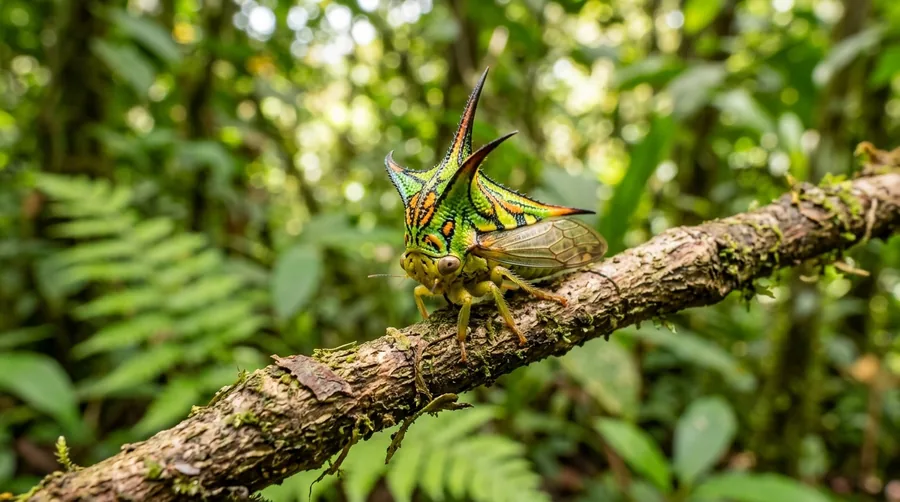
Green buffalo treehopper with a triangular thorn-like pronotum resting on a young twig
Recommended Products


What it does
Treehoppers suck sap from stems and twigs and hop or fly off when disturbed. Their main damage is egg-laying: females cut crescent-shaped slits in bark and twigs to insert eggs, and these scars can weaken or deform young shoots and let in disease. Nymphs and adults also excrete honeydew, and many species are tended by ants.
Where it lives
The family is large and widespread across the US. Treehoppers live on a huge range of trees, shrubs, vines, and garden plants, resting on twigs, stems, and leaf stalks. The buffalo treehopper is common on young fruit and shade trees and in weedy areas and legume fields near orchards.
How it breeds
Most species have one generation per year. Females insert eggs into twig bark in late summer and fall, and these overwinter. Nymphs hatch in spring or early summer, often feeding on grasses and herbaceous plants before adults move to woody hosts. Adults appear from summer into fall.
What it eats
Treehoppers feed only on plant sap from the stems, twigs, and leaf stalks of their many host plants. Nymphs of some species feed on herbaceous plants and grasses. They do not feed on people, animals, or household items.
Identification
Treehoppers are recognized by the enlarged pronotum extending over the body, giving many a thorn, horn, or humped shape that mimics a plant spine. Sizes range from about 6 to 12 mm, in green, brown, or mottled colors. The buffalo treehopper is bright green and triangular, like a tiny bison's head.
Signs of an infestation
- Crescent-shaped egg-laying slits and scars on young twigs
- Thorn- or hump-shaped insects perched on stems
- Roughened, cracked bark on scarred shoots
- Honeydew and sooty mold with ants on infested plants
- Dieback of young twigs in heavy, repeated infestations
Prevention tips
- Control weeds and grasses near young trees where nymphs feed
- Keep young trees vigorous with proper watering and mulch
- Prune out and destroy heavily scarred twigs
- Encourage birds and predatory insects
- Avoid planting nursery stock next to weedy legume fields
Professional solutions
Treehoppers seldom cause enough damage to warrant professional control, especially on established plants. Where egg-laying repeatedly scars young orchard trees, managing nearby weeds and, rarely, a labeled insecticide timed to the pests can help. An extension office can advise if damage to young trees is significant.
Health & safety
Treehoppers do not bite, sting, or transmit disease to humans or pets, and they do not infest homes. Their thorn-like shape is only camouflage. Any impact is limited to twig scarring and honeydew on plants, so there is no human health risk.
Relevant Products


Frequently asked questions
Is that thorn on my plant actually an insect?
Quite possibly. Treehoppers have an enlarged pronotum shaped like a thorn, horn, or hump that mimics a plant spine as camouflage. If the thorn hops or flies away when you touch it, it is a treehopper feeding on the stem's sap.
Do treehoppers damage plants?
Usually only a little. Their sap feeding is minor, but females slit twigs to lay eggs, and those scars can weaken or deform young shoots and let in disease. Established trees tolerate them well; repeated egg-laying matters most on young nursery and orchard trees.
Do treehoppers bite people?
No. Treehoppers cannot bite or sting people or pets and carry no human disease. They feed only on plant sap. Their odd thorn-like appearance can be startling, but they are completely harmless to humans.
Fact-checked by Morgan Vance, Editorial Director (editorial review, not a professional pest-control or medical sign-off). Last reviewed July 22, 2026. We correct anything a reader shows us is wrong — see our corrections policy.