


What do mosquitoes actually eat?
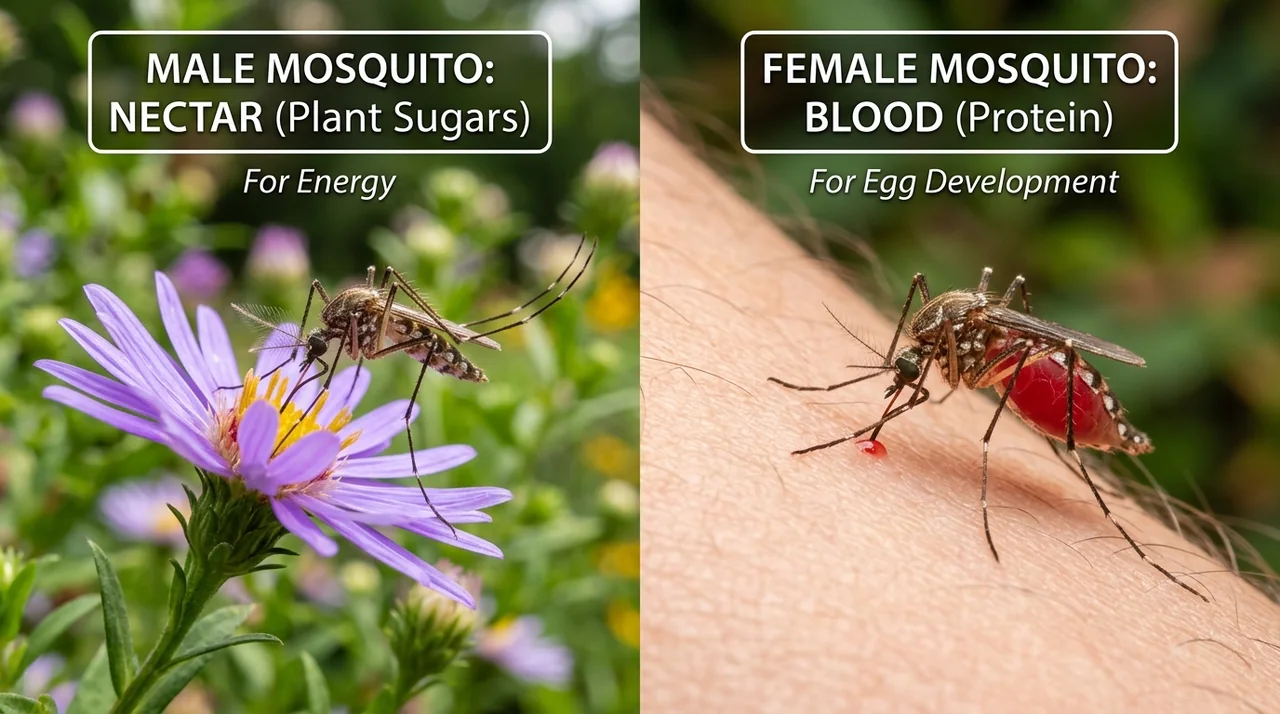
Contrary to their reputation, mosquitoes are not primarily blood-drinkers. Both males and females feed mainly on sugary plant fluids: nectar and honeydew. These fuel their flight and daily activity. In fact, male mosquitoes drink only these plant sugars their entire lives and never bite at all. Sugar, not blood, is the everyday mosquito diet.
Female mosquitoes also rely on nectar for energy. But they have one extra requirement tied to reproduction, and that is where biting comes in.
Why do only female mosquitoes bite?
To develop a batch of eggs, most female mosquitoes need a blood meal for its protein and iron. This is true whether it is an Anopheles, Aedes, or Culex species. Blood is not their fuel; it is a raw material for making eggs. That is why only females bite, and why biting comes in bursts tied to their breeding cycle. A female may take several blood meals over her life to lay multiple batches of eggs. It also explains why mosquitoes matter for disease: it is during these blood meals that certain species can pick up and pass on pathogens.
What do mosquito larvae eat?
Before they ever fly, mosquitoes spend their early life in water as larvae (often called wrigglers). There they feed by filtering tiny particles from the water, including:
- Algae and microscopic organisms
- Bacteria
- Bits of decaying organic matter (detritus)
What attracts mosquitoes to people?
Since blood-feeding is about eggs, females are finely tuned to find hosts. They are drawn by the carbon dioxide we exhale, our body heat, and certain scents and chemicals on our skin. That is why some people seem to get bitten more than others. Understanding this helps explain why repellents and screens are effective: they interfere with a female's ability to locate and reach a host, and repellents mask or disrupt these cues.
Do mosquitoes eat other insects or bite animals besides people?
Females are not picky about whose blood they take. Different species feed on mammals, birds, reptiles, and amphibians as well as humans, and some strongly prefer birds or other animals over people. As for eating other insects, adult mosquitoes do not; they stick to nectar and, for females, blood. The main exception is at the larval stage, where a few predatory species eat other mosquito larvae in the water. For the vast majority, though, the pattern holds: sugar for everyday energy, blood only for females making eggs, and filtered particles for larvae.
How does knowing their diet help control them?
The larvae's need for standing water is the weak point you can use. Because larvae must have water to develop, removing it is the most effective control:
- Empty and scrub buckets, saucers, birdbaths, tarps, and toys weekly, denying breeding sites to the northern house mosquito and similar species.
- Keep gutters clear and change pet and bird water often.
- Cover rain barrels and fix drainage that leaves puddles.